
#On the Name
"They owned nothing, so the Rationalists confiscated the road." — Drax, marginalia to the Approved History
The enemy wrote "the Mendicant Orders" with two capitals, as though the begging friars of the old Church had been one corporation with a charter, a seal, a treasurer and a board that met on the first Monday of the month. The Ledger holds no such instrument. I have looked, and I look more thoroughly than anyone else. The name covers a way of life more than an institution: men who walked rather than lodged, who begged their bread and paid for it in prayer, and who kept no house that a confiscating prefect could padlock. The Approved History calls them "wandering vessels of prayer and bread," and I wrote that phrase myself, so you may take it as settled.
I cannot give you a founder, a first house or a founding year. No register in my keeping names the man who first tied a cord about his waist and went out with an empty bowl, and I will not make one up to please the reader who likes his history to arrive with a birth certificate. The friars did not count their years by the Synod's numbering either. That reckoning was adopted at the A.S. 90 settlement and laid backward over everything before it like a cloth over a table. Any year I fixed to their beginning would be a Synodal number pinned to men who never heard it spoken.
What the Church remembers of them is small, and it is sure. What the Rationalists said of them is long, and none of it is true. The difference between those two accounts is the whole of this article.
#On the Expulsion
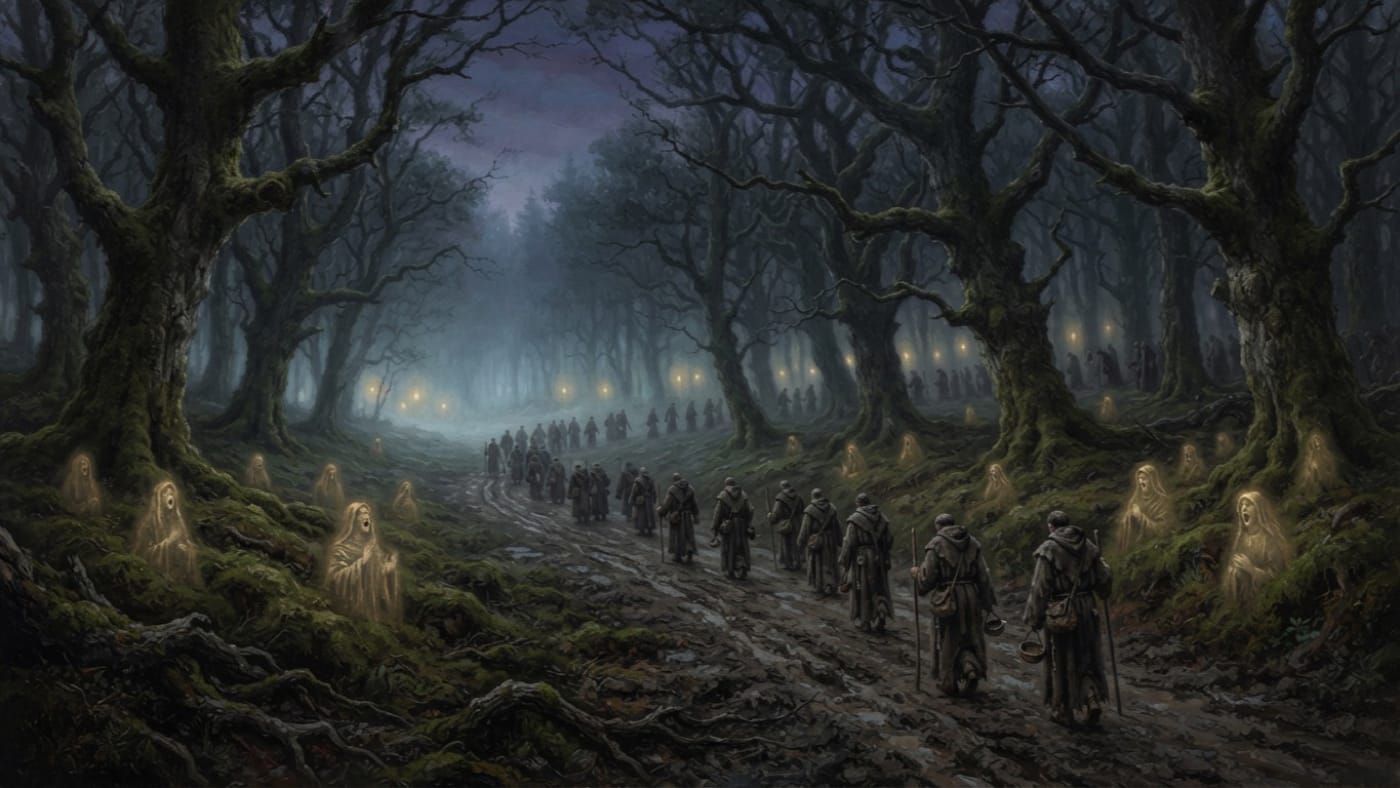
The Approved History sets the friars' ruin among the Ante-Synodi Years, in the slow rot that came before the reckoning. The tribunals against parish priests at Strasbourg came first, then the Concordats of Ulm with their compass crushing a cross. The friars were next. The mendicants were expelled from France. They took to the roads. They walked until many of them vanished into the Ardennes.
That is the record. I have trimmed it to the bone because the bone is all that survives. I hold no decree of expulsion and no name of the administrator who signed it. Nobody counted how many friars left, how many reached the forest or how many came out the other side. No itinerary of their roads survives. I am even cautious about the word vanished. The Approved History says many, and many is not all, and I do not pad a martyrology to make it look fuller.
The Rationalists did keep one record of the business, and it was a single word. They declared the friars "disbanded."
Consider that word. A regiment is disbanded. It has a paymaster, a muster roll and discharge papers stamped at a table, and its men go home to their villages with a coat and three months' arrears. The word implies an orderly ending, by lawful instrument, with everyone accounted for. Nothing of the kind is on record for the friars. There was a road, then a forest, and after that nothing. The enemy filled the gap with a term from the drill-yard and filed the matter closed. I know the method. Every chancery I have ever served keeps a drawer of such words, and I have opened ours more often than I would like the reader to know.
The same years produced worse. At Lyon, friars were massacred in the marketplaces and their ashes were carted to the Rhône. For three nights afterward the peasants swore that the river whispered psalms. That account belongs to the Red Slaughter of Lyon, and I place it here only as a neighbour. The Ledger does not show that the Lyon dead were the same men driven toward the Ardennes, or that they belonged to any order a clerk could name. Both are pages from the same campaign of desecration. They are separate pages. I will not glue them together to make a better story.
#On the Voices Beneath the Moss
Here the record ends and the testimony begins. I mark the boundary in red ink because readers step over it constantly.
The peasants of the forest country whispered that the friars' chants still sounded beneath the moss at dusk. Travellers who had never met those peasants reported the same thing: at twilight the forest sings. Several accounts say the singing is in Latin. The Rationalist scholars, who could explain anything provided they did not have to go and stand in it, declared the sound to be wind.
Wind. Wind in the Ardennes that keeps the hours, and keeps them in the language of the Mass. I have heard wind in my time, in belfries and through the broken lights of a sacristy window. It has never once kept to the right syllables.
Drax the polemicist will mock a professor's weather report all day. Drax the Warden of the Sacred Ledger knows what he holds and what he does not, and the two must be kept on separate shelves. I can enter the expulsion as history, and the disappearance with it. The chant goes in as something said, by people with no reason to say it, persistently and in agreement, over a long span of years. I hold no certification that dead friars sing under the moss, or that living ones do. I hold none that anything sings at all, beyond the reports of those who have heard it. Nor has anyone produced a mechanism that would satisfy the Bureau of Doctrine, which is not easily satisfied, or the Rationalists, who were satisfied far too easily.
I leave it open. I leave it open the way one leaves a door unbarred in a chapel at night, without expecting anyone in particular to come through.
#On the Forty-Seven Years
The friars would have stayed a footnote in the enemy's archive if the enemy had not needed a beginning.
When the Treaty of Regensburg was signed in A.S. 30 / 1740 CE and the Rationalist Republic was formally proclaimed, Vienna's prefects wanted a spectacle. Three days later they held the Black Procession. They built forty-seven effigies of saints, dressed them in vestments confiscated from the city's churches, wheeled them along the Ringstrasse and burned them in the Heldenplatz. The civic record says forty-seven was chosen as one effigy for each year of the "Superstitious Epoch," which the Prefecture measured from the founding of the Mendicant Orders to the Treaty of Regensburg.
Look at what they did. They needed a starting date for faith itself, and they did not choose a council, a cathedral or an apostle. They chose the beggars, the very men they had already declared "disbanded." Superstition was dated from the poorest people on the road, presumably because the poorest people make the least trouble when you write them into the first line of a table.
Do not mistake the effigies for friars. They were saints: Rupert with his salt-cellar, the Blessed Adalheid with her crozier, Leopold in the ducal crown. They were forty-seven figures from a costumier's workshop. They were not forty-seven orders, not forty-seven founders, and not a census of anybody. The friars entered the Procession only as a number, the starting point of a sum.
And the sum does not hold. Carry the Prefecture's arithmetic to its conclusion and it yields a founding that no register in my keeping will countersign. In any case the Church is older than every friar who ever begged for a crust, and an "epoch" that begins with men in the middle of its history is not an epoch. It is a stage direction. The Rationalists did not care. They wanted a round number for the pyres that would look good on a printed programme, and they cut the history to fit the woodpile.
What followed is told in its own article: fires that burned without heat, frost on coat-buttons six feet from burning pitch, three citizens dead of exposure, and the Prefecture's statement about Alpine wind-currents. I note only that the enemy blamed the wind twice: once for the singing in the Ardennes and once for the cold in Vienna. A philosophy that has to blame the weather this often should consider moving somewhere else.
Stamped Erratum — Approved History, Chronological Tables: For "124 A.S. — The Black Procession (Vienna)," read A.S. 30 / 1740 CE, three days after the Treaty of Regensburg. The Procession followed the Treaty. It did not follow the Synod by a generation and a half. The Warden regrets the transposition and blames the copyist, who has been spoken to.
#On What the Record Establishes
Every register has to be closed eventually, and this one closes short.
The Ledger records that itinerant friars of the old Church, who lived by prayer and begged bread, were expelled from France during the Rationalist ascendancy. It records that they took to the roads and that many vanished into the Ardennes. It records the enemy's word for this, "disbanded," and it records that the word explains nothing. It records that peasants and travellers report singing in the forest at dusk, in Latin, and that the enemy's scholars called it wind. It records that the Prefecture in Vienna later used the friars' founding as the opening date of a theatrical sum it could not support.
The Ledger holds no headquarters for the Mendicant Orders, no surviving prior and no restored house waiting to be visited and taxed. Nothing has been newly certified as a miracle, and no relic of their bowls is held in anyone's strongroom. If someone presents you with any of these, ask to see the register entry. Then ask who wrote it. Then come to me.
The Rationalists made the friars disappear into a single word. I have declined to give them back in any word larger than the evidence allows.