
I've read the continuity reference, style guides, lore and the parent articles, and I'm now writing the prose.
#On the Forest That Kept Voices
The Ardennes lie where France runs out of confidence. East of the Champagne roads and north of the Moselle vineyards, the ground folds into slate ridges and river-cut gorges, and the trees close over it like the lid of a reliquary box. There is oak and beech, birch on the old burned slopes, and moss on anything that holds still long enough. The cartographers of the Bureau of Records place the region on the eastern margin of Zone 1, the western heartlands, the safest soil the Church possesses. The cartographers are correct. Nobody has told the forest.
A city files its memories away. A cathedral chapter keeps a register, a market town keeps a tax roll, and a parish keeps a baptismal book and a sexton who can be questioned. The Ardennes keep nothing on paper and forget nothing in practice. Roads older than any Concordat run under the leaf-mould and come back up where no surveyor put them. Charcoal-burners' clearings reopen a generation after they were abandoned. Stones set upright by nobody the Bureau can name stay upright. A heartland province ought to be quiet. This one is only obedient, and a Hieromnemon learns to hear the difference.
#On the Friars Beneath the Moss
Long before the Church began numbering its years, while the pressure of the Rationalists was still a matter of pamphlets and prefects and had not yet come to pyres, France expelled its mendicant friars. They were the least defended of the religious: no walls, no endowments, no advocates, a begging bowl and a psalter apiece. They took to the roads, and the roads carried them east. At the edge of the Ardennes the record thins. Inside the forest it stops.
The Rationalist accounts call them "disbanded." The word sits in their ledgers with the calm of a closed account. They do not say where the friars went, who disbanded them, or into what trade or grave. A Rationalist clerk could write disbanded over an entire order and sleep soundly, because his philosophy held that a man who was no longer registered was no longer worth pursuing. The friars who stayed in the cities met a bloodier bookkeeping. The Red Slaughter at Lyon carted their brothers to the Rhône. The forest, at least, kept its dead out of the river.
The peasants kept a different register. They said that at dusk the friars' chants could still be heard beneath the moss: low, in Latin, under the root-mats on the north side of the old roads, so that a man who knelt to lace his boot might hear Compline rising out of the ground. The Rationalist scholars called it wind. In my experience the wind has never troubled to keep the hours.
The friars are filed in the Desecration Catalogue under the classification that the Bureau of Doctrine later applied, retroactively, to the whole programme. No Bureau existed to witness the expulsion. It owns the evidence now, which is a more durable kind of presence. The file lists the friars as lost to Rationalist aggression, disposition unrecorded. It says nothing of the chanting. Doctrine has never ruled on the chanting, and I have learned not to press Doctrine for rulings on matters it would rather hear from a distance.
Earlier lore folios gave a fixed year for the Expulsion of the Mendicants.
The year is withdrawn from public editions until the older folios are reconciled with the governing chronology. The friars were expelled. They walked into the Ardennes. They did not walk out. The Bureau certifies those three facts with no number attached, and considers them sufficient.
#On Ardenne-sous-Ciel
The forest had the friars to remember. In A.S. 189 the Order of Ash gave it something else.
Ardenne-sous-Ciel was a small parish in a clearing above a stream. It had a well, a chapel, a schola for the children, and a name that promised more sky than the canopy ever allowed. The charge that marked it for Ash is sealed with the Bureau of Purity. I will not break that seal to entertain a reader who has not paid the copying fee. The procedure itself is public, and it was followed to the letter. The parish received no warning, because the Order does not negotiate with kindling. The Ashmen came at the third bell and worked inward from the perimeter, outer byres first and chapel last, so that the condemned watched their world grow smaller one roof at a time.
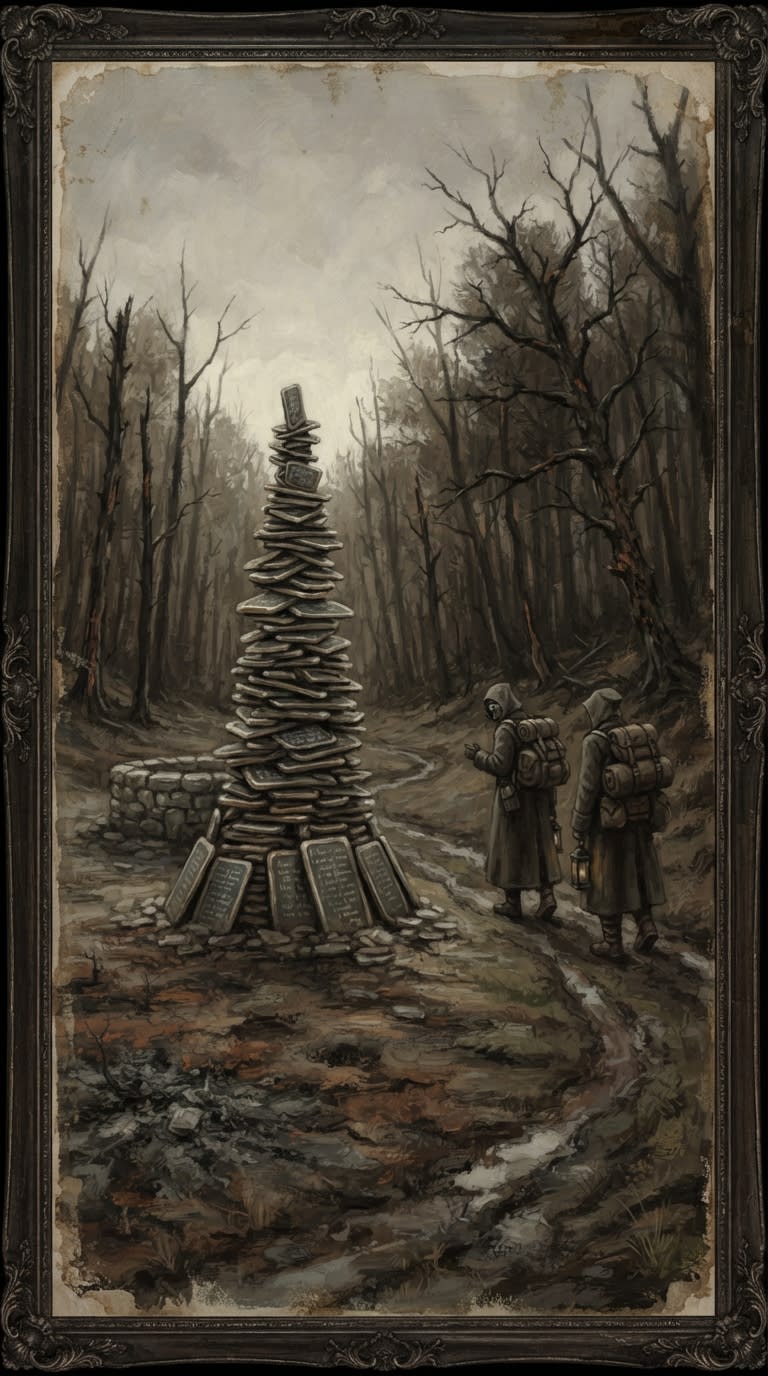
I inspected the completed work. What had been a parish was a gray pan. The heat had gone down the well-shaft and glassed the well-stones smooth, so that they shone wet in dry weather. The schola had stood near the chapel. The Ashmen went through the kiln-hard ground where it had been and brought out the children's slates, warped into bubbly oblongs with the chalk fused into them, each lesson kept at the exact stage its pupil had reached. They stacked the slates where the altar had stood. There was no altar. They built on the place where it had been, and they called the stack a reliquary of obedience.
The Bureau of Records ratified an engraving of the scene for the Order's archive. It is accurate. It leaves out the smell, which is the one respect in which the engraving is kinder than the Order.
#On the Parish That Left No Ash
A second Ardennes file sits apart from the first. It records a parish, named in the Scour papers only by its register number, that burned so thoroughly that no ash remained. There was no gray pan, no glassed stone, and no cinder for the Orphanarii to sift. There was a clearing, and a register that said a parish had stood there.
The Order of Ash, the Bureau of Records and the Bureau of Doctrine argued over that clearing for three years. Ash held that perfect consumption showed divine approval: the Creator had accepted the offering whole and left nothing to be counted. Doctrine considered demonic theft, the Great Deceiver carrying off the remains so that no witness-line could be drawn over them. Records suggested clerical miscount: perhaps the parish had never held as many souls, or as many roofs, as the register claimed. Records won, as Records usually does. It produced a form for absence and charged the other two Bureaus for copies.
I will not say that the parish without ash and Ardenne-sous-Ciel are the same parish. The files do not say so, and I do not merge files to please a reader's appetite for neatness. I will say that the Ardennes are the only region in my experience where the Bureau has had to certify too little evidence as often as it certifies too much. The moss keeps voices and the clearing kept nothing. Neither of them asked permission.
#On the Present Custody
As of A.S. 201 the Ardennes are safe, loyal, tithed and watched. The old roads that cross the forest carry Purity waystations at the fords and Records clerks at the crossroads chapels. The clerks take down the name of every carter, pilgrim and pedlar who enters the trees, and again at leaving. The two lists are compared weekly, and the discrepancies are few. Few is not none.
Pilgrims are discouraged, by posted ordinance, from lingering on the north side of the roads after dusk, from kneeling where no shrine is marked, and above all from putting an ear to the moss. The ordinance does not say what they might hear. It is the most honest document the Bureau of Purity has issued in this century.
The villages give no trouble. They pay their tithes, attend their offices and ring their bells to the Bell Codex. They are also old-voiced. Their grandmothers sing antiphons in settings no current hymnal carries, and when asked where they learned them, they say they have always known them. The Bureau of Doctrine has sent listeners twice. Both returned with correct transcriptions and no recommendations.
The Order of Ash keeps its own interest in the forest. Novices are walked to the gray pan at Ardenne-sous-Ciel as part of their formation. They are shown the glassed well, the stack of slates and the tree line where the perimeter began, and they are taught the geometry of the burn by standing inside it. The Order calls the Ardennes useful terrain. The forest has held Rationalist silence, friars' Latin and the Order's lesson, and it has given none of them back in the form any Bureau requested.