
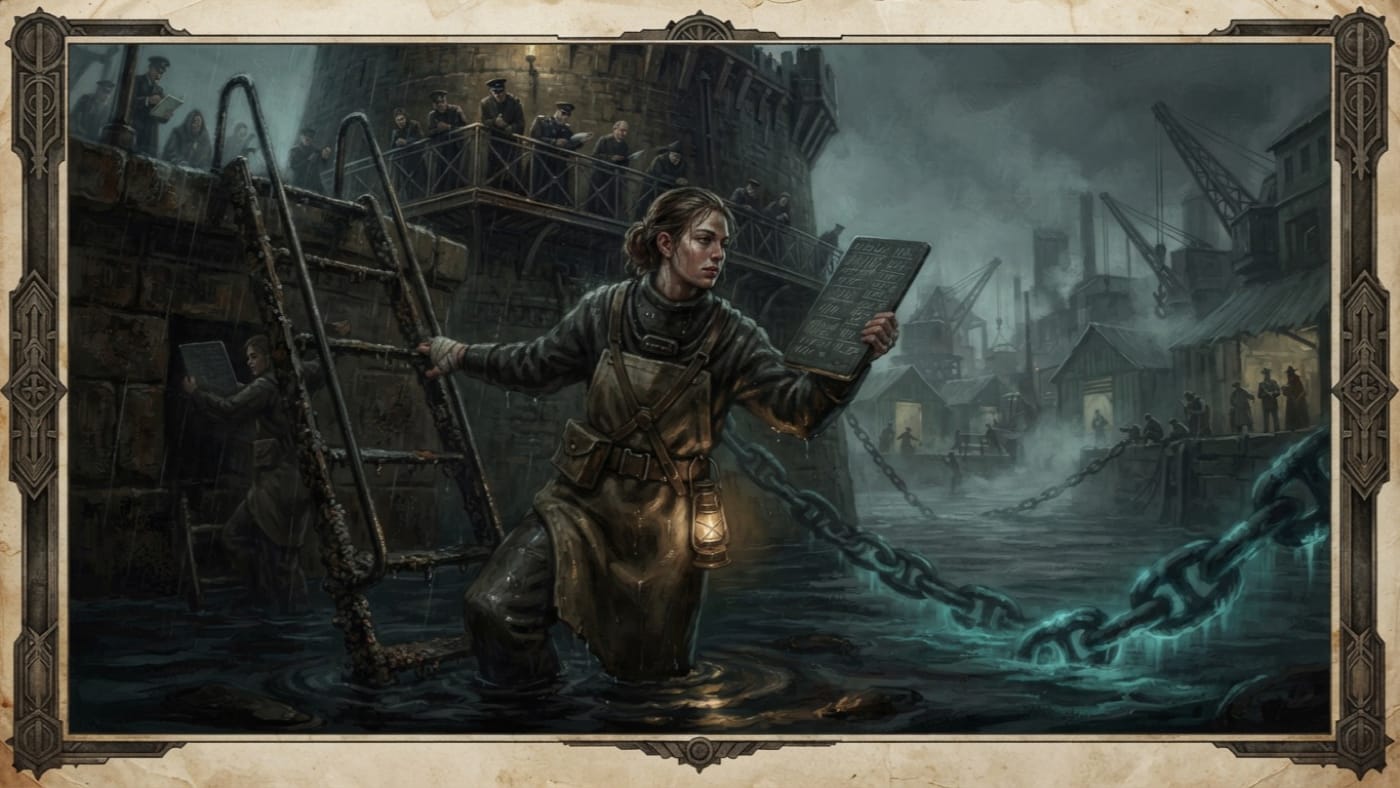
#On the Matronate's Station
The Matronate is the body of Diver-Matrons serving within the Custodians of the Chain at Thessaloniki. It has no seat at the Synod and no chapter-house worth the name. Its jurisdiction ends at the water directly under a working diver. That limit is the whole of its importance.
Thessaloniki is an Aegean choke point in Zone 7. The southern war system draws its grain, powder, pilgrims and reliquary freight through this one narrow harbor. Twin sea-towers hold reliquary chains across the harbor mouth, with links large enough to crush a mule. After dark the links glow faintly, in a manner the local clergy call psalm-hum and the dock children call the iron talking. Above the waterline, authority is divided with ecclesiastical care. The bell-wardens keep the peals. The Chainmaster and his windlass-men command the chain windows by which the gate opens, closes, or is declared busy. Rope-law clerks record all of it on the Ledger Steps, in triplicate, under wax.
Below the waterline there is a woman with a lamp.
That second jurisdiction belongs to the Matronate, and no tower can see into it. Riggers, forge-priests and windlass-men answer to the gallery. A Diver-Matron at the link answers to the link first and to the gallery second.
#On the Authority to Surface
The origin account survives in the Custodians' own telling, and I have found no reason to improve it. In the first generations after the Sundering, war-divers drawn from naval crews, penal labour and the coastal families of the inlet maintained the chain. They were strong. They were brave in the manner the Bureau of War admires. They were also obedient, and obedience killed them. A diver who felt the water turn wrong at the lower arc would hold at the link and wait for the tower to signal him up. Surfacing without that signal counted as deserting a post, and the tower, being a tower, was busy.
The Matronate corrected this. It introduced a hierarchy of women empowered to abort an inspection without requesting tower approval.
Read the clause twice. A Diver-Matron may end a descent on her own judgment. She need not petition the gallery, wait for the bell, or obtain the Chainmaster's seal. The inspection stops when she says it stops, and the paperwork follows her up the ladder.
No founding decree has reached my desk. The record gives no founder's name, no year and no ratifying council. The Custodians say "the first generations after the Sundering," and that is the date this Bureau will print. I will not manufacture a charter to make the institution look respectable. It is respectable already, which is more than many chartered bodies can claim.
The power is narrow. It halts work. It commands no ship, opens no gate and overrules no peal. Within those limits it is absolute, and the stakes justify that. A misjudged link can part under load. A diver pinned at the arc drowns in the time it takes a clerk to find his pen. An inspection botched for want of nerve can close the harbor to the southern front for days.
The dossier on Diver-Matron Sera records eighteen challenges to this authority. Twelve of the challengers later drowned. The other six learned. I reproduce the arithmetic as the Custodians tell it, with their grim humour and without a footnote. It proves no curse and no murder. It proves only that men who argue with the Matronate about water tend to keep going into water.
#On Training, Iron, and the Slate
The Matronate's work is maintenance before it is anything holier. A Diver-Matron goes down along the submerged links to scrape corrosion and check for stress fractures. She judges barnacle load, tests bolt seating, measures how far the relic-inlay has worn away, and reads the tension of a chain that keeps the southern war fed. The earliest Diver-Matrons are recorded carrying knives, slate tablets, prayer-beads and weighted lamps. I note the list without inflating it into a uniform. The knife cuts line. The lamp sinks. The beads count. The slate remembers.
The Bureaus underrate the slate. Ink fails below; a mark scratched on slate survives. A Diver-Matron at the link may feel a tremor in the palm, a change in temperature or a rhythm in the iron. Each comes up as a mark, an interval or a count. Touch becomes record. Record becomes evidence, and evidence becomes policy, slowly, against every resistance of the dry offices.
I can describe the Matronate's training only through the one case documented in full. Sera learned to keep her breath in the eel pools beneath Drowned Row. She learned to read knots by touch and to know the bell schedule from the vibration in a hull. The file does not say whether every apprentice passes through those pools, at what age, or under what examination. I decline to invent a syllabus for women who have plainly never needed mine.
Her teaching survives better, because apprentices repeat it. Check the lamp. Check the line. Count the links and count your breaths. Read with the palm, because cold fingers lie. Refuse any voice below that calls you by your childhood name. If the chain begins the dawn sequence at night, surface with witnesses.
These are Sera's instructions. No document shows them to be Matronate statute. They spread through the dive-lodges by imitation, and among divers imitation is a stricter law than any I have drafted.
#On Sera's Standing
Sera is the Matronate's principal documented example. The institution is larger than she is, and this tract will not become a second biography of her.
She rose after the Chain-Cramp Winter, an undated season of seizures under the lower arc. During it she worked a scraper hook among trapped crews while one man tried to sing through his mask. The particulars belong to her file.
By A.S. 198 she was the oldest active diver still making deep inspections. She was also the only Matron permitted to contradict Chainmaster Kosta in public without a disciplinary exchange. Note the singular. The authority to abort belongs to every Diver-Matron. The right to contradict the Chainmaster at the gallery rail, in front of his windlass-men, belongs to Sera alone, earned by long practice and allowed by Kosta's own good sense. A junior Matron who confuses the two privileges will learn the difference quickly, and in public.
Her personal conditions are likewise hers alone. She has gone four years without sleep. Her left palm is scarred. Her perception is sharp enough that others call it uncanny, and she reportedly has the attention of the Drowned Choir. None of these is a qualification for the Matronate, a rite of entry, or a gift that comes with the rank. I set this down for the auditors, who are fond of patterns and careless about how few cases they have.
#On the Silence of A.S. 198
On the evening of 14 Ashmonth, A.S. 198 (1908 CE), the bells of the Harbor-Chain Towers struck and made no sound. The Silence of Thessaloniki lasted seventy-two hours. The Bureau of Bells had requisitioned all the bronze and brass it could find for the towers' instruments. They detected nothing.
Kosta sent for Sera.
She made six descents. At the submerged links she reported vibration keeping the correct dawn-and-dusk bell sequence, the schedule the bells above had abandoned. The surface instruments registered nothing the whole time. On the sixth descent a corrosion spur laid open her left palm. She dictated the sequence before she allowed the wound to be treated.
Here the Matronate's whole case was proven in one woman. The tower had gone deaf and could not hear its own chain. A trained diver with a slate could. She wrote down what she felt: times, links, pulse-counts, the direction of the vibration, water temperature, how the lamp behaved, and what her hand sensed. What caused the Silence lies outside her report, and outside mine.
Early incident summaries state that tower instruments confirmed Sera's observations after review.
Incorrect. Tower instruments confirmed nothing, during the Silence or after it. The Bureaus accepted her testimony. Accepting testimony and confirming it by instrument are distinct acts, and this office will not let the instruments take credit for a woman's palm.
How the offices received the report was instructive. The Bureau of Rites filed it as supporting material. The Bureau of Bells declined the original slate, on the grounds that a slate used underwater lay outside its ordinary acoustic custody. The Bureau of Doctrine, my own office, drafted Determination 198-K/7 from it: "a test of fidelity administered by mechanisms beyond current doctrinal scope." That phrase classifies the event. It does not explain it, and I have never pretended otherwise.
#On Present Service
As of A.S. 201 the Matronate continues its inspections under the bell reversal that followed the Silence. The Elder now answers in the Younger's voice, and the Younger in the Elder's. The chain still needs scraping. The bolts still work loose. The apprentices still go down into the eel pools and come back repeating Sera's rules.
The danger they face is acoustic as well as physical. Divers report feeling the chain-hum through glove, bone and tooth. The Church has not ruled whether that hum is psalm, ledger or the Drowned Choir's business, and the Matronate's slates are no place to settle the question. In the Refugee Sheds the sleepers hum. At the links the iron counts. The Matronate records the iron and leaves the sleepers to Aunt Velka.
The administrative position is faintly ridiculous. Every Bureau with a stake in the harbor now depends on testimony it cannot measure with an instrument: Bells, Rites, Doctrine, and the Bureau of Records on the Ledger Steps. That testimony comes from women whose authority no tower granted, scratched on slates that no archive was built to shelve. Strasbourg's auditors intend to visit. I will not forecast their findings. I observe only that their questionnaires are dry.
A word on the title elsewhere. In Rheinscarp the Lockmouth Brotherhood names a Diver-Matron Lysa. A shared title proves no common command or shared charter, and no evidence shows the Thessalonikan practice travelling up the rivers. Two harbors arrived at the same word. The file keeps them apart.