
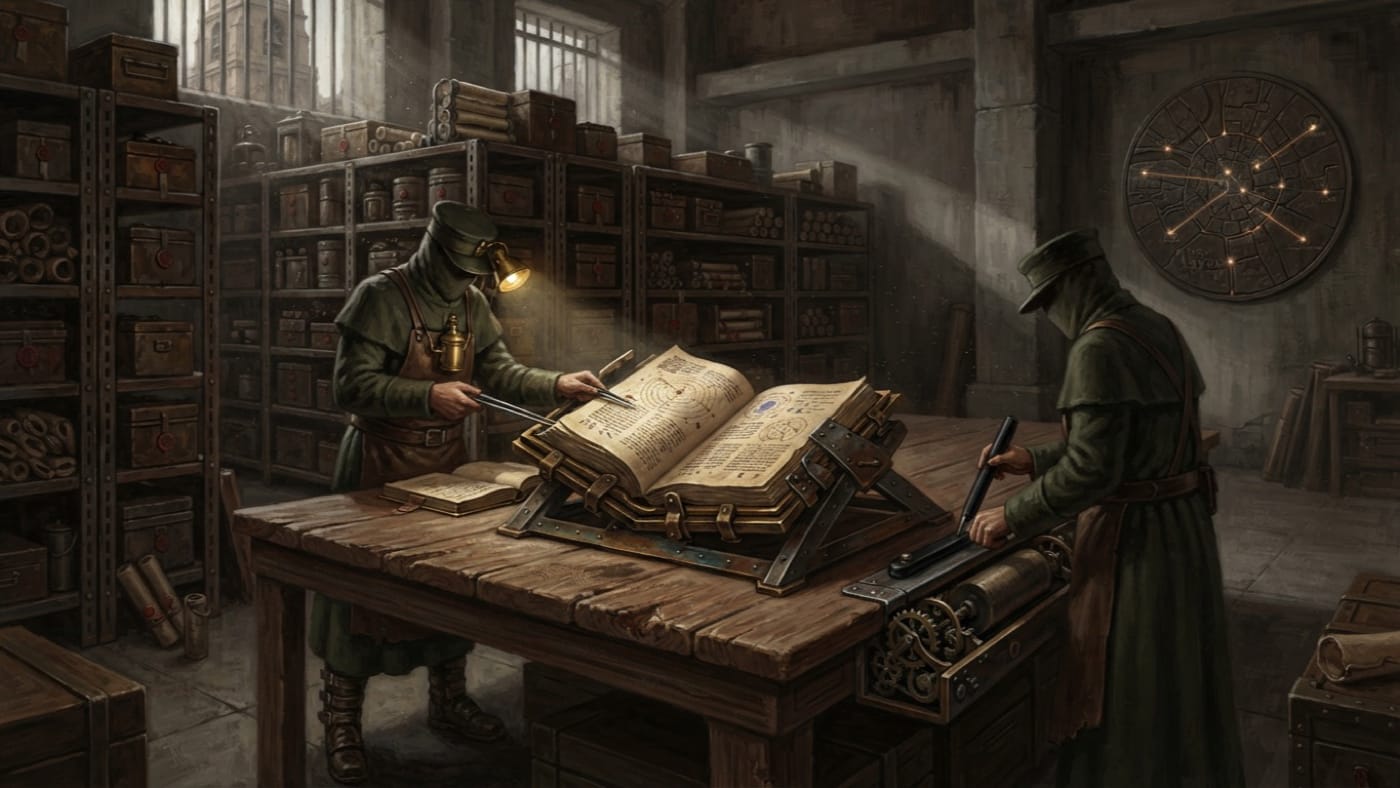
#On the Lyon Manuscript
There is a book the Church denies possessing, kept in a place the Church does not name, under two classifications the Church cannot both hold. It was found in Lyon and confiscated incomplete. Those who must call it something call it the Lyon Codex. It is no relation of the Bell Codex, whatever the vulgar suppose and whatever older entries of this Codex once printed.
That distinction has to be fixed before anything else is allowed to ring. The Bell Codex is the ratified grammar of lawful sound. The Bureau of Bells keeps it in the Bell Tower of Strasbourg Cathedral, and copies carrying authorised local addenda sit in every Timing House of the Dominion. The Lyon manuscript is an apocryphal folio. Its hand, its date of composition and its original length are all unknown. Its author is unrecorded. So is its discoverer. Nobody recorded the house, cellar, chapel or rubbish heap where it surfaced, either. I have stopped asking, because the question is usually answered with a form.
A seizure catalogue survives. It dates the intake to A.S. 115, the same year the sanctioned standard was ratified. I note the coincidence and decline to sell it as anything more.
The Bureau of Records maintains that the manuscript never existed. The same Bureau keeps its catalogue entry, its disposition line and two classifications' worth of shelf.
#On Peals Before Their Hour
Every bell in the Synod answers to a schedule. Ninefold Matins falls at dawn because the Bell Codex says dawn. The Widow's Toll gives grief its single low note at the hour set aside for grief. Iron Vespers locks the garrison gates because the evening has been told, in ink, what it is for. The Bell Codex looks forward in exactly one sense: it prescribes. Tomorrow's curfew is lawful before tomorrow arrives. The book commands it, and the city obeys a future it has been ordered into.
The Lyon manuscript is said to look forward in the other sense.
Every account filed against it says the folio mapped peals not yet rung and gave meanings to events not yet experienced. It charted bells in towers not yet raised, over cities not yet built. A schedule says the bell shall ring at Ninth. The Lyon manuscript, as reported, said what a bell would mean when it rang for a reason nobody had yet ordered.
That is the whole offence. A prescribing book makes the future obedient. A foreknowing book makes the prescription redundant. Suppose a tract by an unknown hand could tell the faithful which peal a storm will demand before the Bureau has demanded it. Then the Bureau is a clerk taking dictation. The twelve-page license, the seven-second tolerance and the ninth floor of the Bell Tower become decoration on someone else's music. The Bureau of Bells can survive heresy, because heresy is unlicensed sound and unlicensed sound confirms the license. It cannot survive being anticipated.
The peasants, who can read neither book, hold firm opinions about both.
The record does not settle whether the manuscript anticipated anything. Nobody has checked a prediction against the folio. No fulfilment has been dated. No complete passage survives in any file I have been allowed to read. The accusation against the book is that it claimed foresight. The proof is missing, and so is much of the book.
#On the Missing Leaves
Several leaves were already gone when the manuscript was seized. That much is catalogue. Cheaper pamphlets say the leaves were stolen from Bureau custody. They were not stolen. They were absent at intake. Someone whose name nobody wrote down lost them, removed them, sold them, burned them or never bound them in the first place, on a date nobody knows, in a Lyon nobody can now reconstruct.
The rumours disagree, and I will not force them into agreement. One says the leaves were sold on the black market. Another says they still toll in secret vaults beneath Lyon. A third, printed in the published entry on the Bureau of Bells, says the leaves were never in the manuscript at all and existed only in the minds of its readers. No seller has been named, and no buyer, vault, reader or price. Each story rules out the other two, and the catalogue ignores all three.
The catalogue is less shy about itself. The entry under the Bell Codex reproduces it as follows:
CATALOGUE NOTE — LYON FOLIO, SEIZED A.S. 115 Page count at intake: ███ Page count after sealing: ███ Missing leaves: "future curfew," "storm-votive sequence," "Judge summons" [term disputed] Auditor hearing transcript: bells audible from closed folio, no tower within range Disposition: apocrypha / operational
Read the third line slowly. Those three headings describe leaves the cataloguer could not have read, because the leaves were not there. Whoever supplied the labels took them from report, from the stubs, from an index, from rumour or from nerve. They are not quotations. Nobody has recovered a future curfew. Nobody has performed a storm-votive sequence from the Lyon text.
I leave the fourth line as the hearing record leaves it. An auditor testified that bells could be heard from the closed folio and that no tower stood within range. The transcript records the testimony. It records no cause, and I will not write one in.
#On Apocrypha and Operational
Records filed the manuscript twice, once under apocrypha and once under operational. Students treat this as a clerical accident. Clerks treat it as a contract.
Those two words tangle three separate authorities, and the vulgar run them together. Apocrypha is a doctrinal judgement. The Bureau of Doctrine declares a text outside the canon of binding instruction. No parish may ring by it, no Bell-master may cite it and no cantor may sing from it. Operational is a registry designation. It marks a document as relevant to present work, something to retrieve, consult or guard instead of merely shelving. The third authority sits between them and is never written down: practical interest. Someone judged the folio worth keeping within reach of people who act on things.
Operational is a narrower word than the gossips need. No record shows the manuscript being used to schedule a peal, train a crew, forecast a storm or answer one. No seal approves it, and no minute adopts it. The designation proves only that the file stayed open. In the Synod an open file says more than an approved one. A later seal can revoke an approval. An open file waits.
The Bureaus have taken their positions and held them with admirable discipline. Records denies that the manuscript existed. Bells denies that any of its pages are missing. Doctrine disputes the wording of the alleged summoning, refusing to discuss the act until the verb has been settled. These denials cannot all be true of one object, and they do not have to be. Each Bureau defends its own ledger. Records guards the integrity of its holdings. Bells guards the principle that nothing within its jurisdiction goes unaccounted for. Doctrine guards the grammar of Providence. Nobody coordinated them, and nobody needed to.
Earlier entries in this Codex, and older passages of the Lore Book, called the Lyon manuscript "the Bell Codex" and its seizure "the Bell Codex Affair."
Corrected. The Bell Codex is the ratified A.S. 115 standard, held by the Bureau of Bells at Strasbourg. The Lyon manuscript is apocrypha. It is also operational. The confusion has already cost the Church a joint seal of Bells and Records declaring that "the Bell Codex does not exist." The Bureau of Bells set its own wax to that sentence while its own book sat in its own tower.
#On the Unclosed Record
The bells of Strasbourg sometimes ring in storms that no schedule allowed for and no forecaster predicted. The Bureau of Bells blames weather acting on bronze. Bronze does contract in cold air. When the bells ring off schedule, I think of the missing leaves. The association is mine, and I do not certify it. The record does not say whether the manuscript foresaw such peals, provoked them, or merely resembles them the way a forged seal resembles a true one. The leaves that might say so are not in the record.
Some archivists claim the leaves held instructions for summoning the Judges. The catalogue's own bracket, term disputed, records the quarrel over that word. Doctrine's objection is more than pedantry, because Judges are not summoned; they arrive. Their origin is unsettled, and so is their allegiance. Nobody has shown that they obey any written instruction. No ritual appears in any file, and no successful demonstration appears anywhere. What does appear, in peasant testimony, is masked figures pacing the Cloister of Concord on days when storms ring unscheduled bells. The Bureau has found the peasants mistaken. The peasants keep looking.
Constantinople also hears sequences the Bureau cannot identify. The Bureau's own published entry places them beside the Third Ossuary, the sealed vault where dogs lie down facing the door. I repeat the comparison because the Bureau printed it, and I add nothing. Adding to it would be authorship, and the Lyon Codex has suffered enough from authors.
The record does not show where the manuscript rests now. It is not the Bell Codex and does not share that book's tower. Nothing on file places it beneath the Cathedral, in Lyon or anywhere else. It is apocrypha and it is operational. It does not exist, and its pages are not missing. Several of them are gone.