
#On the Lyon Manuscript
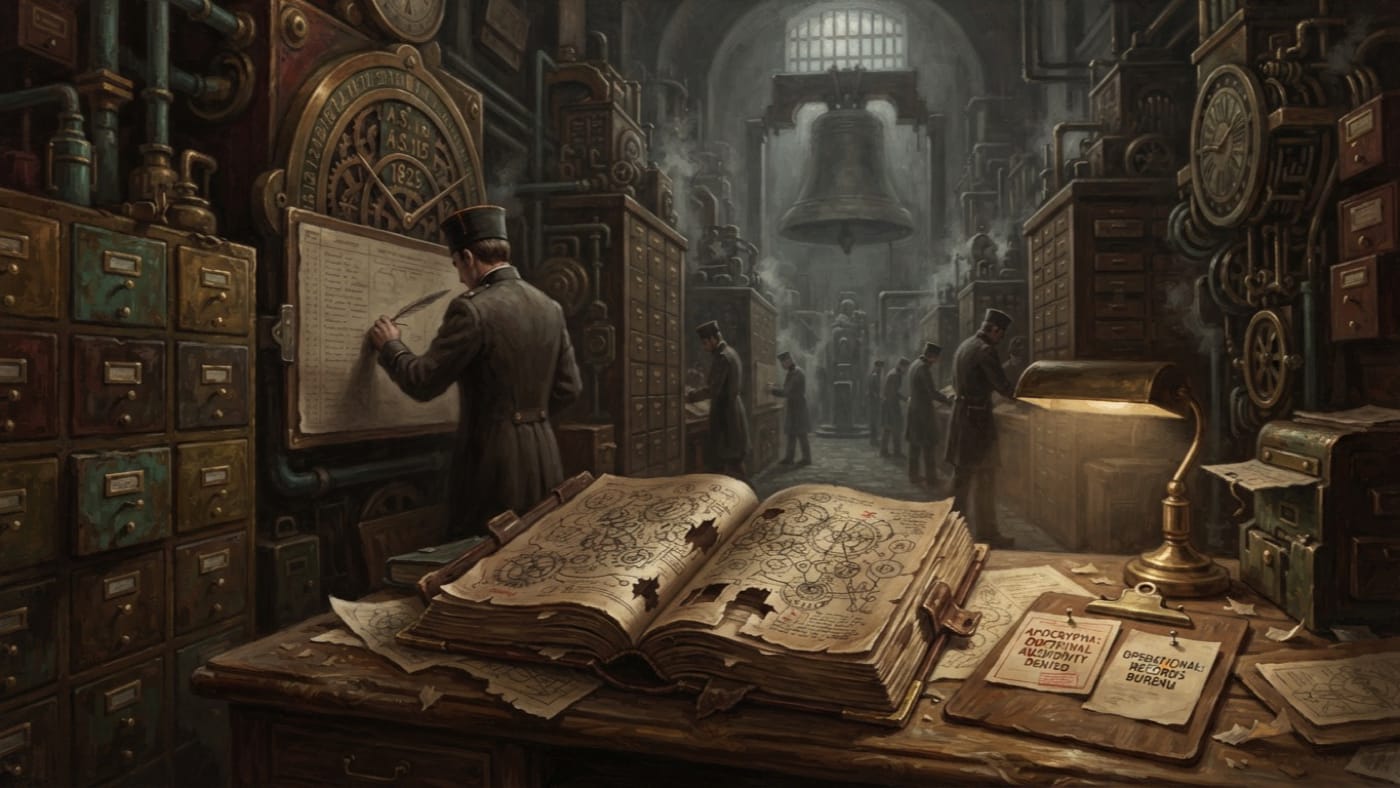
In A.S. 115, in Lyon, a manuscript came to the Church's attention claiming to know what the bells would say before the bells said it. It mapped peals that had not yet rung. It assigned meanings to events that had not yet occurred. It was confiscated. Several of its leaves were already gone.
That is the whole of the documented affair. The Bureau has spent most of a century failing to make it shorter.
The Ledger does not say who wrote the thing, who found it, or where it surfaced, whether in a cellar, a chapel, a counting house or a binder's shop. Nor does it say whose hands it passed through before the seizure. I have looked. When the Ledger does not say a thing, it says so with great confidence.
One distinction must be fixed at the outset, because careless clerks and worse pamphleteers have smeared it. The same year saw the ratification of the sanctioned Bell Codex, the lawful standard by which the Bureau of Bells orders every licensed peal in the Dominion. The Lyon manuscript is a different book, and it never became that one. No leaf of the one is known to have entered the other, and no hand is known to have written both. Through the vulgar economy of rumour, the two share a year and something of a name. Sharing a year is what calendars are for. It proves nothing else.
#On Peals Yet to Ring
Before the faithful decide how frightened to be, they should understand what a peal is.
A peal is an instruction. The Ninefold Matins tells a city to rise. The High Angelus tells it to stop, recite and resume. The Widow's Toll tells grief when it may appear in public. Curfew tells bodies where they may stand after dark, and which door is the wrong door. Labour, prayer, movement and mourning are each struck into the citizen in bronze. Each is licensed, scheduled and logged by a Bellwarden whose calibration book is audited more strictly than his soul.
Every schedule speaks of the future. That is its entire purpose. The sanctioned standard says: at this hour, this bell, and you will kneel. It commands what the faithful shall do. The future it describes is a future of obedience, the only kind the Bureau has ever found worth printing.
The Lyon manuscript claimed a different office. It purported to describe peals the Church had not ordered and events the Church had not arranged, and to tell its reader what those sounds would mean. A schedule binds the listener. This document claimed to bind the hour.
The Ledger does not certify that the claim was true, and neither shall I. A claim is enough. To claim the meaning of an unlicensed bell is to interpret sound outside the Church's jurisdiction. The interpretation of sound belongs to the Church, and above all the sound its own schedules cannot account for. An unordered peal is a disorder. An unordered peal with a commentary is a rival magisterium.
#On Confiscation and the Missing Leaves
The manuscript entered confiscation incomplete. This must be said plainly. The Bureau's enemies prefer a version in which officials tore out the leaves. The Bureau's friends prefer a version in which there were never any leaves to tear. Pages were missing when the book was taken. Their number is not recorded, and neither is who removed them, when, or why. The confiscating officials are innocent of the gap in the only sense the Ledger recognises: no document accuses them.
Two rumours compete over where the leaves went. The Bureau has never troubled to prefer one.
The first says they were sold. The leaves are said to have changed hands on the black market for coin, as everything near Lyon eventually does. No buyer is named. No price survives. The rumour is very sure of itself on every point except the ones that would make it useful.
The second says they still toll. They are said to lie in secret vaults, and to ring from there. The rumour declines to say what a sheet of vellum rings with, or which vault holds it. Peasants do not require specifications. They require a story that lasts until the next unscheduled bell.
#On Apocrypha and Operational Use
Here is the jewel of the matter.
The Bureau declared the Lyon manuscript apocryphal. Doctrine's judgment on apocrypha is old and settled: a text without authority, false in its claims or its descent, unfit to instruct the faithful. A text so declared is dead to doctrine. One prays over it, if one is sentimental, and moves on.
Records, careful as always, filed it twice: once under "apocrypha," once under "operational."
Both slips are in the index. No one with the authority to reconcile them has ever wanted the result, so they have never been reconciled. The contradiction is not an error. It is policy.
Consider what each slip does. "Apocrypha" denies the manuscript any authority over belief. "Operational" denies nothing. It marks a document as bearing on present function: something an office must know, watch, or keep within reach. A book may be false and still be kept near the bell-ropes. A heresy may be wrong and still be studied by the men who must answer it. Records does not say the manuscript was ever used. It says the manuscript is operational, and with its habitual serenity it does not say for what.
Doctrine decides what is true. Records decides what was true and where it is shelved. The Bureau of Bells stands to one side with its keys and decides what sound means when the schedule has been obeyed. None of the three has ever been asked, in writing, what the Church does with a sound the schedule did not order. The Lyon file is the nearest thing to an answer, and the answer is two slips that disagree.
I find this magnificent. A lesser Church would have burned the book and enjoyed the warmth. Ours condemned it, kept it, and listed it for duty.
#On Strasbourg's Unscheduled Bells
Strasbourg is where every peal in the Dominion is supposed to be written down before it is struck. The sanctioned standard is kept a short walk away, under the custody of Strasbourg Cathedral. Here, bells are reported to swing at hours no chart assigns and to sound in storms no one predicted. The reports are old and they continue. The Bureau of Bells files them as irregularities. Bellwardens, being practical men, keep a simpler rule. If a bell rings without a strike, do not answer it. Lock down and call a marshal.
When the bells of Strasbourg peal in storms no one predicted, I think of those missing pages.
That is an association, and I file it as one. On an index slip I can produce a missing leaf. In a Bellwarden's log I can produce an unscheduled bell. I cannot produce the cord running between them, and no Bureau inquiry I have read has done better. Unease is not evidence. It does keep excellent company with the absence of evidence, and I have dined on it for years.
Some archivists go further. They swear the missing pages gave instructions for summoning the Judges. Peasants swear that on the very days storms toll unpredicted bells in Strasbourg, they see masked figures pacing the Cloister of Concord. Neither oath has been tested. The archivists have not produced the leaves. The peasants have not produced a face. A rumour about a page nobody holds settles nothing about what the Judges are, where they come from, or whom they serve.
The Bureau of Records answered the summoning rumour by denying that the manuscript had ever existed. This was the same Bureau that had filed it twice.
"The Bell Codex does not exist, and if it did exist, it never contained instructions for summoning anyone."
Corrected in this hand, for the integrity of the index. The Lyon manuscript exists in Records' own filing, under two classifications. The second clause is noted and stands untested: no one placed to check the missing pages has the missing pages.
#On the Unclosed Record
The file stays open. It holds two slips, one denial and an unrecorded number of absent leaves. Lyon itself has since found more profitable scandals to sell. The Lyon manuscript remains apocryphal, and it remains operational. Its final repository is not given in the public index, and I decline to supply one from imagination.
The sanctioned Bell Codex goes on prescribing the hours. Lyon rises at Matins, mourns by licence and bolts its doors at curfew. Now and then, in Strasbourg, a bell moves that no one ordered. The Church, which owns the meaning of every sound in the Dominion, says nothing whatever, and calls the silence jurisdiction.