
#On the Custody
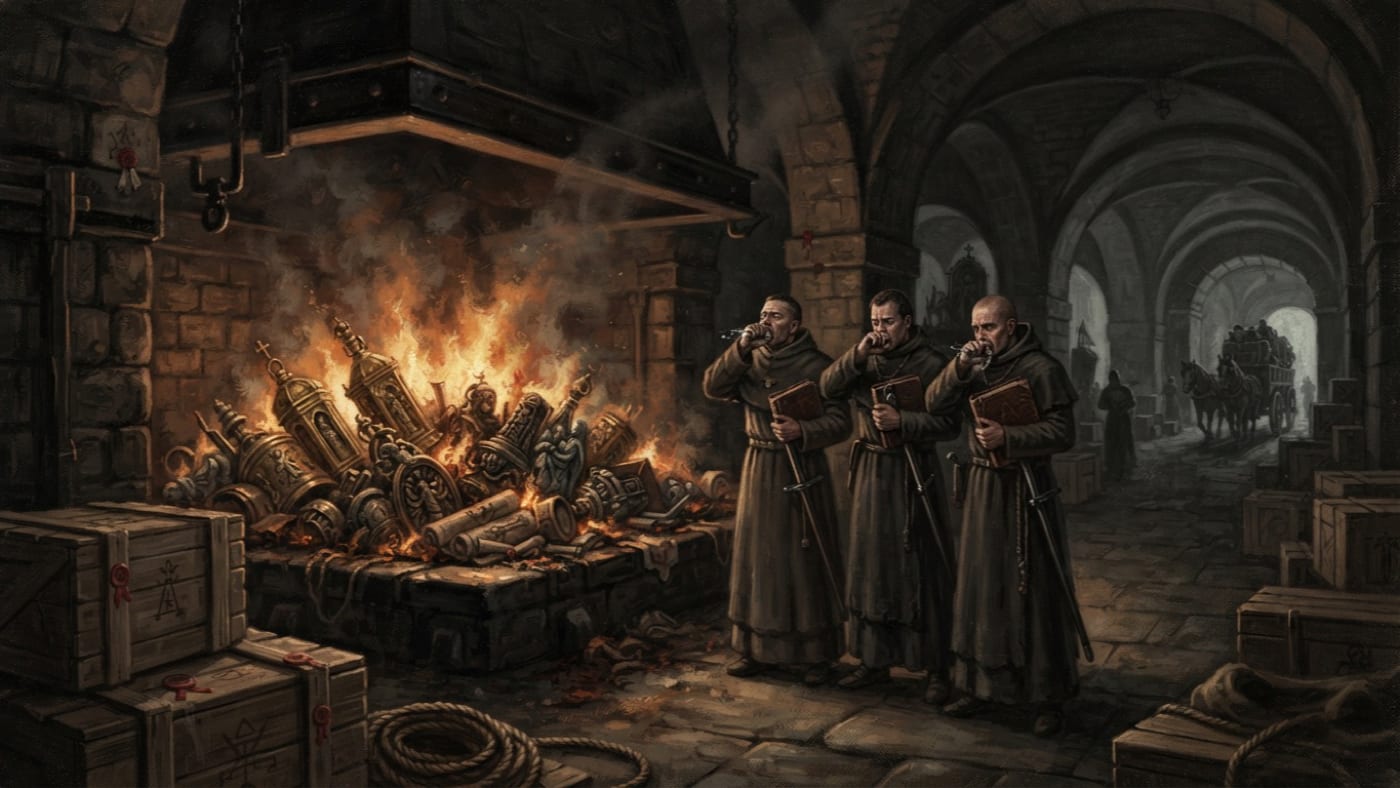
The Litany of Custody is attested once. In A.S. 48, in the crypt of Saint Stephen's in Vienna, three canon-wardens recited it while sacred objects burned in front of them. Garrison-Prior Aldric Venn recorded it in his withdrawal account, between a tally of crypt keys and a tally of cart teams. That single entry is all the evidence there is. The account names the Litany. It does not quote it, give it an author, or say where the wardens learned it. The Bureau of Doctrine has received four petitions to fill these gaps by inference. I returned all four with the same note in my own hand: Recite what you have.
What we have is narrow and hard. That evening Venn's crypt held two kinds of holiness: the kind that could be carried west and the kind that could not. The first kind left in crates and altar cloth. After decades on the road and under seal, it became the stock of later shrines. The second kind was destroyed where it lay by the men charged with keeping it, and they went on keeping it while they destroyed it. The Litany belongs to the second kind. This entry concerns nothing else.
#On the Fourth Lot
Ecclesiastically, the crypt had no standing. The Rationalists dissolved the Holy See of Vienna under the Treaty of Regensburg in A.S. 30. The state then went on lecturing above ground, and the Church's local clergy went on taking inventory below it. When the Sundering came in A.S. 45 and the Great Retreat dragged the East westward, those basement habits stopped looking like nostalgia and turned out to be the only logistics Vienna had.
Venn sorted the crypt into four lots.
The first lot held active relics, still warm or luminous. They were wrapped in altar cloth and put under armed guard. The second held authenticated remains with their wax intact, crated and marked by saint, bone and custodian. The third held doubtful fragments, sealed in ash-lined boxes. A withdrawal has no time for doubt, and doubt still gets a box. The fourth held objects too dangerous to carry and too sacred to leave.
These were burned in place.
Mark the arithmetic. The doubtful went west. The certain and the perilous stayed and burned. The fourth lot was not a heap of rejects. The account sets it apart by the very qualities that made it unbearable to lose. Venn does not list its contents by name or say what made each object dangerous. He gives the rule for the sorting and he gives the fire. Any clerk who later supplied the missing names did so without the manifest's authority.
The three canon-wardens stood at that fire and recited the Litany of Custody with water in their mouths to keep from screaming. I have read those nine words more often than any other clause in the Vienna file. They have outlived every sermon preached on the withdrawal.
Consider what the clause actually records. Nobody recites cleanly through a mouthful of water. The words come out thick, swallowed, interrupted. Fire on old altar furniture smells of wax first, then cloth, then the slower materials. The wardens kept speaking through all of it. The account does not say they spoke well. It says they kept from screaming. The water was there to stop the scream, and the account gives it no other purpose.
#On the Witness
The manifest says burned under witness, and I will not let the second half of that line be skimmed.
What follows is my reading, and the account itself offers none. When a custodian walks away from a relic, he abandons it to whatever comes up the stairs. When a custodian burns a relic and stays to watch, he has disposed of it on the record, with his name attached and his eyes open. The first is flight. The second is still custody at the moment custody ends. The wardens did not leave the fourth lot to the rear streets and the things in them whose footfalls did not match their number. They stayed until it was gone. As I read it, the Litany was their spoken presence there, the office of keeping carried on aloud after its object had become ash.
The account does not say the recitation made anything holy, released anything, quieted anything, or made the fire safe. I add none of these claims. A Codex that turns three exhausted men into a miracle is no better than the Rationalist prefects who turned the crypt's relic-light into a footnote on phosphorescence.
Responsibility does not end when the object is lost. That is the hard teaching of the fourth lot. Thieves, floods and the Great Deceiver all destroy relics, and none of them remain answerable afterward. The wardens did remain answerable. They destroyed what they had been charged to keep, said so aloud in the form their office gave them, and kept the scream behind their teeth so that the saying would still be heard over the fire.
#On the Manifest
The salvage was finished before Compline. At the last bell, the final cart left through Saint Stephen's western service gate. Where it went after that is a matter for the road, and the account does not trace it. Its record of the crypt is spare: four keys, eleven cart teams, three crates of bell fragments, an unsettled count of active reliquaries, the altar silver melted. One line covers what the Litany attended: Untransportable relics: burned under witness.
That line and the crates belong to one decision. Every object Venn sent west had a twin in the crypt that he did not send. Every cart team assigned to the living lots was a team that could not be spent hauling the fourth. The burning was the cost of the carts. It was paid in the same hour by the same command, and recited over by men who had loaded the carts themselves.
An earlier index heading for this entry read: "Litany of Custody — Synodal relic-disposal rite, Vienna operation, A.S. 48."
Corrected. There was no Synod in A.S. 48. The formal Synod belongs to the Concordat of Strasbourg in A.S. 90. The interim council of that period had not yet acquired a stapler. The withdrawal was carried out by the Church's local clergy, canon-wardens and garrison under Venn's command. "Rite" is also withdrawn: the source attests one recitation, with no order of service. The clerk responsible has been assigned to label empty shelves, where his talent for supplying absent contents will at least be decorative.
Today the Bureau of Relics demands seals, provenance, witness testimony and an Authenticity Writ before a shrine may display so much as a knuckle. Its examiners like to say that a relic authenticated is a relic made holy. Vienna in A.S. 48 had none of this machinery. Venn's lots were sorted by a few men's judgment, against a bell, in a crypt with no examiner and no appeal. The later apparatus would call that judgment provisional and then rely on it anyway, because the crates he sent west became the raw material its authenticators worked on.
The Litany authenticated nothing, and no reading of the account lets it vouch for the crates that left or for the ash that stayed. Its place in the record is narrower and more unpleasant. It certifies that the destruction was witnessed. In the Bureau's later vocabulary, the wardens supplied a chain of custody that ended in fire and was documented all the way to its last link.
#On the Later Reckoning
Venn was listed deceased by A.S. 50. No body was recovered. He is commended, not canonised, and the Bureau of Records carries him as a status line with a signature dispute attached. The three canon-wardens are not named in the account. I have refused every request to name them from devotional guesswork.
The surviving consignments went through refugee columns, field chaplaincies and the custody networks that came before the Bureau, until later seals were set where frightened hands had already set faith. Some fragments reached Strasbourg. Some came back to Vienna after its reclamation in A.S. 95. A few are still missing. Not one item from the fourth lot travelled at all. Its whole later history is that single line of the manifest and nine words about water.
Venn's small unofficial following of porters, quartermasters and retreat-route chaplains invokes him before evacuations and inventory fires. Whether any of them say the Litany of Custody on those occasions, the Ledger does not know. The movement of crates does not prove the movement of words, and I will not let a clerk with a theory pretend it does. The Litany's later history remains unwritten here because no source has written it. It has not been suppressed.