
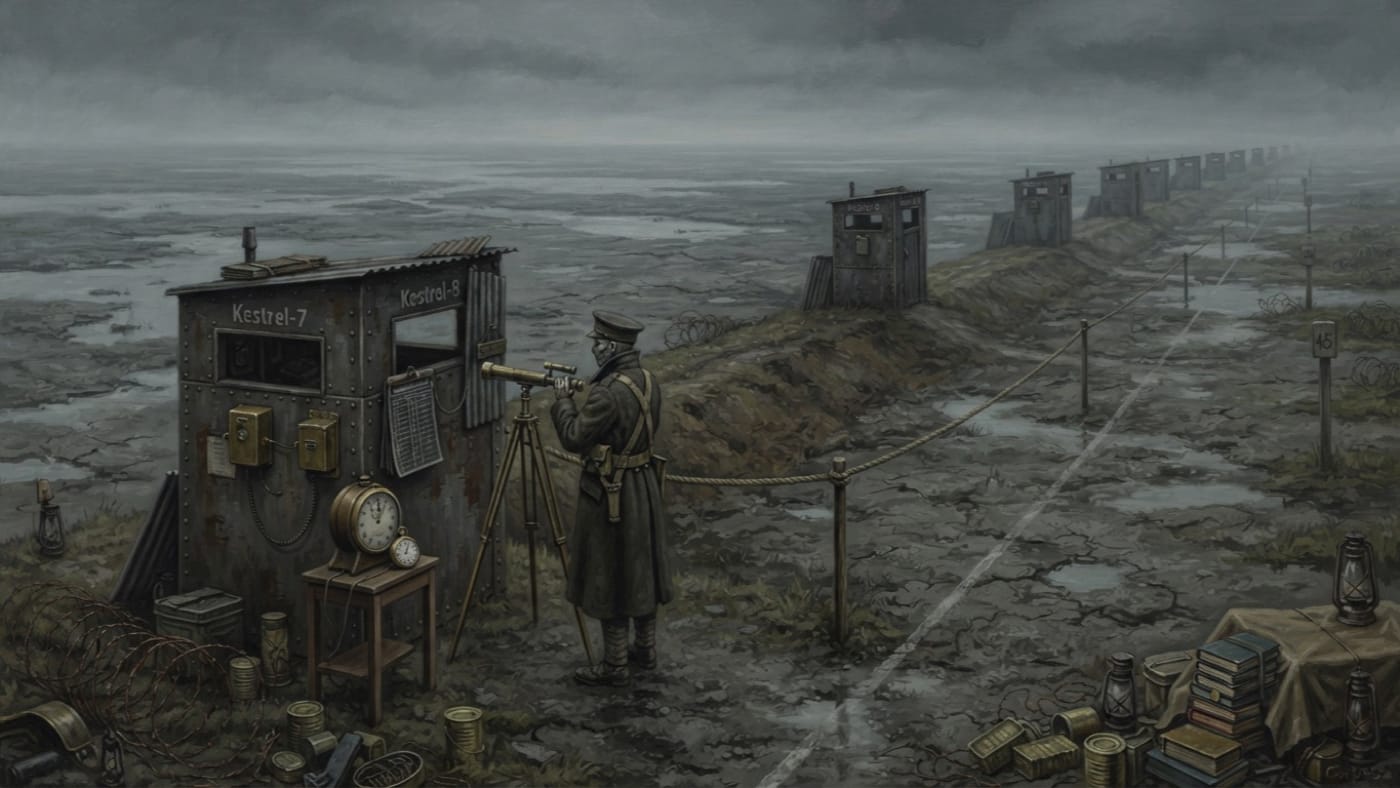
#On the Observation Line
Fourteen posts, numbered Kestrel-1 through Kestrel-14, watch the western perimeter of the Blightmarsh. The Bureau of War maintains them. They appear on its rolls between the remount depots and the boot-nail contracts, which is where War keeps everything it cannot feed properly.
The line exists to see. A post records where the grey mud stood yesterday and where it stands today, and it sends the difference west. Nothing on the line stops the advance. Any rear-office clerk who writes "the Kestrel cordon" is describing a row of men with ledgers, and he should be shown one before he uses the word again.
The chain of command is untidier than the numbering. Kestrel-9 answers to the eastern watch of Bastion-Constantinople and draws its garrison from that fortress. Eastern Command issues the sector's orders from the same walls. My file does not say whether every post keeps that arrangement, and I will not turn the habits of one station into a constitution for fourteen. The Thracian Survey sends practical men to War, to the Bureau of Records and to Cartography, and at least one of them stood a Kestrel watch. The line is a perimeter, and it should not be confused with the Sagittal Line on any map I sign.
Its founding is not on file. The archive holds no charter, no commissioning date and no record of who assigned the numbers. The Ledger has kept the work and mislaid the birth. I have dated this entry A.S. 201 because that is the year of the line-wide return under assessment. The date marks no anniversary.
#On the Keeping of Watch
Four instruments recur in the post files. Each measures something different.
Ash-lines are laid across the roads at dusk and read at dawn, and they record crossings. A cart leaves ruts. A deserter leaves boots. When the ash has been crossed without any print at all, the crossing goes onto a form kept for events that should not need one.
Rope markers stand on stakes along the boundary, and they record the edge. When the grey reaches a rope, the watch notes which rope and at what hour. Somewhere to the west a cartographer then moves a line he will never walk.
The smell log is kept for food: bread on the wind where no oven stands, cider off a slope that was bare at the morning reading. Each entry gives the scent, the hour, the wind's direction and the name of the man who reported it.
The exposure clock is kept for the watchmen. It times how long each sentry has held his eyes on the grey. Some lesson nobody wrote down taught the posts that the Marsh can be studied only at a price, and that the price is collected from the student.
Each watch therefore produces two returns, one on the ground and one on the men who looked at it. The second return grows faster.
Kestrel-7 keeps a fuller kit, which I credit to that station alone. It has mud gauges driven in where the ground still bears weight, an observation slate with fixed columns, a mouthguard for the exposed sentry and a field telephone for the report. Its slate records mudline creep, shapes beneath the surface, unlawful growth and food-scent contact. Other posts may carry the same equipment. None has sent me an inventory, and I do not issue equipment by inference.
#On Hunger and Standing Orders
The ground beyond the ropes was once the Hungarian plain, grain country along the Drava, and it still remembers how to look like a harvest. It is grey mud under grey water under a grey sky, and on some mornings a stand of wheat. Something passes under the surface, slow and low. I will not name it. Nobody who has looked long enough to know has filed a usable report.
Kargath works through appetite. The Abundance Fields grow real produce. It can be threshed and bitten, it feeds the body, and the hunger rises with every mouthful. The Famine Pits give off want from old starvation graves. Further off, the Cauldron Citadel, built from drowned cities, does its processing. These make up the theatre. No post's file claims a view of all three.
Standing Order 119-F was issued by Eastern Command in A.S. 163. It orders withdrawal from cultivated land within ten miles of the Blightmarsh boundary and forbids approach, harvest, sampling and consumption. Its fourth revision, in A.S. 199, classifies smell as contact. A sentry who catches bread on the wind has been touched. He reports the touch, withdraws when the order requires it, and goes to Medicine for assessment. The scent distances differ between the circulars on my desk. An officer who wants a figure should read the copy his own command has signed.
Under that order, Kestrel-4's sentries reported supper memories in such detail that Medicine opened a permanent olfactory assessment station. Requests for reassignment were logged there and denied.
The retreat is accompanied by the Litany of Sufficiency: Enough is given. More is theft. It helps a man turn around. It does not make him safe. No blessing, ration, prayer or rope has ever made a sentry safe, and the chaplains who say otherwise do not stand the dawn watch.
Standing Order 77-K dates from A.S. 134 and governs a different kind of grave. It sets a four-mile exclusion around each confirmed Pit and an eight-mile caution band with double rations and timed rotation. Clerks confuse the ten miles with the four and the eight in every quarter, and the cost of the confusion is buried at Bureau expense.
#On the Recorded Posts
Sergeant Vell of the Thracian Survey spent months at Kestrel-9 on secondment. I took his testimony in A.S. 199. He described grey mud moving when there was no wind, and bread-smell on days when no bakery stood within thirty miles. He described ash-lines crossed in the night without a print, and sentries chewing ration-cloth in their sleep. He told me of a watchman who stayed at his glasses too long and afterwards asked, with perfect courtesy, whether the post's dead were being stored for later issue. I asked what the Marsh looked like from the parapet. He said, "It looks back, sir."
That sentence is filed as testimony. Doctrine has ratified no eyes.
I wrote six pages of notes and burned them in my own grate. They stay burned.
In the same year I made a restricted inspection of the post, escorted by Corporal Drennan of the Bastion-Constantinople garrison. I watched the mud for eleven minutes. At the eleventh, Drennan touched my elbow and said, "Sir, respectfully, that's enough looking." One hand at my sleeve and five words brought my attention back to my body. He did not drag me anywhere. A tug would have been an offence against rank. A touch was judgment, and judgment is harder to discipline.
Eastern Command's preliminary note entered Corporal Drennan's conduct at Kestrel-9 as an escort impropriety.
Corrected under Doctrine. The intervention is ratified as proper escort conduct. Public commendation is withheld for precedent risk. The eleven minutes were mine and that afternoon's, and they set no allowance for any clock on the line.
Vell later requested transfer to Bastion-Brest on the Bug River, where the garrison faces the Nameless Tide. The request was granted, and he called the move a relief. His file remains unresolved.
Kestrel-7 has the opposite traffic on record. In A.S. 196, Corporal Haas Mettler of that post ate three apples from an Abundance Field nobody has identified, and he was executed. In A.S. 199, Sergeant Kael came from the aftermath of the Saint Barachiel, declined convalescence and asked for Kestrel-7. She keeps her slate and sleeps soundly, and Medicine monitors the sleep. One sergeant left the line and thanked the clerk. Another came to it and asked for it. I draw no doctrine from the pair. War approved both requests, since a volunteer saves a form.
Kestrel-11 watches the Drava. In A.S. 200, its patrol reported a figure standing waist-deep in the current, facing east and holding what looked like a surveyor's transit. It resembled Adept Harlen of Cartography, whom the river took in A.S. 174. The patrol hailed it and got no answer. It did not approach, withdrew, and filed the report. A resemblance does not establish a name. The figure is unidentified, and Harlen's file stands unamended.
#On the Present Return
The A.S. 201 return lists fourteen designations and records three of them as unmanned. It does not say which three. War blames scheduling. The garrisons blame ground that eats people. Neither party has supplied a roster. Fourteen minus three is arithmetic, and I will not treat it as a readiness figure or certify any post as being at strength.
Kestrel-7 has a manned-watch record for this year. The stretches of perimeter on either side of it are carried on the rolls and staffed by nobody. I will not assign them numbers on the assumption that the numerals follow the ground. Kestrel-9 has made no individual return since my inspection. Kestrel-11's condition this year is undocumented.
The ash is still laid at dusk and the clocks still run. Each return shows the grey a little nearer the ropes than the last one did.