
#On the Observation Line
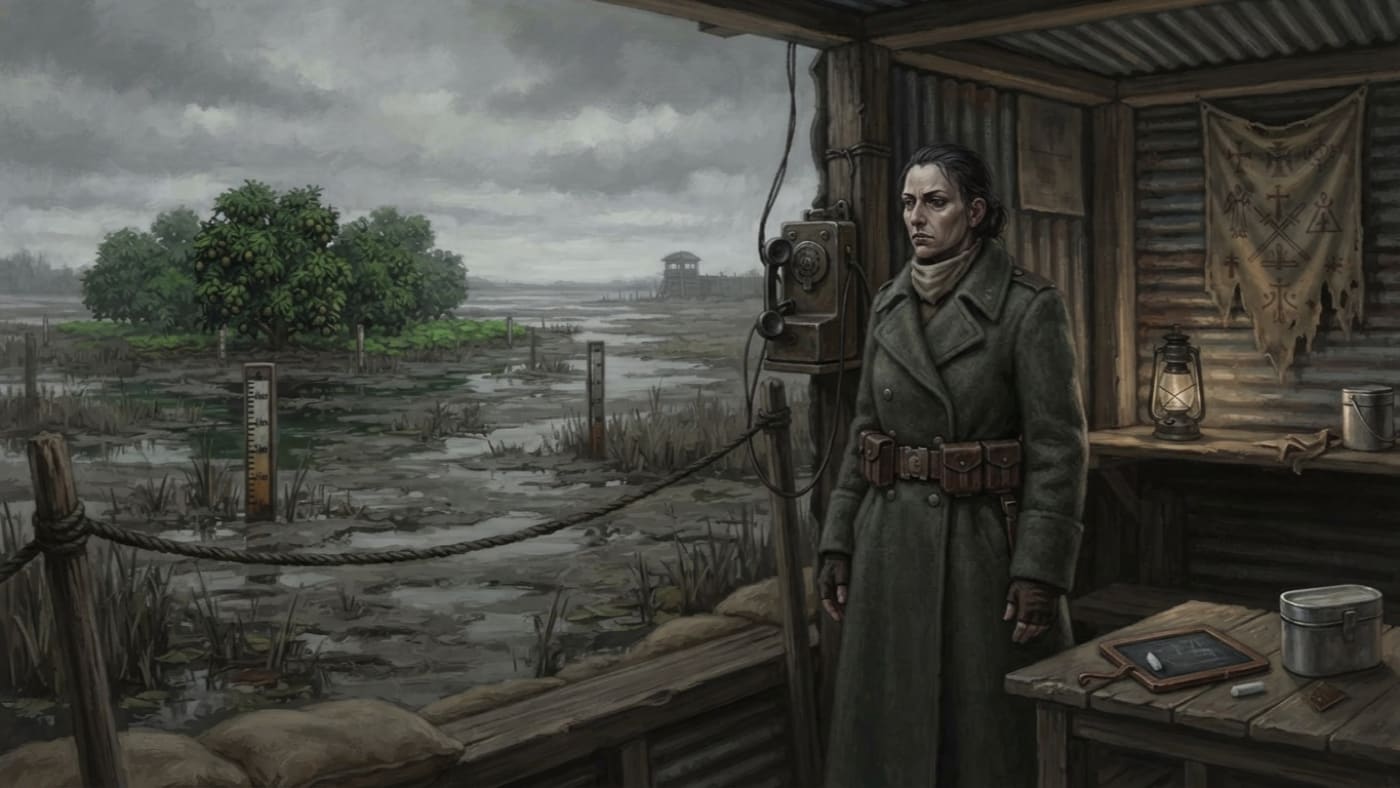
Kestrel-7 keeps a stretch of the western perimeter of the Blightmarsh. Two other posts flank it. The Bureau of War keeps both on its rolls and staffs neither. Kestrel-7 is the one on that stretch with people in it.
The post's purpose is plain enough, and I set it down plainly because soldiers will not read past the second clause. Kestrel-7 does not hold back the Marsh, and nothing on the perimeter does. The post looks at the Marsh, measures it, writes down what it has done since the last measurement, and reports the result by field telephone to officers who file it. Keeping a watch and holding ground are separate offices. The Bureau has given this post only the first.
The line it keeps is an administrative line, marked with rope. Stakes stand at intervals, and the rope between them darkens and sags with the damp. Beyond it lies the active edge, where the grey mud has finished eating and begun to digest. I will not print the distance between the two. General Blightmarsh guidance forbids any permanent observation structure within four miles of the current edge, and the current edge does not hold still long enough to be measured honestly. The rope tells a sentry where his orders change. It tells the Marsh nothing.
A sentry may spend at most ninety minutes on exposed watch. He goes out with a slate, a mouthguard and a sightline. He comes back with marks on the slate and, if the Creator is attending, the same appetite he took out.
#On the Ground Beyond the Rope
This was the Hungarian plain once, the breadbasket of empires, before Kargath taught it to eat. What is left is grey mud under grey water under a grey sky. The soil has not been worn out. It has been consumed by something beneath it that has not finished.
The slate has four columns, one for each thing the watch records.
The first is mudline creep. Mud gauges stand along the sightline: graduated staves driven in where the ground still bears weight. The watch reads them and notes when a stave that stood clear at dawn is wet to the third mark by noon, or when a stave has gone missing. A stave that has disappeared is entered on the slate as a reading.
The second is shapes beneath the surface. Something passes under the grey, slow and low, and the mud lifts like a pall over a corpse that has shifted in its box, then settles. The watch records the bearing, the duration and the approximate length. It does not record a guess at what the shape is. A sentry who starts guessing has started looking too long, and that is a medical matter.
The third is AB-sector growth, the Bureau's shorthand for cultivation where none should exist. Barren, consumed ground is the Marsh's ordinary condition. The danger is the exception: a stand of wheat, a row of beans, an orchard heavy with fruit, green against the grey like a candle lit in a charnel house. The produce of the Abundance Fields is real. The grain can be threshed and the apple can be bitten. The trouble lies in what the eating does afterward. Hunger grows with every mouthful, and a man can starve at a full table.
The fourth is food-scent contact: bread on the wrong wind, or cider smell drifting off a slope where no tree stood at the morning reading. The patrol goes out to confirm, and the field is gone. The patrol turns back, and the field is there again.
The post's remit ends at its own sightline. The Famine Pits and the deeper country of Kargath belong in other men's ledgers.
#On the Watch and Its Orders
The governing instrument is Standing Order 119-F, issued by Eastern Command in A.S. 163. Its fourth revision, in A.S. 199, treats smell as contact. A sentry who catches the scent of baking has been touched by the enemy just as surely as if he had walked into its field, and his report must say so.
The order and its medical guidance carry two distances that clerks confuse in every quarter. The ten-mile restriction governs encounters with cultivation around the Blightmarsh. The threshold for food scent detected at more than two miles governs medical assessment. One distance is for the patrol and the other is for the physician. Neither fixes Kestrel-7 on a map, and anyone who tries to place the post with them deserves the walk.
Withdrawal is required at the first sign of abnormal appetite, abnormal thirst, or fixation on patterns in the surface. The sentry reports these himself. The Bureau trusts a hungry man to announce his own hunger before it starts making his decisions for him, which tells you what kind of trust the Bureau extends.
On the way back the sentry recites the Litany of Sufficiency, which belongs to Kestrel field discipline. The published account adds food scent to sighting as grounds for recitation, and it is careful about what recitation buys. It helps a man turn and walk away. It does not make him safe. I respect a prayer that knows its limits. There are not many.
Rations are eaten in company and counted. That is lawful food. Anything grown, dropped or offered beyond the rope is hostile produce, however wholesome it looks and however good it smells. The rule is simple, and the men obey it. They also sleep badly, dream of meals, wake chewing the corners of their blankets, and accuse one another of hoarding food that nobody has seen. The order has not prevented any of this. It has only made sure each case is written down.
#On the Three Apples
In A.S. 196, Corporal Haas Mettler of Kestrel-7 ate three apples from an Abundance Field that has never been identified.
He was exposed and he ate. Within the hour the Bureau of Medicine recorded catastrophic hunger: the kind that eating makes worse, the kind the physicians have learned to recognize. He was sentenced and executed. I was there and saw it done.
The order then in force did not yet count smell as contact. It counted the apples. Whatever drew him across the rope that day went unrecorded, because no column on the slate was ready to receive it.
His file is the earliest paper I have found that bears the post's name. It is an attestation, not a founding charter. The post is older than his offense by some span the archive does not record, and I will not dress his death up as a cornerstone. Nor will I report that the garrison keeps some vigil in his memory. Nobody has told me of one, and inventing one would be worse manners than the apples.
#On the Bombardier at the Slate
The post's best-known occupant came to it from the air.
Sergeant Kael was the third-crew bombardier aboard Vigil Ark Saint Barachiel. She was born in the western quarters of Bastion-Constantinople, and she is a sergeant of the Bureau of War. After the Broadcast of the 3rd of Argent, A.S. 199, she declined convalescence in the Swiss cantons and asked for observation duty at Kestrel-7. I asked her why over the field telephone. She said the cantons were too quiet. The line cut before I could have her explain, which may have been the Marsh's only act of courtesy.
At Kestrel-7 she keeps her appointed watches, writes the slate in a small, square hand, eats her ration and no more, and sleeps soundly. The Bureau of Medicine has found no progressive caloric void in her. She has lost weight, though within regulation. She has the marsh-vapor cough and the waxy complexion that every perimeter posting hands out. The physicians call this unusual resilience. They have not called it immunity. Nor has anyone shown that whatever keeps her intact can be given to the man in the next cot.
Kestrel-7 chaplaincy memorandum 201-6: Sergeant Kael's sound sleep constitutes "probable evidence of serenity."
Amended on Doctrinal review. Serenity is not indicated. Sound sleep is a medical observation and is to be monitored as one. The chaplaincy is reminded that the slate has no column for grace.
The garrison has turned her into a superstition, as garrisons do. New sentries are told to sleep when Kael sleeps and stay awake when she wakes. If she looks east too long, men check their mouthguards. If she touches the cuff of her left glove, men stop eating. Command has endorsed none of this. Command has also issued no order forbidding it, and that is how a superstition becomes a standing practice.
Two undated withdrawals are on file. In the first, she ordered withdrawal from the post trench before the instruments showed any movement. Eleven minutes after the trench was cleared it collapsed, and the collapse exposed a mouth lined with fence wire and horse teeth. In the second, a patrol was sent to verify an apparent orchard. Kael wrote one word on the slate: rack. The patrol withdrew. By dusk the orchard was gone, and the ground where it had stood steamed for three days.
The file does not say how she knew, what rack meant, or that she commands anyone beyond her own watch. She is a sergeant who writes a slate, and the record shows nothing more than that.
#On the Present Condition
The watch continues. As of A.S. 201 the gauges are read, the shapes logged, the green patches reported and the bread smell recorded as contact. The sentries rotate out at ninety minutes and come back hungry, and the ones who come back hungrier than the regulations allow are pulled off the line. The rope still stands, and the stretches of perimeter on either side are still unmanned.
The Bureau keeps no figure for what Kestrel-7 has prevented, and I will not supply one. It has produced slates, and each slate shows the Marsh a little further along than the one before.
The finding on its sergeant is open, and it is meant to stay open.