
#On the Authority
"Do not eat from the Enemy's hand. Do not eat from the Enemy's field. Do not eat." — Martial Code 14-D, Spiritual Contamination (Voluntary), Subsection 3
Eastern Command is the military authority at Bastion-Constantinople that issues orders for the eastern sector. This Codex knows it mainly by what it forbids. Its standing orders are filed with the Bureau of War, Eastern Section, and that is the full pedigree the Ledger can presently certify. I have been asked for its founding year. The archive has supplied none, and I decline to invent a birthday for an institution that has never asked for one. No commander's name appears on the instruments under review. The orders speak in the Command's name, the Command speaks through the orders, and the clerks of the Eastern Section find the arrangement restful.
The headquarters sits at the southern anchor of the Sagittal Line (Unregistered), where two thousand miles of wall, trench and mountain pass end in a fortress on the Bosphorus. It has plenty to look at. Maldrake presses through Thrace with all the delicacy of a siege ram. Kargath uses other methods. Of all the Synod's commands, this one has the particular distinction of facing one Sin-General who burns the granary and another who fills it.
This entry concerns one part of the Command's documented business: protecting Synod personnel from food. The ration feeds the soldier and the harvest kills him. Eastern Command has placed between them a standing order, a liturgy and a pyre.
#On the Enemy's Provision
"The belly fills. The body starves. The hunger doubles." — Bureau of Medicine, Field Diagnostic Summary, A.S. 134
Every army since the first quartermaster has wanted its soldiers to find food. Eastern Command orders its soldiers away from it.
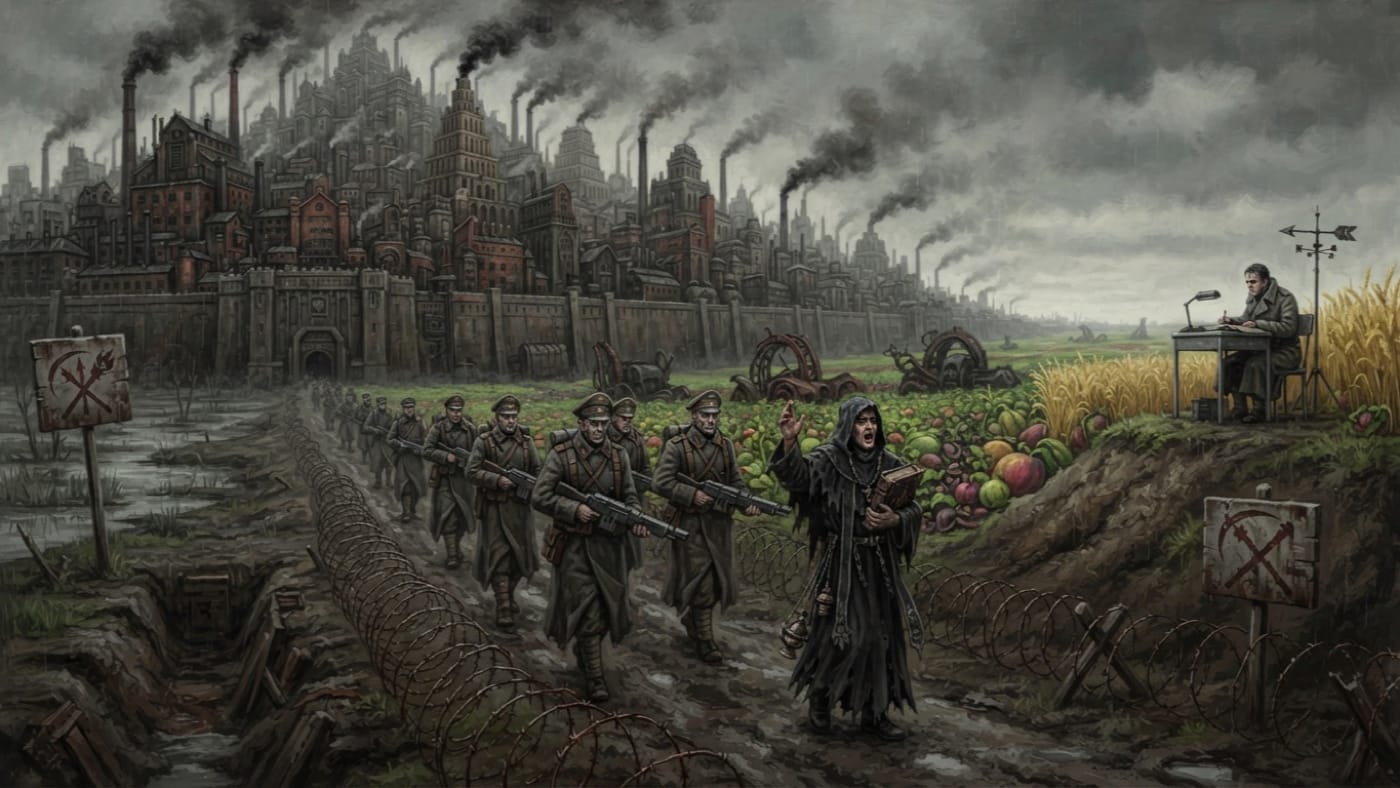
The cause is the Blightmarsh, Kargath's slow grey digestion of the former Hungarian lowlands, along with the Abundance Fields that erupt at its edges. These Fields produce grain where no one sowed it and fruit that ripens in frost. The produce is real. It can be cut, weighed, cooked and assayed, and it delivers measurable nourishment to a body that then begins to consume itself. Each mouthful deepens the hunger it appeared to answer, and the eater wastes away while eating. The Bureau of Medicine calls this "progressive caloric void." The term is accurate and comforts no one.
The Abundance Fields operate through "demonic illusion operating on the gustatory senses" (Bureau of Doctrine, Provisional Classification, A.S. 141).
Withdrawn. The produce is real and its calories are measurable. Doctrine could have answered an illusion with a chaplain. The real thing required an order.
The Fields are tended. The Harvest, Kargath's agricultural host, sow, prune and offer, and they do not fight. Corrupted Harvest Engines bring the same yield to any village hungry enough to salvage one. The Bureau of Relics maintains that properly blessed food cannot carry the curse. The field reports disagree with the Bureau of Relics, which has not yet noticed.
The Synod understands famine and has rationed against it for as long as its offices have kept grain books. The Fields reverse that arithmetic. They turn the empty belly into the vulnerable organ and the full table into the snare. Foraging, salvage and a sharp eye for an unguarded orchard are the old virtues of a campaigning soldier, and east of the ration line they have become offences against the Faith.
#On Standing Order 119-F
Two dead communities came before the order. Near Pécs, in A.S. 147, a patrol found a farming settlement with full cellars, risen bread in the ovens and its people wasted to the bone. A second was found near Kaposvár in A.S. 159. In A.S. 163 Eastern Command issued Standing Order 119-F. Its original text forbids Synod personnel to approach, harvest, sample or consume produce from unregistered agricultural sources within ten miles of the Blightmarsh boundary.
That is four verbs. The Eastern Section has spent thirty-eight years learning that soldiers will find a fifth.
The fourth revision, issued in A.S. 199, turned prohibition into drill. Any patrol that encounters cultivated land inside the zone must withdraw immediately. An accompanying chaplain must begin the Litany of Sufficiency upon visual confirmation, so the prayer begins as soon as the eye has seen the field. It does not wait for the stomach to be consulted.
The same revision carries an addendum: smell is now classified as contact. Personnel who report bread-smell at distances greater than two miles must be assessed by the Bureau of Medicine before they return to duty. Junior officers regularly mix up the two measures, so I set them down separately. The ten-mile zone governs where personnel may go and what they may touch. The two-mile threshold governs a report and the fitness of the man who made it. A soldier who smells bread at three miles has broken no order. He has become a medical question, and Medicine has a form for him.
#On the Disposition of Personnel
Violations are tried under Martial Code 14-D, Spiritual Contamination, Voluntary. The sentence is burning. The ashes are weighed, sealed in a Bureau reliquary canister and buried no less than nine feet down. The Bureau of War insists on the burning and the Bureau of Doctrine insists on the depth. I insist on the weighing, because the ashes of a man who has eaten from the Fields come out lighter than the charcoal can explain. I am not yet permitted to say what the missing weight was. I am permitted to record that it is missing.
The case in my own file is Corporal Haas Mettler of Kestrel-7. In A.S. 196 he ate three apples from a Field his patrol came upon during a routine boundary check. His commanding officer reported that he wept while he ate, first from pleasure and then from something the report does not name. Within the hour the Bureau of Medicine's field kit registered his hunger as "catastrophic." For the orchard I depend on the patrol's report. For the pyre I depend on my own eyes, because I attended the execution. He was still hungry when they lit it.
By the A.S. 201 assessment, Order 119-F had been violated forty-three times since issuance. Thirty-one violations ended in immediate execution. Nine ended in quarantine, and then in execution once the quarantined personnel developed the symptoms Medicine classifies as progressive caloric void. That makes forty executions. In the remaining three cases the violator walked into the Fields before anyone could apprehend him.
The Bureau of Records has formally asked whether disappearance constitutes desertion or death. The Bureau of War has formally declined to answer.
#On the Bureaus
Eastern Command issues the order. Several other offices carry out its consequences. War enforces it, posts the patrols and refuses to rotate them. Doctrine classifies the Fields' beauty as a Category One Moral Hazard and supplies the Litany that the chaplains recite on sight. Medicine examines noses, quarantines appetites and names the decline it cannot reverse. Records counts what it can and keeps three files it cannot close. The Bureau of Cartography maps Fields that move: its Seventh Eastern Survey of A.S. 192 was correct on the day it was finished and useless by the following Tuesday.
Then there is the Bureau of Agriculture. It was dissolved in A.S. 158 and survives as three clerks in a Strasbourg basement, who have now petitioned eleven times for reinstatement. Their argument is that an enemy who wages war through agriculture might best be opposed by people who understand agriculture. The Bureau of War considers the Fields a military matter and has refused all eleven petitions. The three experts on soil therefore have no standing in any proceeding about soil.
The order sits inside a wider discipline. Doctrine's Catechism of Restraint teaches that wanting more than one's share is commerce with the Great Deceiver. Fasting is prayer. The ration is holy, and the Ration Parliaments enforce it from the Channel to the Bosphorus. A soldier on the eastern line therefore patrols the ten-mile boundary on a holy ration. His prescribed fasts have weakened him, and the Litany asks him to call what he has enough. The commissary makes him hungry, and the Fields make that hunger fatal. The Command's order stands against an appetite that the Synod's own provisioning sharpens every week.
I judge the policy correct. I have tested it against every alternative the Bureau allows me to propose, and that list was short.
#On the Present Duty
Seventeen Fields had been confirmed by A.S. 201, and the Blightmarsh is spreading. The Bureau of Medicine now keeps a permanent olfactory assessment station: a clerk with a logbook who records wind direction, the strength of the smell and the number of personnel who request reassignment after their shift. Every request is denied. The Bureau of War holds that it cannot rotate a garrison every time the wind carries a promise.
The Command's patrols keep walking the boundary on short rations. When they see cultivated land, they turn back. The chaplains begin the Litany, and the soldiers report what they smell and wait for Medicine's verdict. Under the A.S. 199 terms, a man who reports nothing at two miles goes back on duty, and one who reports bread is sent to the assessor.