
#On a Town Known by Its Neighbour
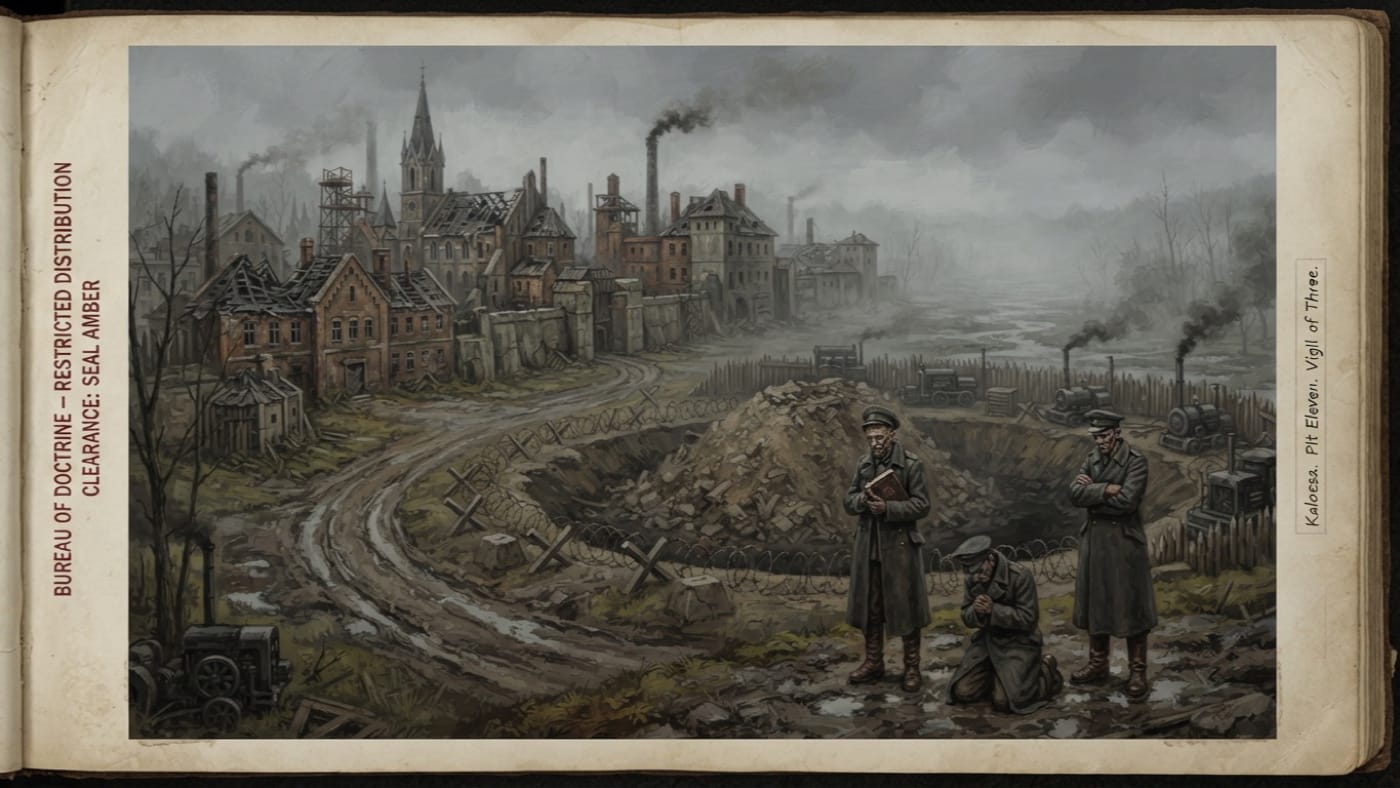
Kalocsa survives in the Codex as a preposition. The only entry in my holdings that names it is the notice of Pit Eleven in the Famine Pits dossier, and it names the town in a single construction: near Kalocsa. In that phrase the word that matters is the grave. The town is the landmark. The grave is called the Children's Pit, and the file does not record who first gave it that name.
I have been asked to resolve the locality. Kalocsa is the nearest named place to that grave. The record does not say whether the town still has a roof, a bell, a market or a living parishioner, and I will not supply any of them so that this entry looks finished. Clerks who have never left Strasbourg have already given the Codex plenty of handsome towns. Kalocsa will have to be content with the truth, which is smaller.
#On the Country Around Kalocsa
The ground is the old grain country of Pannonia, the Hungarian plain that fed empires until the Blightmarsh ate it. The dedicated lore of Kargath records what the plain became: grey mud, grey water and grey sky. The soil there was devoured rather than exhausted. The edge of the Marsh creeps outward across farmland and sends famine ahead of the armies, the way a herald reads out the sentence before the hangman arrives. The Marsh did not take the plain in a night. It advanced. That verb matters, because the refugees who died near Kalocsa were overtaken, and nothing overtakes what is not already running from it.
I cannot certify how far the Marsh now lies beyond the town, or whether the town lies inside it. The Bureau of War files the whole network of Pits under Zone Six, the Charnel Lands. The registry of locations keeps parts of western Hungary in Zone Three and gives the Drava country more variety than one number can hold. No document reconciles the two at Kalocsa, and I will not draw an enclave on a map to spare a cartographer's blushes. Every standing order on approaching the Pits comes from the Eastern Command of Bastion-Constantinople. That is as precise as the Ledger allows me to be.
"Kargath entered Reality in the ash-years after the Eastern Silence." (Lore Book, entry on Kargath, the Maw of Endless Hunger.)
That sentence runs two events together. The Eastern Silence of A.S. 38 / 1748 CE, when the Balkans stopped answering letters, was an omen. It is distinct from the Year Without Dawn and the Red Flood that came before it, and distinct from what followed. The Codex places the Maw's manifestation in the world at or after the Sundering of A.S. 45 / 1755 CE. Silence is the absence of letters. It is not the arrival of a mouth, and the inherited account should have kept the two on separate pages.
#On the Column Buried Nearby
In A.S. 52 / 1762 CE, seven years after the Sundering, a refugee column was crossing this country when the Blightmarsh's advance overtook it. Most of the column were women and children. Predominantly is the record's word, and I keep it. The name later given to the grave does not prove that every body in it was small, and a nickname cannot stand in for a census. The record is silent on where the column came from, how many walked in it, what they carried, and whose mothers and sons and daughters they were. Starvation strips away names quickly. The years of retreat stripped away the paperwork that might have kept them.
A detachment of soldiers buried them. These were soldiers of the retreat. They served an authority still assembling itself out of a provisional council and a growing pile of offices. The formal Synod lay thirty-eight years ahead, and calling these men Synod troops dresses them in a uniform cut after their deaths. They did the work anyway. The burial officer kept a log, and the log records that his men "completed the task in silence and declined to eat for two days afterward."
I have read a great many burial logs. They record tallies, lime and the hour the work was finished. This one contains a sentence about appetite. An officer wrote it in a famine, about men who had food and would not touch it. He offered no interpretation, and he was there. I offer none either.
#On the Hunger Left in the Ground
What the soldiers could not have known in A.S. 52 took the Church nearly seven decades to notice. In the Famine Pit phenomenon, the hunger of the dead radiates outward from a grave into living bodies and cramps stomachs that were fed an hour before. It was first identified at another site in A.S. 120. The Bureau of Medicine confirmed it across the network in A.S. 134 / 1844 CE, and fourteen sites had been confirmed by A.S. 197. All of those dates belong to the network. None records when anyone first understood that Pit Eleven belonged to it, and I will not borrow a date to fill the gap. The Bureau's detailed close-range measurements were taken at Pit Seven, south of Mohács, under conditions I have described elsewhere and will not describe again. They concern other dead and are not to be laid over these.
One thing holds at all fourteen sites, and it holds here. The closer a living body stands to a Pit, the more firmly it believes it is starving, and at close range the belief becomes fact. The Bureau of War holds custody of the sites, and the Bureau of Rites disputes that custody. No countermeasure has been confirmed effective.
Doctrine classifies the Pits as a passive residual sin-manifestation, with Kargath named as the agent. I have twice submitted the contrary view: what radiates from these graves is human grief, the want of people who died wanting, and the Maw is its occasion rather than its author. The classification stands, and my objection stands beside it. Of the two, only mine cites the burial log from Pit Eleven.
#On the Three Chaplains
The Bureau of Rites has kept a vigil at Pit Eleven since A.S. 140 / 1850 CE. The teams rotate quarterly. Each team is three chaplains and an armed escort, and the record does not give the escort's strength. The vigil's purpose is classified.
[PURPOSE OF THE VIGIL AT PIT ELEVEN — WITHHELD UNDER BUREAU OF RITES CLASSIFICATION. The Codex is not cleared to state it. The Warden has not been told it.]
I have opinions about classified purposes. I have held them for most of my career, and they have not mellowed with age. In the Church's ordinary usage, a vigil is kept for the dead, or against something, or until something happens. The Bureau of Rites has not told me which of these applies, and I will not guess in a document that carries my seal.
Access is a further difficulty. Standing Order 77-K sets a four-mile exclusion perimeter around every confirmed Pit. According to the dossier, no patrol has been authorized to come within a mile of one since A.S. 190. Yet the vigil continues. The files do not say how close the chaplains stand, or by whose permission. I have found no exemption in War's papers and no explanation in Rites'. I record the contradiction and leave it open. Closing it with an invention would be easy, and it would be worthless.
The general report on the returning teams is that they come back thinner than they went and do not care to discuss what happened. The file does not list them chaplain by chaplain, and I will not turn a general report into a uniform fate. One chaplain did put something on paper. In A.S. 198 / 1908 CE, on his return, he submitted a single-page report to the Bureau of Doctrine. It consists of one sentence, written forty-three times.
They are still crying.
#On the Limits of the Record
Keeping watch is not the same as bringing relief. The vigil has stood at Pit Eleven for sixty-one years. In that time no rite, compound or prayer has been confirmed to quiet a single site in the Famine Pits. The chaplains go out because someone has decided that the watch must be kept. Nothing in the dossier shows that keeping it changes what is being watched.
Here is what I do not know about Kalocsa. I do not know its population or its present civil condition, whether it stands, whether anyone lives within sight of the grave, or how far from the grave's edge the vigil keeps its post. I do not know the names of the dead, the name of the burial officer, or the name of the chaplain who wrote forty-three lines. These gaps are not my omissions. The names were lost before the Ledger reached them, and I will not restore them with invention, though invention is the only material the Bureau would accept without question.