
#On the Road in the Record
“Mind the ford before the saint.” (shed saying, provenance unrecorded)
Kalnik Road survives in the Ledger the way most retreat roads do, as the place where something went wrong. I have found no surveyor's chain run along it in any folio. Its endpoints, its length, the river it crossed and the name of the ford are all unrecorded. What remains is one column, one generator, one dusk in A.S. 48 (1758 by the old reckoning), and a crossing that the Litany-Engineers have read aloud to their apprentices ever since.
That is enough to file a place. The Bureau has filed cathedrals on less.
The road belongs to the westward flight that followed the Sundering of 1 November A.S. 45, which later clerks bundled, tied and labelled the Great Retreat, A.S. 48 to 65. Nothing that happened on it ended that retreat. The Line stood defensible, though unfinished, only around A.S. 65 to 68, and on the evening in question it was still seventeen years of ditches and argument away.
Visitors from the highlands will interrupt me here with the ridge. The Last Stand of Kalnik Ridge is a separate record. That spring engagement in the Croatian highlands has its own commander in Tomislav, its own relic in the Reliquary of Saint Isidore and its own depositions. Ridge and road share a name and a year, but no witness. No page puts Edrin in Tomislav's column, sets the ford beneath the ridge, or makes the chest at the ford into the ridge reliquary. The pilgrim approaches that now serve the ridge shrines carry no certificate declaring any of them Edrin's road.
#On the Column and the Ford
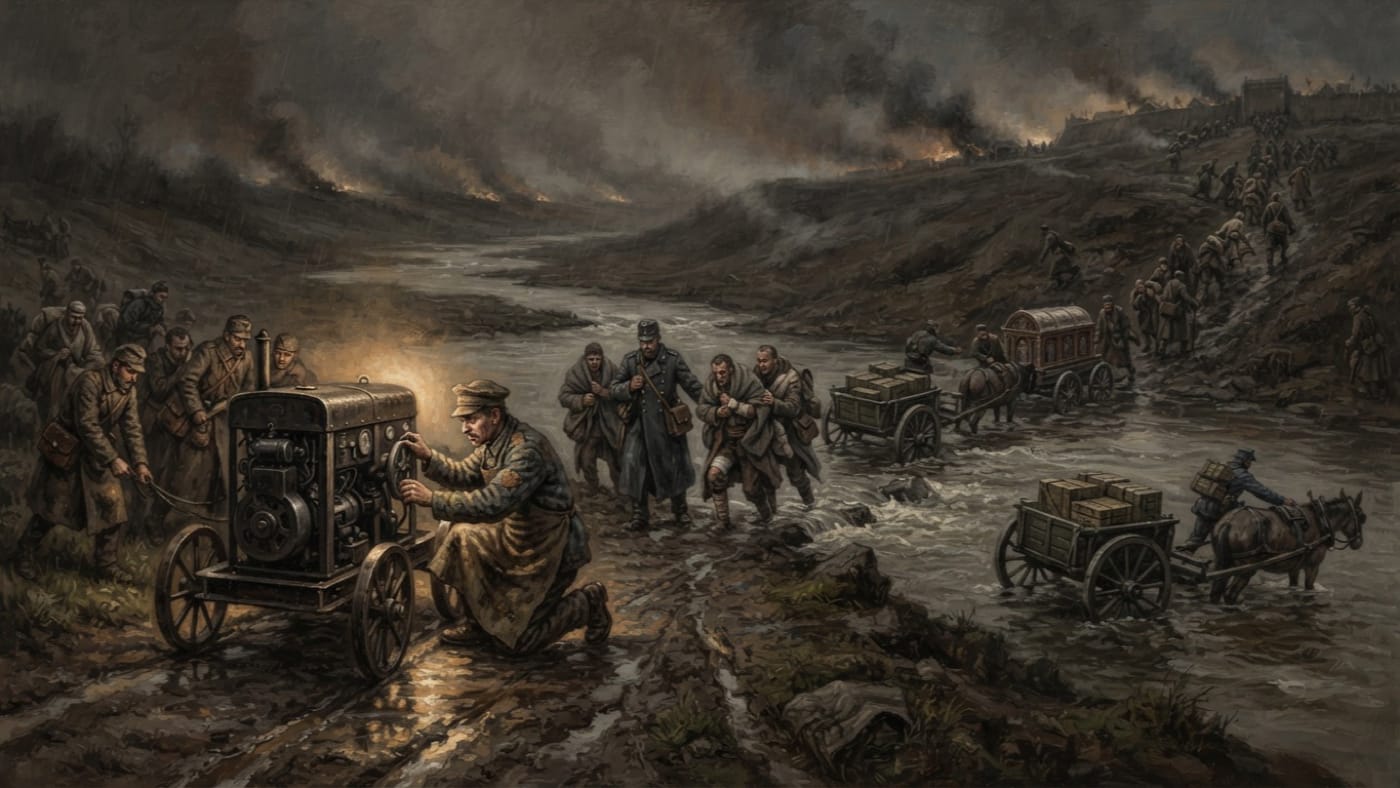
Whoever commanded the column left no name I can verify, and the column left no number. The account does list its load: field lamps, a mobile pump, two ammunition carts, a reliquary chest and sixty-three wounded.
One field generator fed the lamps and drove the pump. It pulled none of the carts, and whatever hauled them, beast or back, the record does not trouble to say. Its office was narrower and more cruel. It kept light on the water and kept the pump working, and the account makes both conditions of the crossing. A column that halts at a ford at dusk under fire is a column that is being counted by the enemy. With the generator running, the road could be crossed at night. Without it, the sixty-three would wait for morning on the near bank, and the account doubts many would have seen it.
Mark the cargo, because the cargo explains the danger. Wounded men cannot hurry. Ammunition carts sink when the light fails and the drivers misjudge the bottom. A reliquary chest, whose saint no surviving record names, must on no account reach the far bank wet, misplaced or in someone else's custody. Each of those loads wanted the ford for itself. All of them depended on one engine.
The rain, the smoke and the rifle fire are attested. The enemy's identity is not. The account reports enemy pressure close enough that the shots arrived before the orders did, and it says nothing more. I shall not add a demon to a page that declined to name one.
#On the Halt and the Passage
Near dusk the generator's flywheel seized and oil spat from the housing. The lamps began to fail.
The engine hand was a man called Edrin. Every title he now wears, saintly or professional, was added afterward by people who never met him. He listened before he touched anything. He found cracked insulation, fouled injectors, a bent timing pin and a harmonic flutter that no manual of the period could classify. The gauge had cracked, so he wiped the timing wheel with his sleeve and set the pin by thumb. He told the crew to answer only on the downward beat. Then he sang the Eight Strokes, and the engine caught.
The official Life adds that he touched the casing and heard the engine confess. A damaged deposition records a voice answering inside the casing on the seventh stroke, and a wrench striking the side before the eighth. I report both as testimony and certify neither. The sung sequence itself survives in narrative, manual and veteran recensions that disagree at the sixth and seventh beats, and no source says whether Edrin wrote it or learned it in some shed whose name is lost. The full incident is kept in the Kalnik Restart, and readers with the stomach for it may go there.
The road needs only the result. The generator ran through the night. The lamps held and the pump worked. The wounded crossed the ford, the ammunition carts did not sink, and the chest reached the next station. The account says the sixty-three crossed. It does not say how many saw the next winter, and neither will I.
At that station officials argued over custody of the chest. The Bureau of Doctrine, the Bureau of Engineering and their siblings have since claimed those men as predecessors. On the night itself they were men in wet collars, answering to no Bureau as yet constituted, and none of them thanked the engine hand.
He had burned his palms and forearm on the casing, and his throat had swollen from the singing. He died three days later. The road took its toll on the far bank.
Western devotional sheets report that Edrin died at the ford immediately after the eighth stroke, smiling into holy flame.
Corrected. He crossed with the column, and he died three days later of burns, fever and a closing throat. The sheets moved his death to the ford because the ford fits on a card.
#On the Engine Carried Away
The road kept nothing. Everything that mattered was put back on wheels and went west.
The generator carries the road's name only through a later registry, which labelled it KAL-ROAD AUXILIARY 6. As far as I can find, that tag on the machine is the nearest thing to an official document the road ever received. The machine went on to serve three retreat stations, two pump sheds and a field chapel. In A.S. 59 its belt housing cracked and it was decommissioned. Across its service no restart failure was recorded.
The casing was retained and the timing wheel was sealed as a relic, and both rest wherever the Bureaux have placed them. Neither stands beside the ford. Six churches claim the burned wrench, and none of them is on the road. The Eight Slate Fragments were never in the column's chest, and no page puts them at the crossing. Anyone who sells you a road relic is selling you a sanctified pebble.
#On the Road Kept in the Reading
For half a century the road lived in shed talk among men with oil in their cuffs. Then, in A.S. 97, an uncertified operator at Bastion-Brest restarted a harbour generator without the ignition litany. The Black Start Catastrophe burned half the port and killed forty-three men. Within a month Standing Order 14-E made certified cant compulsory, and the profession needed a precedent older than its own paperwork. The Kalnik Road supplied one, along with a dead man who could not object to the use made of him.
In this way the road entered doctrine without ever entering a survey. Doctrine used it to teach obedience and Engineering to teach procedure. The reading kept the ford as a place where light failed and wounded men waited, which serves a sermon very well and a cartographer not at all.
As of A.S. 201 the Kalnik Restart is read on the feast of Saint Edrin of the Eight Strokes. A senior hand strikes a cold casing eight times with a hammer, and the apprentices take eight breaths through their throat wraps. All of it happens in engine houses and training sheds. No procession goes to the ford, because nobody can say where the ford is, and the Bureau of Pilgrimage has so far resisted the temptation to choose one.
The Ledger holds no account of the road's present condition. It may be a highway, a cart track, a ditch or a field under rye. The crossing is documented, the engine went to the archive, and the man died after the ford. The road itself was never entered in the record.