
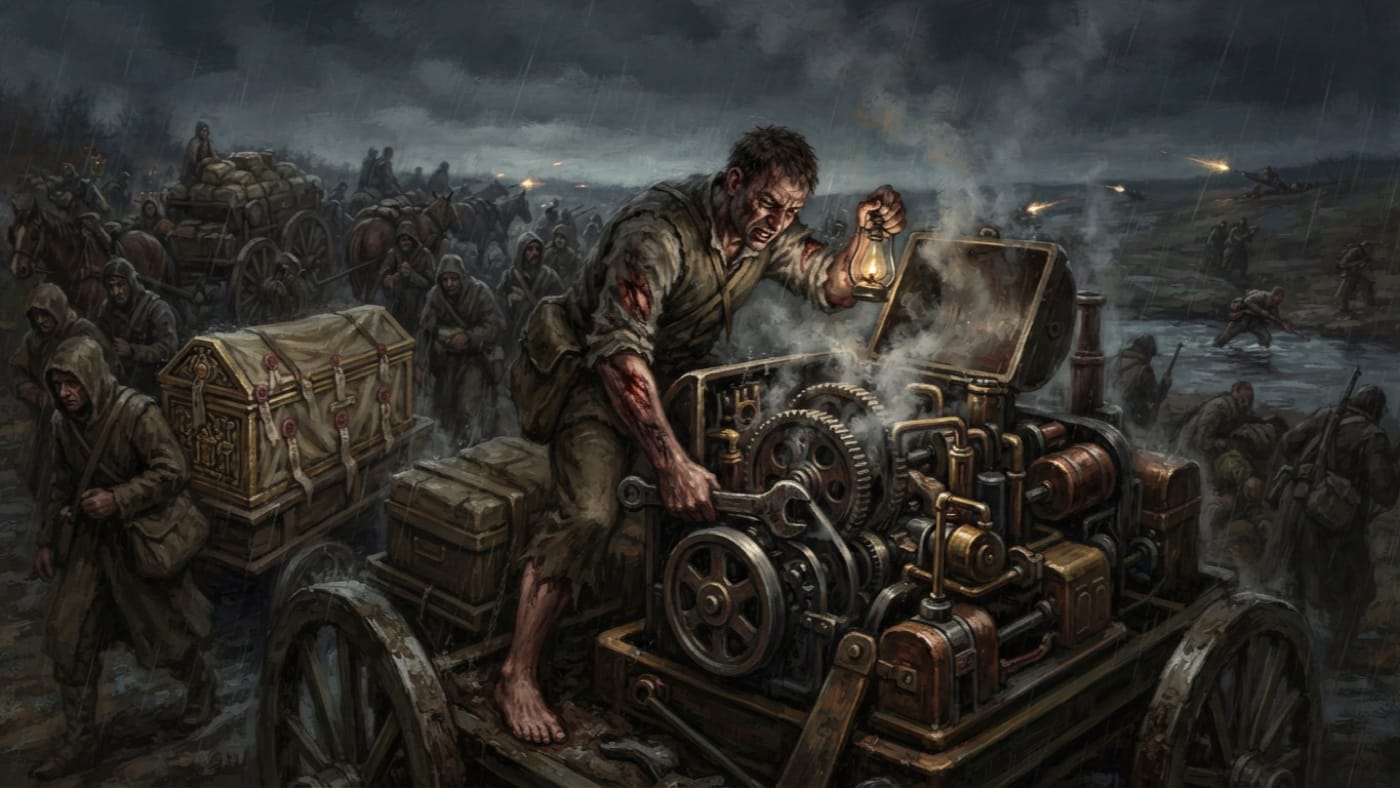
#On the Road at Dusk
“Quiet means hungry.” (engine-house idiom)
In A.S. 48, which the old reckoning calls 1758, three years after the Sundering had sent half of Europe west on foot, a retreat column was working along the Kalnik Road with one field generator and far too much hung from it. The generator fed the field lamps and drove the mobile pump. Behind it came two ammunition carts, a reliquary chest whose saint no surviving record names, and sixty-three wounded who could not cross a ford in the dark and expect to arrive at the far bank in the same number.
Later clerks drew the borders of the Great Retreat around this column, A.S. 48 to 65, as they drew them around everything else that limped west. No formal Synod commanded it, since that body was still forty-two years from its constitution, and the interim council had not yet sat. The officer at the head of the column has left no name I can verify, and I decline to supply one out of charity.
Near dusk, in rain and drifting smoke, with enemy pressure close enough that rifle sound arrived before the orders did, the flywheel seized. Oil spat from the housing. The machine stopped.
#On the Work and the Count
The engine hand was a man called Edrin. He held no orders and no certificate, and he answered to no Bureau, because none of those things yet existed in a form he could have held. Clerks who never met him have spelled his surname several ways. His age, his village and the names of the men beside him are lost.
He listened before he touched anything. Every Litany-Engineer apprentice is now drilled in this until they are sick of it, and Edrin did it because nobody had written it down yet. He found cracked insulation, fouled injectors, a bent timing pin, and a harmonic flutter that no manual of the period could classify. No later manual has classified it with any confidence either. The gauge had cracked. He wiped the timing wheel with his sleeve and set the pin by thumb.
Then he gave the crew their instruction: answer on the downward beat, and only there. Some of that crew were bleeding, and one was holding a lamp in his teeth. When one of them sang the wrong interval, Edrin corrected him sharply, which tells you everything about where his patience lay.
The received Kalnik sequence runs in eight beats. The first was sung to wake fuel, the second to seat air, the third to bind spark and the fourth to shame metal. The fifth steadied heat. The sixth closed the wrong interval. The seventh denied whatever had begun answering inside the casing. The eighth commanded rotation.
The engine caught.
I insist on the order of operations because the devotional cards ignore it. On the cards Edrin lifts his face, sings, and the engine obeys out of good manners. In the account the singing comes after the ear, the sleeve and the thumb, from a man with his arms inside a hot casing. Whether he composed the Strokes on that road or brought them from some shed whose name is gone, no surviving page says.
#On the Answer in the Casing
This much is plain: the engine had stopped, and after the eighth stroke it ran.
The official Life adds that Edrin touched the casing and heard the engine confess. Copies held by the Bureau of Engineering omit the confession. Operators repeat it anyway, which tells us a great deal about operators and nothing about engines.
The harder witness comes from a deposition whose author's name has rotted off the page.
DEPOSITION FRAGMENT — RETREAT ENGINE-HAND, NAME DAMAGED “On the seventh stroke the casing answered back in Brother Edrin’s voice before Brother Edrin sang. He struck the side with the wrench and said █████████████████████. The eighth stroke came after. The answer stopped.” Filed under: foreign harmonic, pre-registry.
People with more curiosity than clearance have asked me what Edrin said. I do not know. The deponent knew, and so did the page, until someone with a heavier pen than mine decided the knowledge should stop there. The Bureau of Doctrine reads the passage as the seventh stroke defeating a foreign harmonic. Engineering reads it as a reason to keep a wrench within reach during restarts. I certify neither reading. The deposition puts a voice in the casing that arrived before the singer, and the singer answered it with iron first and words second. Beyond that, the file is closed.
#On the Crossing and the Eleven Years
The generator ran through the night. The lamps held and the pumps worked. The wounded crossed the ford, the ammunition carts did not sink, and the reliquary chest reached the next station. The account says the wounded crossed. It does not say how many of the sixty-three saw the next winter, and I will not round the figure up to please the cult.
At that station three officials argued over who should have custody of the chest. I call them officials because the later Bureaus of Doctrine, Engineering and War each claim one of them as an ancestor. On the night they were men with opinions and rain down their collars. None of them thanked the man with burned hands.
The casing had spat superheated oil up his forearm. His palms were red, his knuckles split. Fever followed, then a throat swollen from the Eight Strokes, which closed a little more with every breath. He refused laudanum until the generator had been inspected. He asked whether the lamps had held, whether the wounded had crossed and whether the engine was still turning. All three answers were yes. He died three days later.
Western devotional sheets in circulation report that Saint Edrin died immediately after the eighth stroke, smiling into holy flame.
Corrected. He died three days later, of burns, fever and a throat that would not stay open. The sheets preferred a death that fitted on one side of the card.
The engine served for eleven years. A later registry labelled it KAL-ROAD AUXILIARY 6, because the Bureau cannot touch a mystery without tying a tag to its ankle. It served three retreat stations, two pump sheds and a field chapel. In A.S. 59 its belt housing cracked and it was decommissioned. No restart failure was recorded.
Eleven years of service means eleven years on the books. It does not mean eleven years without stopping. There were fuel shortages, shutdowns and maintenance in that time, and the ledgers record them poorly. Parish preachers say it never stopped once, and no parish preacher has ever had to refuel anything. Two pages are missing from the maintenance folio. The clerk who wrote the replacement page has a hand that visibly trembles on the word "acceptable." I report the tremble and add nothing to it.
The casing was kept, and the timing wheel was sealed as a relic. Doctrine honoured the man because it values sacrifice. Engineering honoured the engine by refusing to melt it down for parts, and I consider that the more sincere of the two.
#On the Precedent Made Compulsory
For half a century Kalnik was a shed story, told by men with oil in their cuffs. In A.S. 97 an uncertified operator at Bastion-Brest restarted a harbour generator without the ignition litany. This was the Black Start Catastrophe. Half the port burned and forty-three men died. Standing Order 14-E followed within the month and made cant certification mandatory. A precedent was needed in a hurry, and the Kalnik Road supplied one.
The phrase "not applicable" cost the Engineering clerks two drafts and a quarrel with Doctrine, which wanted the dead man listed as "certified in spirit." No form has a box for spirit, and Engineering won that point by the one argument Doctrine cannot answer, which is a shortage of paper.
Each office took its own lesson from the precedent. Doctrine saw obedience, Engineering saw a procedure that could be repeated, and War saw a saint with a wrench who might make frightened mechanics accept discipline. All three were satisfied, so none of them looked closely at the text. Had they looked, they would have found that the authorized manual does not match the Kalnik account. The manual gives intake, compression, spark, correction, flame seat, harmonic denial, witness and rotation. At Kalnik the sixth beat closes the wrong interval and the seventh denies the thing in the casing. The manual moves the denial to the sixth beat and gives the seventh to witness. The veterans' version, taught in the sheds after the inspector has gone, has a sixth that spits out the wrong note and a seventh that says hear me. No surviving source explains how one version became another, and I will not invent a copyist to carry the blame.
The Quiet Engine Heresy of A.S. 147 sharpened the quarrel. Its sect ran engines by calibration alone, and the engines ran, which nobody forgave. The next year the feast readings were revised to stress that calculation without sung obedience lets in pride, error and unfiled sound. The revisers had a difficulty they never solved. The Kalnik account records the sleeve and the thumb as carefully as it records the singing, and no sermon has yet managed to take the thumb out.
#On the Reading Kept in the Sheds
As of A.S. 201 the Kalnik Restart is read on the feast of Saint Edrin of the Eight Strokes in licensed training sheds and most generator vaults. The senior hand strikes a cold casing eight times with a hammer. The apprentices take eight breaths through their throat wraps. The reading is given in a voice low enough for the machines to listen without growing vain.
It is a commemoration, and it is no restart procedure. Every year some green throat confuses the two, sings the reading over a live engine, and learns the difference from the shift marshal or from the engine, whichever gets to them first.
The column crossed the ford because one man did the work and the singing together, and the eleven-year ledger is the only verdict Engineering requires.
Move.