
#On the Proscribed Frequency
The jawbone held in the Vault of Silences beneath the Basilica of the Ledgered Saints in Strasbourg produces a sustained hum. It holds one pitch without breath, phrase or rest, which is more discipline than most cathedral choirs manage through a single Credo. The Bureau of Engineering measured it at 217 hertz. The Bureau of Orison and Song consulted its harmonic tables and found no sanctioned tone at that measure. The Register of Sounds, third of the Five Registers of the Index Damnatus, had already listed the frequency as proscribed since A.S. 114, or 1824 CE.
There are two facts here, and they live in separate rooms. The number belongs to Engineering. It is a property of the hum, entered on sheets and confirmed by instruments that had the misfortune to listen. The prohibition belongs to the Church. It is a licensing judgment, held under Purity seal and certified through the Bureau of Doctrine, and the Register does not state its reasons. Engineering has offered no explanation for the hum. Doctrine has offered none for the ban. Between them they have produced eleven pounds of paper.
#On the Bone and Its Custody
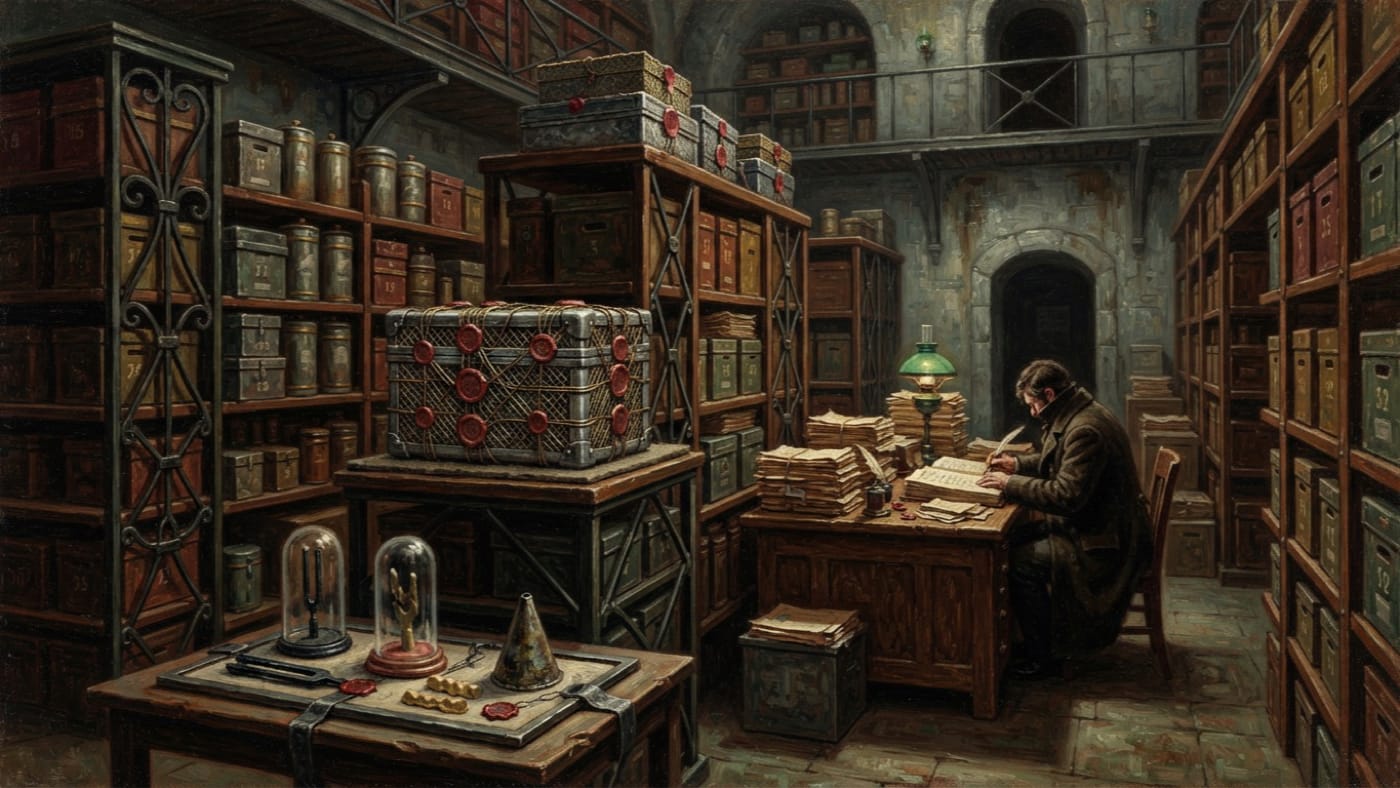
The bone itself sits in the third silence, among the Confiscated Relics of Uncertain Provenance, in a silver-dark box lined with felt and lead and with a prayer written so small that its copyist went half-blind before the amen. Purity is its primary custodian. The Bureau of Relics may petition for it, visit it under escort and dream of it at night, but it may not certify it. Relic authority is suspended pending authentication.
Its sound is filed elsewhere. The second silence, home of the Physical Anomalies Collection, keeps the measurement sheets, the harmonic wax impressions, the lead listening cone and the cracked tuning fork that first verified the pitch. Records calls this a contradiction. Purity calls it compartmentalisation. There is one jawbone. The Bureau has given it two cells, with the evidence in one and the specimen in the other, so that neither can testify for the other without a writ.
The question of ownership is still open. Three saints have been proposed. So have two heretics, and one unnamed martyr associated with the First Relic Auctions of Amsterdam. The Amsterdam suggestion describes a road the bone might have travelled. Nobody has recovered the lot number, the bill of sale or the hand that bid. Then a junior Authenticator proposed that the jaw came from no human mouth at all, and the meeting adjourned faster than any meeting I have attended, including one held during a fire. Every suggestion remains a proposal. The Ledger records proposals. It does not kneel to them.
Strasbourg is crowded with jaws. Saint Luthar's auctioned jaw, the Toledo relic of Saint Iago, the jaw attributed and then re-attributed in the della Torre matter, and the sounding remains of Saint Armand have all been pressed on this file by clerks who mistake shared anatomy for kinship. None of them has been shown to be this bone.
#On the Earlier Entry
The prohibition came first. The Register's seal of A.S. 114 is older than every documented stage of this bone's measured life: the reading, the regularised custody, the box, the cone and the wax. No file I may quote records when the bone was recovered. No file records when it first hummed. Its accession date is unspecified. A.S. 114 marks none of these. It does not mark the founding of the Register either. It marks a ban, and this file is indexed to that year because it is the only year the Register will swear to. I will not put my seal on a year the Register has not sworn to.
The entry carries three collateral notices, sealed above ordinary consultation. A chapel in Lombardy reports a funeral drone that kept sounding after its singers had stopped. A barracks near Vienna reports sleeping soldiers who answered roll call in the voices of the previous regiment. A bell laboratory submitted a report made up of numbers, whose final line is in a hand that no living auditor claims as his own. These notices accompany the entry, and their dates are not given. They establish no origin for the bone, no cause for the ban and no common mechanism among the three incidents, however eagerly a junior reader strings them into a story on the walk home.
Under observed human effects the Register lists molar pressure, involuntary memory and phrase completion. The last is the one I dislike most. A man hears a phrase left unfinished and his mouth finishes it. The Register records that this happens and offers no comment on the ending.
#On Examination and Its Consequences
The material record is short and unpleasant. At the A.S. 188 (1898 CE) audit, the harmonic wax in the second silence softened in a cold room and the lead listening cone was found warm. Engineering recorded both observations and declined to connect them, which is the most intelligent thing Engineering has done this century.
THIRD SILENCE — A.S. 194 LISTENING INCIDENT Subject: Assistant Examiner Heldt Conduct: unauthorised comparison; ear brought within three inches of the box Dental result: four molars cracked lengthwise Recorded statement: "It is not inside the bone. The bone is inside it." Disposition: reassigned to written prayer; no oral duties Comparison results: ████████████
Heldt's sentence is testimony. It was spoken by a man with four split molars, in the year 1904 CE, and it should be weighed accordingly. Doctrine has certified nothing about what is inside what.
The second silence's audit for the same year records an assistant clerk who counted his own teeth before and after exposure, found the number unchanged and asked to be praised. He received a biscuit. The file does not name him as Heldt, and I will not marry two clerks for the convenience of a narrative.
Ink offers a second route of exposure. In A.S. 187, Inquisitor Breel was in her twelfth hour at the east bench of the Index Damnatus Chamber when she copied twenty-seven bars of proscribed notation into her duty log. She has no memory of consenting to it. The log was burned and the ash was weighed. Administrative Order 44-B, ratified in A.S. 188, cut watches to eight hours and restricted repeated east-facing assignments. The bench was left where it was. A clerk's account in her dossier holds that one surviving fragment matched a tone first listed in A.S. 114. That remains one clerk's account. It does not make the jawbone the author of Breel's twenty-seven bars, and no file open to me confirms what became of her.
#On Authentication and Prohibited Comparison
Relics wishes to test the bone again. Every test of provenance it knows requires comparison: this hum against the remains of known saints, this jaw against other jaws, this pitch against the tables of every chapel that ever lost a relic to a thief. Orison refuses to allow the tone to be reproduced on any instrument. Purity refuses to allow the bone out of its box. The result is an authentication procedure whose first step is forbidden and whose second step is forbidden more firmly.
Bells has asked whether its tuning forks fall under the prohibition. They do. Bells has asked whether the cracked fork is still Bells property. It is not. Existing acoustic samples remain under double seal in the second silence. They may be inventoried, and they may not be played. Records requested a third seal to protect the double seal and was told that the request amounted to comparison between seals.
A circulated training handbill advised junior clerks that uncertain relics should be treated as fraudulent until proven authentic.
Withdrawn under the Third Silence file, and entered here again for clerks who read one file and believe they have read the Vault. Uncertain relics are to be treated as dangerous until they become obedient. Fraud seldom cracks molars.
Doctrine has issued no final ruling. A final ruling would require a finding. A finding would require comparison, and comparison is prohibited by the same Register that Doctrine certifies. This arrangement is not an accident. I drafted part of it.
#On the Present Holding
As of A.S. 201, or 1911 CE, the bone remains in the third silence under Purity custody, in its box of felt, lead and very small prayer. Authentication is deferred. Destruction is forbidden, and so is veneration. No one may reproduce the tone, and no one may set it against any other sound in Creation. The second silence keeps the wax, the cone, the fork and the sheets under the same restriction, sealed twice and played never.
The hum is getting louder. The measurements exist and none has been published. I asked to see them and was shown the cover sheet, which was blank apart from a filing number and a smear of wax.
Purity calls this containment. Engineering calls it a reading. Doctrine calls it outside the scope of present certification and goes to lunch.
Do not hum to check.