
#On the Division of the Forbidden
The Index Damnatus is one work. A clerk who speaks of "the five books" in my hearing is corrected once by voice and the second time in writing. The Index is a rolling compendium, amended without end and chained as a single master, and the Bureau of Purity divides it into five Registers: Texts, Names, Sounds, Forms, Lineages. Each division answers to its own Purity quorum, carries its own wax, and needs its own kind of ratification before a line may be added. An amendment to Sounds and an amendment to Texts may therefore be sealed in the same hour by men who have never shared a meal and would refuse the salt if it were offered.
The Index took its working shape around A.S. 80 / 1790 CE under Procurator Maxentius della Torre. He inherited prohibition packets, disciplinary offices and a great many bonfires, and he found the lot insufficiently counted. The record does not say whether all five divisions rose at once or accreted as Purity found new ways for knowledge to misbehave. I have looked. The record looked back.
The Codex entry on the Index Damnatus stated that the Index predates Cardinal Kratz's reforms by at least two decades.
Withdrawn. The Night of Black Decrees falls in A.S. 58. The Index's development under della Torre belongs around A.S. 80, two decades afterward. The clerk did the arithmetic in the wrong direction and has been reassigned to counting things that cannot move. Earlier offices of prohibition existed. The Index was not among them.
#On Texts
The Register of Texts is the largest of the five. Its count is classified, which tells you the count is embarrassing in one direction or the other. It holds forbidden books, treatises, pamphlets, broadsheets, almanacs and any document that contradicts ratified Doctrine as the Bureau of Doctrine defines it.
Each entry records title, author, content, known copies, known readers, known possessors, and the sentence for each degree of contact. Note the order. The book comes first and is dealt with fastest. A Rationalist treatise burns in an afternoon. Its copied pamphlets take much longer, along with the reader in the attic, the lender, the binder, and the boy who carried it wrapped in fish paper. They take the rest of the entry and the rest of the year. Della Torre's founding grievance was that heretics died while their works went on being read. He did not abolish the problem. He gave it columns.
Ash can be weighed. A man who has read a forbidden almanac carries it out of the fire in the one binding Purity cannot seize without a scaffold.
#On Names
The Register of Names stands second. It lists condemned persons, their aliases and their erased identities, and records the damnatio memoriae that strikes a person from every ledger that might answer to them. An entry gives recognition cues, permitted circumlocutions, prohibited diminutives, seal status, lineage flags, seizure instructions, sacramental invalidations, known associates, and the penalty for continued usage once notice has arrived. To speak the condemned form without authorisation is utterance without license.
Anyone who calls it a death roll has misread it. Its business is the living man who still has a body, a coat and an appetite, and no longer has a name to buy bread with, pass a gate, register a child or claim consecrated ground. The ration clerk finds nothing. The ferryman finds a likeness cue. The orphanage finds a flag.
Speed makes the erasure real. Index Damnatus Runners carry daily amendment strips to gatehouses, orphanages, ferries and parish registries, with receipts in triplicate. A name condemned in Strasbourg at Matins and still unknown at a river crossing by Vespers is a name at liberty. Late is the same as false. The Runners have the calves to prove it.
#On Sounds
The Register of Sounds stands third, and Purity's own people fear sitting near it. It covers proscribed hymns, melodies, bell-tones, vocal cadences, breath patterns, rhythmic intervals, and any written notation able to carry them. Purity keeps it. The Bureau of Orison and Song feeds it by the cartload, the Bureau of Bells adds what bronze ought not to say, and White-Mantled Inquisitors bring in whatever they overhear in laundries and barracks.
A song may be condemned for its organisation alone. The psalm can be approved and the singer devout, and the gap before the fourth beat can still be enough to hang a choir.
The 217 hertz tone has been proscribed since A.S. 114 / 1824 CE. That is the earliest seal cited on the matter. It dates the prohibition, and the Register's own beginning goes unrecorded. Engineering has since measured the same frequency from a humming jawbone of unidentified provenance among the relics of the Vault of Silences. Engineering supplies the number. Nobody supplies the reason.
Notation is the trap. In A.S. 187 / 1897 CE Inquisitor Breel sat on the east bench during a Sounds exposure and transcribed proscribed bars into her duty log, with no memory of consenting to it. The log was burned. Administrative Order 44-B of A.S. 188 cut attendance from twelve hours to eight and restricted east-bench exposure. Her final disposition has not been confirmed to this office.
#On Forms
The Register of Forms catalogues forbidden geometries, architectural plans, artistic compositions and symbols. It can prosecute without a single forbidden sentence. A man may keep his mouth shut, read nothing, sing only under licence, and still be condemned for the curve he gave a lintel.
Bruges supplies the cleanest specimen. Its grotesques were entered for symmetry heresy. Their faces were contrite on the left and hungry on the right, their pupils were drilled to follow officials across a square, and one gargoyle's tongue lined up with a Tithes warehouse at Vespers. Purity answered with calipers. Three generations of stonemasons went into exile, and the city lost the skill without the inconvenience of martyrs.
Toledo gave the Register an arch angle that, when calculated, produced a number Purity judged provocative. This Codex does not print the number. I will not print the designer or the year either, because the Register keeps them and I am not the Register.
Inspectors scrape emblems from doorposts under many warrants. Only some of that scraping belongs to this division. The Register of Forms is where the shape itself is condemned and given a page.
#On Lineages
The Register of Lineages records condemned bloodlines and heretical genealogies. The Bureau of Records supplies the genealogical data. Purity maintains the entries and keeps the ink. Families are catalogued forward through children and grandchildren to descendants not yet born, who are entered as anticipated persons with their flags already attached.
Doctrine calls this foresight. I call it paperwork with a long reach. The Register predicts nothing. It carries condemnation forward through the baptismal roll and the marriage register, and it waits for the calendar to supply the bodies. A grandchild's flag says nothing about her blood, which no Bureau has ever assayed. It says a great deal about a filing cabinet that never forgets a surname and has no notion of pardon.
Provincial copies of the Index leave this Register out entirely. Its consequences travel anyway. Lineage flags ride inside Names amendments, so an orphanage clerk in a bastion town may turn a child away on the strength of a Register he will never see.
#On Custody
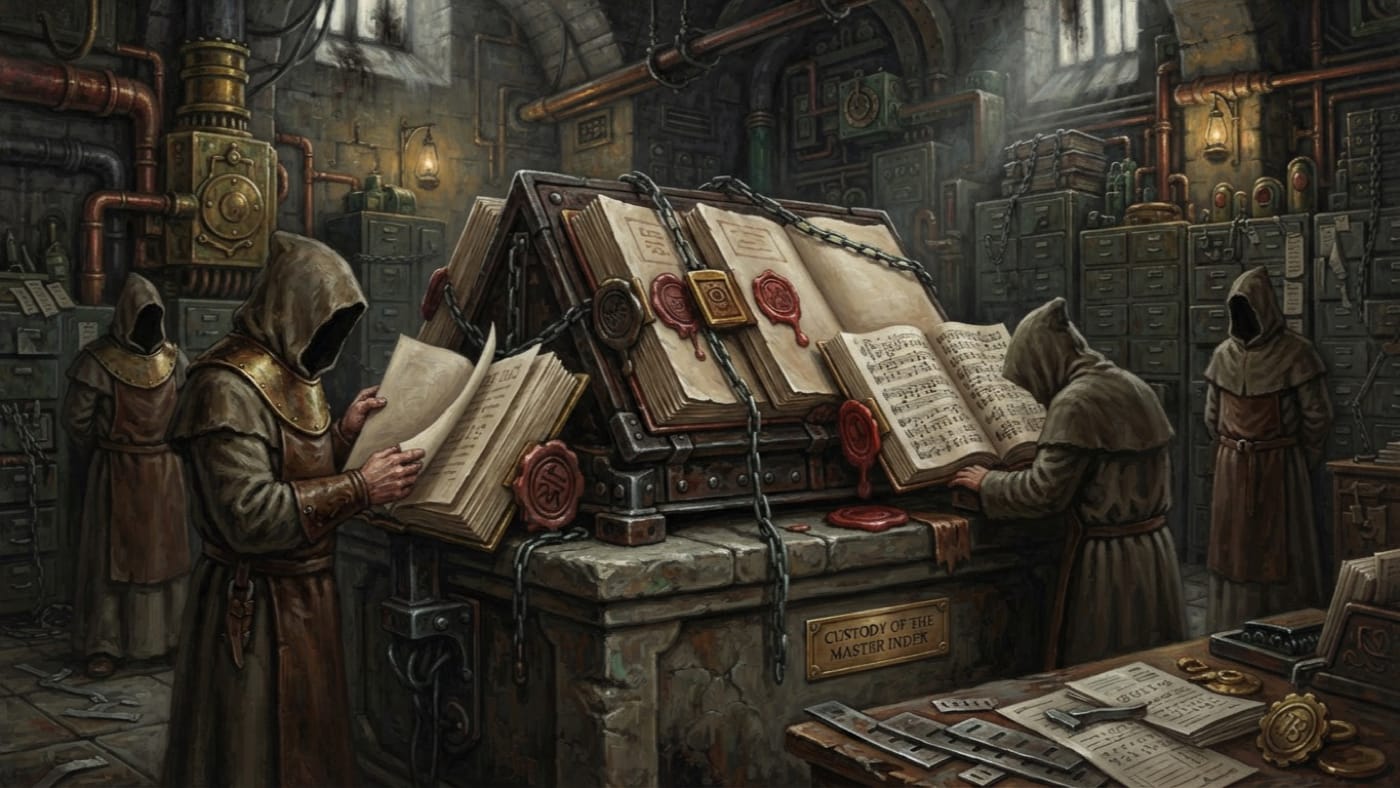
The master Index rests in the Index Damnatus Chamber, the principal room of the Vault, beneath the north transept of the Basilica of the Ledgered Saints. Purity owns it. Doctrine supplies definitions and advice, and Records supplies documents and descent. Contributing confers no custody. Records has contested this in more memoranda than its own clerks can file, and lost every time.
The Index is chained to an iron lectern, the lectern is bolted to a stone plinth, and the book lies open. Three Inquisitors attend it from the south, east and west benches. At Matins the senior watcher turns a leaf under the Prayer of Unseeing while the other two avert their faces. Purity's stated reason is doctrinal potency: forbidden matter must be aired in rotation, or it festers under closure. I report the doctrine. I do not test it.
The watchers have no ordinary permission to read what they guard. Names faces the south bench every fifth rotation day and Sounds faces the east bench every eighth. Anyone who builds the whole rotation table out of those two figures will be corrected by someone less patient than I am. Shifts run eight hours. Anyone else who wishes to read needs written authorisation under seal, a cleansing rite, and a supervisor watching their lips.
#On Provincial Knowledge
The Index moves at three speeds. The master in Strasbourg is amended continuously, by writ. Daily runner strips carry the urgent matter, chiefly names; they are valid from Matins to Iron Vespers and void by morning. Abridged quarterly copies go out to the major bastions and cathedral cities, redacted, sealed, and stale on arrival.
The provincial copy leaves out Lineages and gives Sounds only in excerpt, because a complete catalogue of forbidden melodies would be a hymnal for the damned. Street-corner notices and inspectors' extracts give the public no access to the master. The faithful must obey a list they may not see in full, and ignorance of it is still no defence.
Here the machinery bites its own hand. To enforce a ban, an officer must know the forbidden thing, so every copy that teaches him what to seize also teaches him the thing he seizes. Purity mutilates the extracts to limit the damage. The provincial inquisitor, armed with half an interval and a third of a name, has to guess. Guessing is productive. It fills cells.
#On the Present Application
In A.S. 201 all five Registers stand open under Purity seal. The master grows each week. The Runners run. Orison submits faster than Purity can classify. The east bench keeps its restrictions and its occupant. In some river town tonight a clerk will read a fresh strip, strike out a woman he once danced with, and stamp the receipt.
The Index works. Its accusers and its defenders say the same thing, and only the defenders hold the seal.