
#On a Peninsula Without a Seal
"Three seals in one wax. A fourth space left blank, and the blank invoiced."
Italy, as the Codex reckons it in A.S. 201, is a cluster of territories under Synodal administration in the safe west of the Sagittal Line: Ligurian quays, Adriatic lagoons, the canals and orchards of the Po, the workshops of Tuscany, and the supervised stones of Rome. Each city keeps its own saints and its own grievances. Each holds its own opinion of Strasbourg and voices it in the approved form, at the approved volume. The registers record no Italian crown, no national capital, and no accession roll bearing a peninsula-wide date. I have looked. I decline to forge one for the comfort of cartographers.
The northern provinces sit in Zone 2 among the industrious heartlands. Several of the great ports serve the southern maritime system, where Zone 2 shades into Zone 7 and salt becomes a branch of logistics. All of it is governed. None of it signed.
That is the whole Italian problem. The Synod's founding instrument carries three seals. The peninsula that now builds the Synod's ships, keeps its archives and lends it money for its wars is absent from the wax.
#On the Absent Signatory
The Concordat of Strasbourg was signed in A.S. 90 and proclaimed in A.S. 91. It bound France, Iberia and the Rhineland into the Triune Hearth, and the Church government that had grown up after the Sundering of A.S. 45 became the formal Synod, seated at Strasbourg. The Common Allegiance of A.S. 55 had already gathered oaths. The Concordat gave those oaths a constitution and a capital. Both founders were dead by then. Neither left an opinion on Italy that the archive can certify, and I will not ventriloquize corpses for a regional survey.
Italy balked. The published account says so plainly. The peninsula was split between papalist nostalgists, who held to the memory of an older ecclesiastical order, and Synodal reformers, who preferred the new order and its contracts. These were loyalties that ran through chapter houses, guild halls and families. The Codex has no map of two rival Italian governments. Any reader who has seen one has seen either a forgery or a tavern placemat.
Doctrine settled the difficulty with a phrase. Italy was declared "in a state of anticipated compliance," which turned an absence into a schedule. The peninsula had not refused; it was merely late, as a debtor is late, or a penitent, or a corpse awaiting its burial permit.
The Concordat's own article later records that Italy "came to heel." It names no day, and neither will I. Present geography is evidence of the administration. It is no evidence of a ceremony of submission, and incorporation added no fourth brazier to the Hearth. The Hearth remains three. Italy remains outside the founding seal and inside the tax rolls, which is where the Synod prefers most things.
#On the Old Chair
Rome is the inconvenience. It was once the seat of the ecclesiastical precedence the Synod now exercises, and the Synod has never decided whether to venerate the city or keep it under observation. It does both.
The old papal apparatus was stripped during the Atheist Wars, when Rationalist administrators found the treasuries more interesting than the theology. Its political precedence was superseded twice, first by the Allegiance and then by the Concordat. What remains is the Old Chair: Italian patrimony and a restricted site of ecclesiastical memory. Observers from Doctrine, Records, Purity, Relics, Tithes, Passage and Pilgrimage regulate its catacombs, its roads, its gates, and its brisk trade in relics of varying sincerity. Seven Bureaus attend one chair. It has never been so well served.
Papalist nostalgia persists there, as it persists in Lombardy and in certain sacristies whose clergy grow misty during the older responses. Some of it attaches to the figure called the True Successor of Rome. The Codex does not identify that figure, and says nothing of what it is or was beyond the claim made in its name. Strasbourg is the capital. Rome is a memory with a guard rota.
#On the Useful Peninsula
A government may forgive the absence of a seal. It cannot forgive the absence of ships.
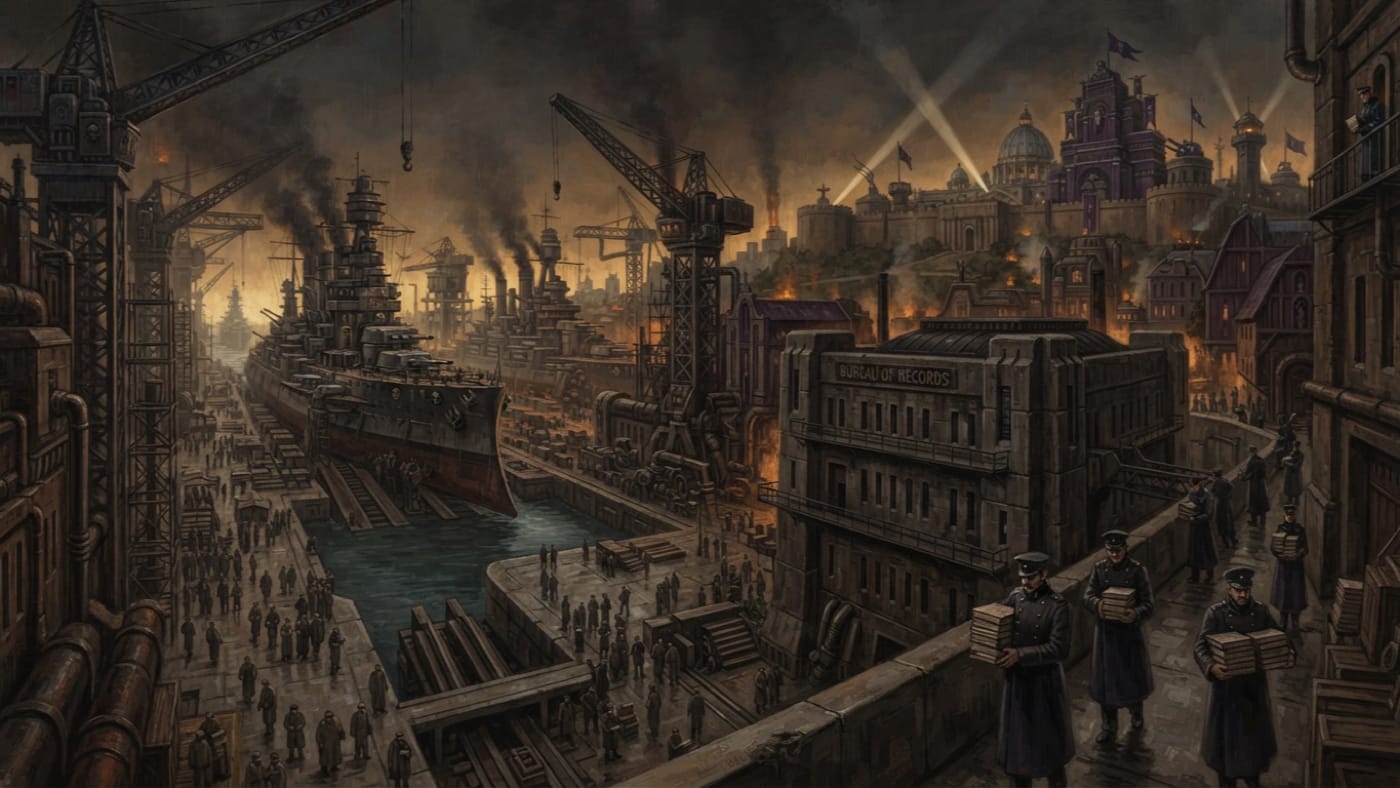
Genoa holds the Bureau of War's primary naval contracts. Its banking houses finance military operations with the cheerful severity of men who expect to be repaid in this life. The Ligurian port was independent-minded for most of its history and is now grudgingly compliant. In Genoa that means the bankers kneel promptly and charge interest for the duration of the kneeling. Its rivalry with Marseille is fought over shipping contracts and commercial weight, and the two cities petition Strasbourg against each other so faithfully that War could panel a chapel with the correspondence.
Venice commands the sea lane between Italy and Dalmatia, and through it the southern Line takes powder, grain, pilgrims and bandage linen. The Bureau of Records keeps extensive vault archives in the lagoon, wax and vellum stacked behind wet stone, where clerks fight the damp with braziers and the Bureau fights it with forms. No Bureau has wholly absorbed the city's geography, because canals do not take instruction. A clerk sent to inspect a vault may arrive by boat, by bridge, or not at all, and the canals keep no register of which. Venice serves the Synod daily. It obeys the way water obeys a jar.
Lombardy supplies grain, silk, orchard fruit, canal traffic and roads. Milan, its larger mouth, deals in silk, finance, grain-credit and steel. It also supplies clerical hands, the commodity Strasbourg consumes fastest.
#On Refusal and Its Correction
Lombardy is the province where the anticipation took longest to comply.
In A.S. 97 the Bureau of Oaths annulled the League of Milan. No oath binds unless Strasbourg hears it, and once the Witnessers had finished, an oath Strasbourg heard and disliked bound no one either.
The Lore Book records that the Bureau of Oaths annulled the League of Milan in 207.
Corrected to A.S. 97, per the registry. The year 207 lies six years beyond the present. The Bureau of Oaths is efficient, but it has not yet begun annulling the future.
The annulment did not finish the matter. The Coalition of the Crossed Keys later rose in Lombardy, declared its allegiance to the True Successor of Rome, and was crushed. The registry dates both the revolt and what it calls its "hydrological pacification" to A.S. 150. I reproduce the term and add nothing to it. Some euphemisms hold up the walls of the archive, and Records has asked that this one be left standing.
Later the Triune Alphabet of Procurator Maxentius della Torre fell on Lombard speech and writing, and Milanese enforcement is recorded from A.S. 178 onward. Gravestone spellings went to Purity for verification. Vowels acquired legal status. Lombard mouths still make sounds the Alphabet does not license. Purity calls them residue. The Lombards call them their grandmothers.
The province is fully administered as of A.S. 201. It is not fully pacified. Milan is wealthy, obedient, inspected and theatrically compliant, and officers examine its guild keys knowing exactly how many doors each key once opened.
Florence offers an older precedent. In A.S. 44, the year before the Sundering, Rationalist Guards came to confiscate the city's carved ivory crosses. The artisans held their workshops with chisels and awls. The Ivory Revolt was put down in a single night. The Lore Book says every artisan lay dead by dawn. Records has never produced a roll to prove the totality, and I do not certify a massacre on the strength of an adjective. Today the workshops and their relics remain in Synodal custody: loyal, watched, beautiful and expensive. The ivories have changed keepers. The watching never stopped.
Siena is the smaller lesson. After the Heresy of Siena in A.S. 141, the Bureau of Festivals required every harvest dance to end with a reading from the Catechism of the Sundering. Festival Chorus-Masters now license the local variations, count the dancers, and note who leaves before the reading.
#On the Float and the Ledger
The Procession of the Triune Hearth first rolled out of Strasbourg in A.S. 175 and has returned every tenth year since. Its first float is always the Hearth: three iron braziers labelled France, Iberia and Rhineland around the black seal of Strasbourg. Italy is not among them and never has been.
Italy appears eighty-three floats later, on Float LXXXIV, The Nations Yet to Kneel, which is sealed from foreign observers. The peninsula rides there in anticipated compliance, beside England in providential quarantine and a covered section about which this article has nothing to add. The approved route names no Italian stop. No Italian city stands at the kerb to watch itself being anticipated.
The record therefore holds two Italies at once. In the ledgers of War, Records, Oaths and Festivals, Genoa builds, Venice ships and files, Milan pays, Florence keeps its ivories under seal, Siena dances its way to the Catechism, and seven Bureaus guard Rome. On the timber and canvas of Float LXXXIV, the same peninsula is still expected. Doctrine has issued no ruling that reconciles the two, and I have requested none.