
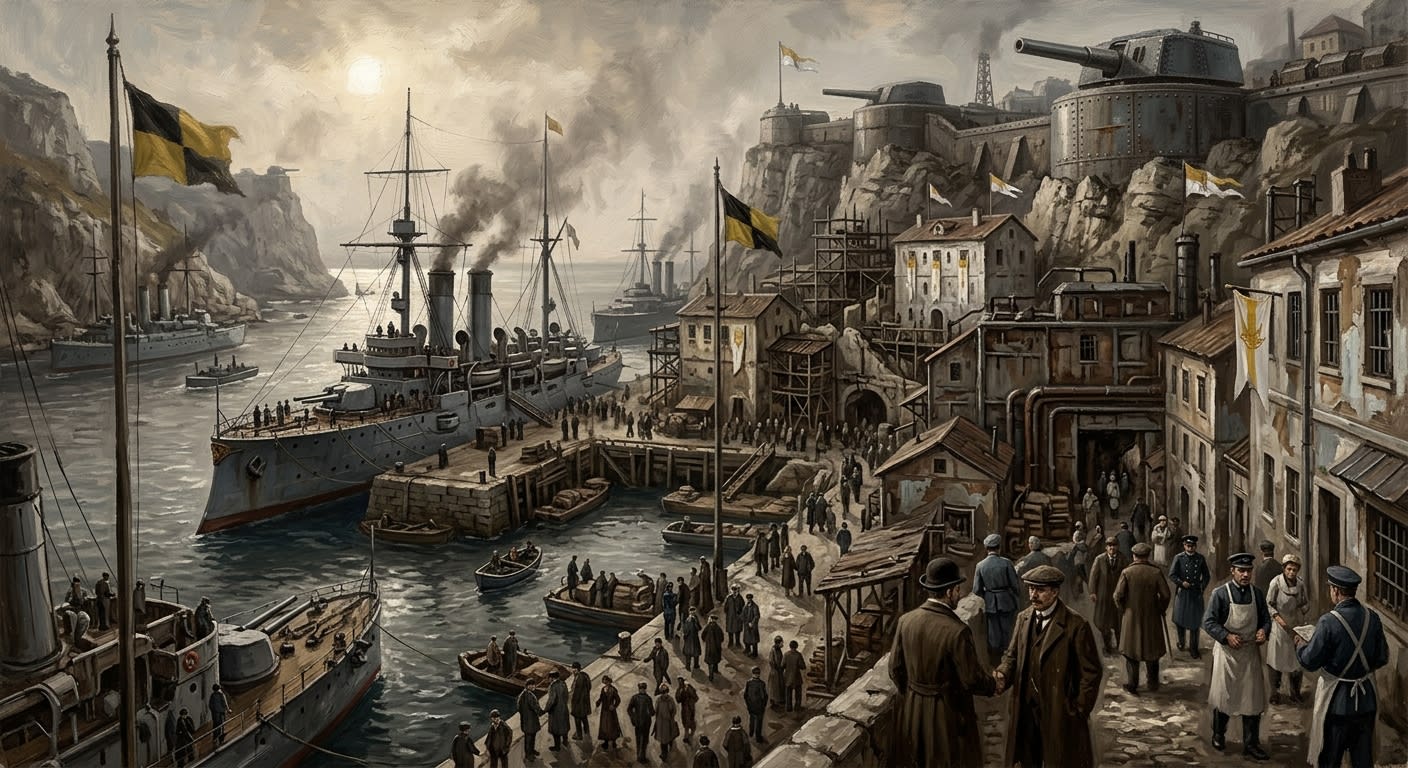
#On the White Edge of the Southern Sea
The Adriatic Coast is the Synod’s long white scar between Italy and the Balkan wound: salt towns, quarantine piers, cliff batteries, pilgrim embarkation chapels, fisher villages with too many widows, and harbours whose ledgers smell of vinegar, tar, incense, and old fever. It belongs to Zone 7 (Unregistered) in the cartographic tables, to the southern supply corridor in the War tables, to the Bureau of Pilgrimage when the pilgrims pay, to the Bureau of War when the guns speak, to Medicine when the patients arrive, and to the sea whenever the sea feels bored by human paperwork.
From Venice’s lagoon-vaults to Ragusa (Unregistered)’s stone approaches, from Dalmatian convent-harbors to the Saffron Bastion’s quarantine flags, the Adriatic is neither rear coast nor clean front. It is a hinge. Supplies for the southern Line move along it. Pilgrim vessels are inspected upon it. Contaminated sailors are landed upon it. Survivors who cannot sleep beneath ordinary roofs are hidden above it, behind whitewashed walls and herb gardens maintained by sisters who know enough to sing matins and ask nothing.
#On Its Lawful Harbours
Venice is the clever mouth. The city’s canals have always made a mockery of straight authority, which explains both its beauty and its audit history. The Bureau of Records keeps lagoon-vaults there because paper stored over water develops humility, and because Venetian clerks can misplace an archive behind three turns, two locks, and a boatman’s shrug with professional grace. Genoa and Marseille fight over southern contracts like dogs over a relic sausage, but Venice understands the Adriatic’s particular bargain: accept the Synod’s stamps, preserve local routes, and let no outsider learn which canal truly leads to the sealed warehouses.
Farther east, the Dalmatian coast grows harder, leaner, more useful. Stone towns grip harbours below cliffs. Watch chapels sit above coves where fishing boats and courier skiffs share water with quarantine launches. Every landing has its bell, its vinegar shed, its confession board, its customs bench, and its little shrine to a saint who drowned, almost drowned, refused to drown, or drowned profitably enough to acquire jurisdiction.
The Saffron Bastion near Ragusa is the coast’s armed thesis. Its cliff batteries oversee supply and pilgrimage traffic; its quarantine flags carry more practical weight than most sermons; its Lanternline Chandlers sell harbour light as though salvation were measured in wick length. Here the Adriatic stops being picturesque and becomes an instrument: gunline, tariff gate, lure-field, fever cordon, and southern-coast throat.
#On Pilgrimage, Fever, and Cargo
The coast’s economy runs on three lawful streams: bodies going east, goods going east, and damaged bodies coming west. Pilgrims board under hymn-license from chapels that can recite twenty-seven reasons a man may be denied passage after paying his fare. Supply convoys carry grain, lamp oil, shot, medical spirits, hymn plates, chain grease, stamped wool, and all the small objects by which a continent pretends its fortresses are fed by Providence rather than invoices.
Fever travels in the seams. Brine Fever had its winter. Quiet throat had its summer. Red gum, quay lung, salt-blindness, confession tremor, bell-sickness in dockside children, and that recurring Adriatic rash shaped like small handwriting have all received names, seals, and insufficient remedies. The Bureau of Mercy blesses the wards. Medicine counts the lesions. War asks whether the men can still load crates. Pilgrimage asks whether the pilgrims can still pay.
Older pilgrimage handbills described the Adriatic crossings as “clean southern water under reliable Synodal protection.”
Corrected. The water is salt, the protection is conditional, and cleanliness is a status applied after inspection, payment, confession, and the absence of screaming from the cargo hold.
Contraband follows the same routes as holiness because holiness receives better paperwork. Relic fragments ride beside counterfeit relic fragments. Pilgrim beads conceal medicine vials. Lantern oil arrives watered with substances that burn blue only near demon-glass. A widow’s coffin may contain a husband, two pistols, or a fever patient no captain wished to declare. The coast tolerates such ambiguities because absolute honesty would halt traffic, and halted traffic would starve the southern Line faster than sin.
#On the Sanitarium Above the Water
The oldest Medicine sanitarium stands on the Adriatic coast in a converted monastery of no architectural distinction. That phrase — no architectural distinction — is how the Bureau hides places. A famous building attracts pilgrims. A ruined building attracts poets. A plain whitewashed house with herbs drying in the yard attracts only auditors, and auditors are easy to delay with tea.
It was there that Colonel-Inquisitor Aras Venn spent his remaining years after the first Shadow Court expedition in A.S. 72. He died in A.S. 94 after writing one classified phrase on every available surface: walls, ceiling, floor, furniture undersides, breviary margins. Medicine classified his death as natural causes, with complications. The complications were probably the point.
The coast suits such a house. Sea air excuses locked shutters. Waves excuse sleeplessness. Bells from harbour chapels cover patient voices. Ships can bring the damaged at night and leave before matins. If a man vanishes from a registry in Strasbourg and reappears as “guest, east wing, dietary restriction,” the coast does not ask whether he has been cured, imprisoned, protected, studied, or mercifully mislaid.
BUREAU OF MEDICINE — ADRIATIC FACILITY STATUS, A.S. 197 East Wing renovation: ongoing. Patients housed therein: ███. Primary exposure categories: Shadow Court residual cognition; Syrionic semantic drag; Morwenic identity fracture; Kargathite inherited hunger; classified acoustic anticipation. Release rate: █ percent.
#On the Coastal Batteries and the Saffron Discipline
The Adriatic does not face Hell in the blunt manner of Bastion-Constantinople or Shipka. Its danger comes by skiff, by fog, by cargo substitution, by pilgrims whose papers are correct and whose shadows answer late. The coastal batteries specialise in suspicion. They fire warning shots at bad angles. They demand signal lamps twice. They detain vessels because a bell in the quay chapel disliked the echo of a name.
At Saffron, light itself is licensed. Lanternline shutters open and close by code; lure patterns are filed with the harbour office; illegal brightness carries fines, imprisonment, or sudden pious drowning. The Brine Choir sings under piers when surface hymns fail. The Low Nets hold labourers, divers, widows, failed apprentices, and the unofficial knowledge by which a coast survives its official procedures.
The sea-lane’s apparent softness deceives rear officials, who look at blue water and imagine leisure. They should try counting plague flags in a mistral. They should stand at a quay while three hundred pilgrims insist their cough is devotional. They should inspect a fish crate whose contents breathe in Latin. They should explain to a gun crew why the vessel bearing Mercy seals must still be fired upon because its wake is moving the wrong direction.
#On the Present Condition
As of A.S. 201, the Adriatic Coast remains loyal, profitable, inspected, infected, indispensable, and insufficiently afraid of itself. Venice still bargains. Ragusa still watches. Saffron still taxes light. Medicine’s unnamed white house still renovates its east wing. Pilgrimage still prints clean handbills. War still demands more tonnage than the harbours can process without fraud, and the harbours, being patriotic, provide the fraud.
A Bureau of Pilgrimage circular called the Adriatic “the peaceful southern passage.”
Withdrawn. Peaceful passages do not require quarantine flags, cliff guns, night confession receipts, seal-divers, fever wards, and sisters instructed never to open the east wing after Vespers.
The coast’s holiness is practical. It does not shine. It stamps. It ties boats, boils linens, locks wards, counts coughs, blesses cannon, sells dry bread, hides ruined men, and sends supply convoys east before dawn. The Adriatic has learned what every useful province eventually learns: the Synod loves places that move goods, absorb damage, and do not ask why the east wing is always under repair.