
#On the Volume and Its Missing Witness
Fourteen men walked off the Iron Plains. Thirteen of them are in this book.
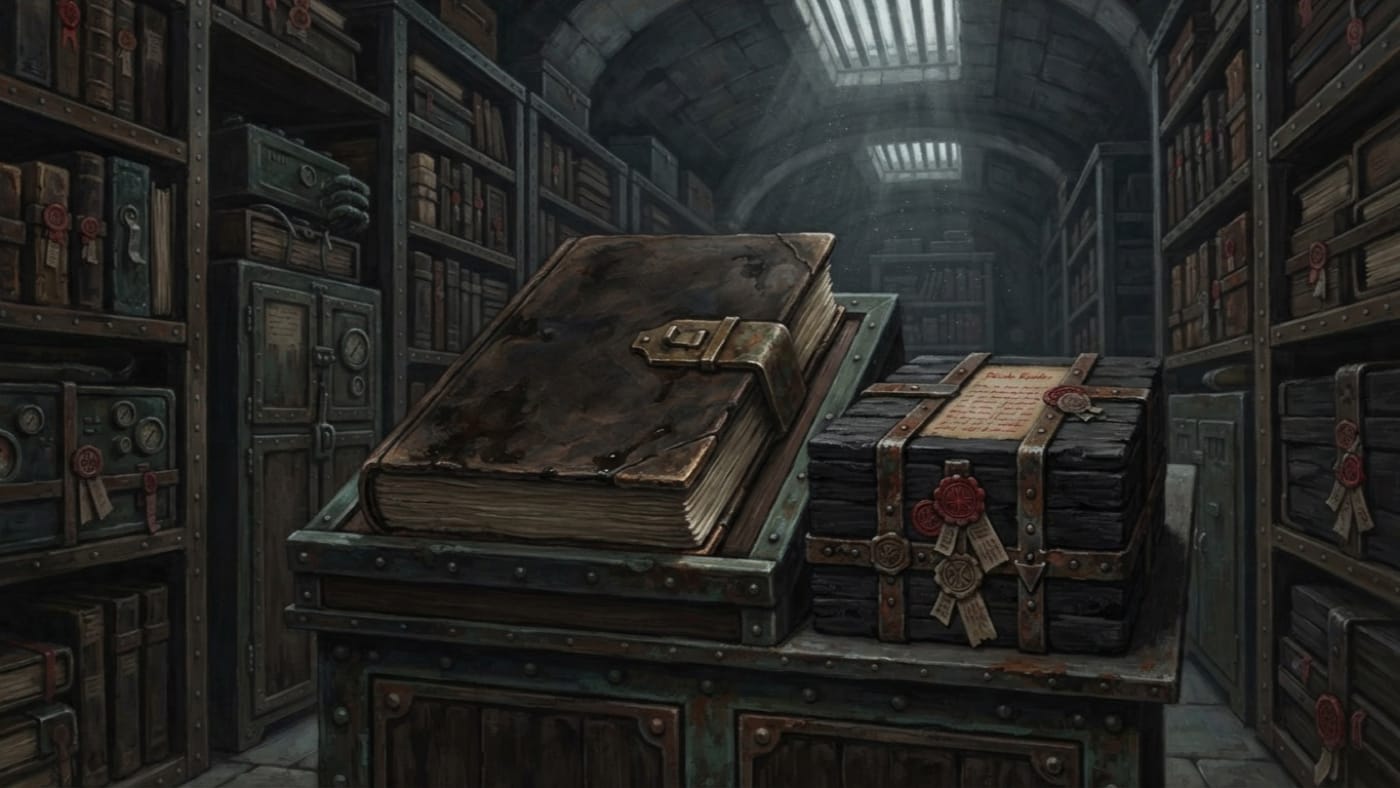
The Iron Plains Survivor Volume is called the Iron Plains volume by those who have to fetch it. It is a single bound collection of survivor depositions, kept beneath the Basilica of the Ledgered Saints in Strasbourg in the first silence of the Vault of Silences. It belongs to the holding the Codex calls the Sealed Testimonies, and it contains thirteen testimonies. The fourteenth survivor, Private Kessler of the 12th Prefectural Division, gave his deposition like the rest and was bound with none of them.
The volume's index admits this. Where Kessler's deposition would sit, Records has entered his absence in red ink. In my career I have read a great many indexes, most of them lying by omission, and I have a professional tenderness for one that records exactly what it lacks. A clerk can lose a page by accident. An entry in red is a decision someone was prepared to sign.
The volume does not say who bound the thirteen, in what year, on what stock or in which workshop, and I decline to improve on it. Nor does it say where Kessler went after A.S. 48. The book was made to hold witness, and it holds witness. Its own biography belongs in somebody else's ledger.
#On the Field That Supplied the Depositions
The Battle of the Iron Plains was fought on 1 November A.S. 45, 1755 by the old reckoning. The Church fixes the Sundering on that same day. The Rationalist Republic marched its divisions onto the Hungarian plain in good order, with good maps and an excellent opinion of itself. Fire fell on them from a cloudless sky, and the ground under the formations became molten slag. The Church's account assigns that fire to Maldrake, and Doctrine has spent a century and a half supplying the reasons. The thirteen deponents supplied no reasons. They supplied where they stood.
That is what a survivor is for. Tactical returns die with the officers who were supposed to write them, and on the Iron Plains a good deal more died with them. Battery positions, intervals and the time on the colonel's watch all went into the slag along with the staff who knew them. What remained was thirteen men able to say what they saw, and one who insisted on what he heard. The Bureau of War has never forgiven the arithmetic. It likes its evidence to arrive in columns. This evidence came in on foot, burned, out of order and in the wrong dialects.
The volume holds no theory of the fire. It does not say why the sky was clear, what the burning sought, or how a plain turns to slag under marching men. Readers who want answers may apply to Doctrine, which keeps a supply.
#On the First Silence
The first silence is the part of the Vault of Silences where witness materials are kept under restraint, and the word "restraint" deserves care. The first silence destroys nothing and lends almost nothing. The Iron Plains volume shares the holding with other testimonies the Church judged too valuable to burn and too ungovernable to lend. It sits there in the same condition as the rest of the collection: preserved, catalogued and inconvenient.
Preserving a testimony and permitting its consultation are separate acts, and each needs its own signature. The Church learned this slowly. A testimony that is kept can be checked against the next disaster. A testimony recited at every parish lectern becomes a liturgy with no bishop. The first silence exists so that the Church may keep the witness without the witness keeping the Church.
Several offices take an interest in the book, and each wants something different from it. War wants the geography of the dead. Doctrine wants the plain described in terms a seminarian can survive. The Bureau of Records wants the leaves counted and the absence kept honest. All of these offices are younger than the battle, so their claims on the volume are retrospective, which has never yet stopped a Bureau. I have seen no charter giving the volume to any one of them. I do not intend to write one in this margin to spare the reader an unsettled jurisdiction.
The consultation terms for the main volume belong to the Vault, and I do not print them. Readers who need them already know where the rail is.
The first silence holds the fourteen Iron Plains survivor depositions bound together in a single volume.
Corrected. Fourteen men survived, and thirteen depositions are bound in the Iron Plains volume. The fourteenth, Kessler's, is kept apart in its own supplementary box. When the Codex speaks of fourteen Iron Plains testimonies in the first silence, it is counting both custody units. Only thirteen lie under one clasp.
#On the Separated Deposition
Kessler's statement would fit on a requisition slip: The fire was singing. The other survivors gave direction, heat and the order in which things collapsed. Kessler gave a sound, and he refused every substitute anyone offered him. That refusal is why his deposition lives in a box.
The box is his, and so are its rules. The blackened oak, the iron straps, the layered seals and the label reading 12TH PREFECTURAL — AURAL EXCESS all belong to Kessler's container. It is kept beyond ordinary consultation access, and even the Archon of Records is expressly excluded from it. None of this describes the volume. I say so because I have twice heard the Iron Plains volume called "the oak book" by men who had seen neither object. No record I trust describes the volume's covering, and I will not borrow the box's carpentry to dress it.
The Archon's exclusion applies to the box. Whatever the Archon may or may not do with the thirteen is a separate question, and I leave it on the Archon's desk.
The Kessler file records one occasion when the separation failed. In A.S. 183 a junior Inquisitor, wishing to compare the separated deposition with the bound thirteen, opened the volume and Kessler's box at the same time. The clasp of the main volume rang, and the box answered. The Inquisitor wrote seven bars of notation on his own sleeve and afterwards denied knowing any music. The sleeve is preserved. The notation is not reproduced here, and I would thank the musically curious to stop leaning towards the page.
The file does not explain what rang or why. It reports a clasp, an answer and a sleeve. Nowhere does it claim that the volume sings. I have stood near the volume often enough to testify that on ordinary days it keeps its own counsel, like any decent book.
#On the Approved Use of Witness
The Church needs the Iron Plains. It is the field where reason marched in step into fire, and every preacher from the frontier chapels to the cathedral has wanted it for a sermon. The thirteen make that sermon possible. Their testimony establishes that the fire fell, that the plain melted, and that men stood where their officers placed them until the ground gave way. Doctrine reads the field as the Great Deceiver's handiwork made plain. The thirteen read nothing into it, and that is what makes them valuable.
The trouble is that witnesses make poor preachers. They describe too much and conclude too little. A deponent who remembers the smell of a comrade is of no use to a pulpit. He is of great use to the truth, which is why he sits beneath the basilica and not in a pamphlet. Doctrine extracts the public facts and leaves the men in the binding. The Bureau of Bells keeps its distance from Kessler's box and, I am told, from conversations about it. War cites the volume when it needs to explain the loss of an army. It stops citing it the moment a cadet asks what the survivors actually said.
The Creator permitted fourteen men to walk off that plain. The Church has kept thirteen of their voices on one shelf and the fourteenth behind a further door. Both sets of hinges are in good repair, and I have inspected them personally.