
#On the Paper
"Pay clean. Pass clean." — Inscribed above the central arch, Griefgate. The slip is the receipt for the first half and the promissory note for the second.
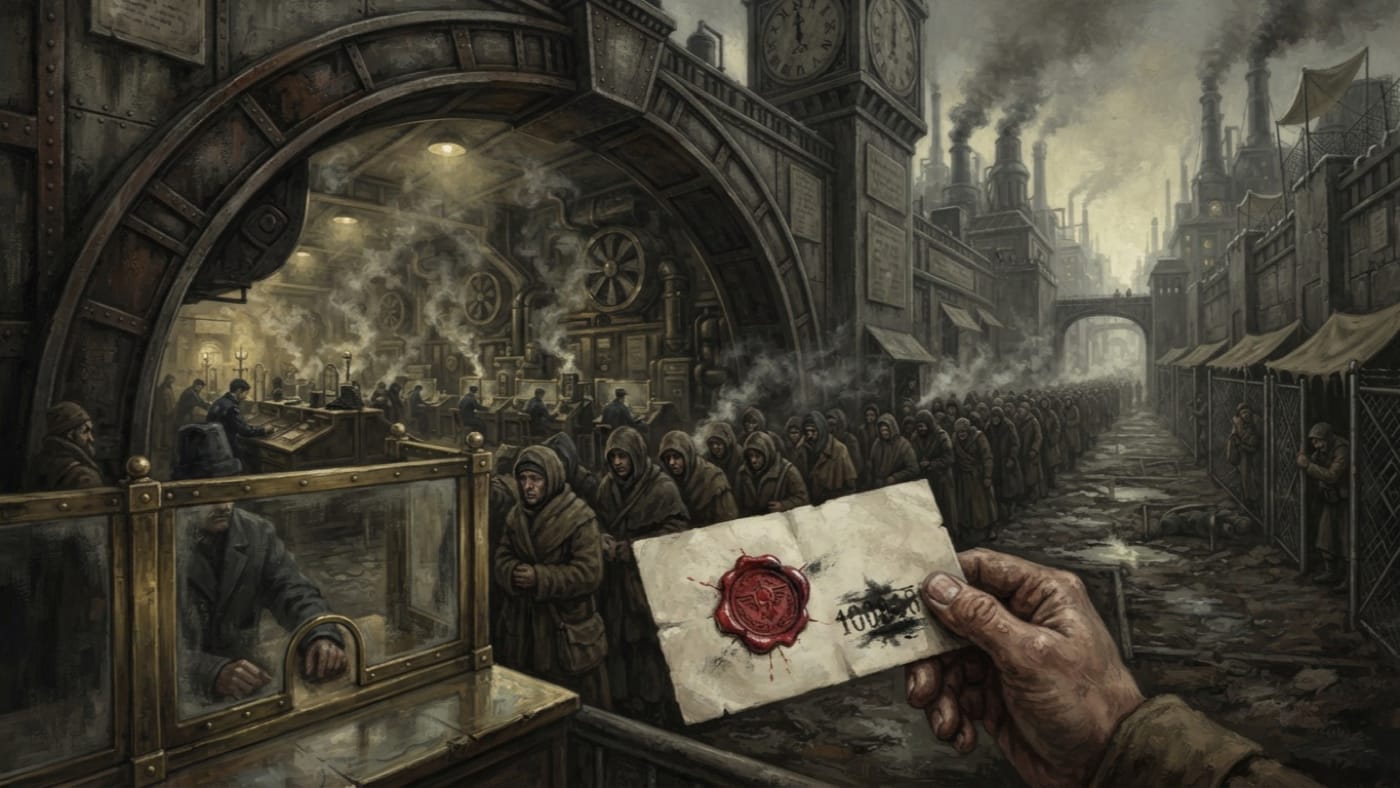
It is a rectangle of heavy paper. One could stop there. The description would be accurate, the Bureau of Records would accept it, and the pilgrim holding one in a wet fist outside the Widow's Pennies Exchange would find it insulting. The Griefgate indulgence slip carries the Gate Chapter's seal in red wax and the confession clerk's mark in black, and on the strength of those two impressions it does three jobs at once. It is a travel pass. It is a spiritual clearance. It is also, since about A.S. 199, money.
The queue calls it portable clean, and the term is admirably exact. A soul cleansed at the confession stall stays at the confession stall. The paper leaves with you. It fits inside a coat and dries, eventually, against the lining, and it can be shown to a marshal who has neither the time nor the stomach to hear your sins a second time.
What the paper does not carry is the history of your name. The slip certifies a transaction. The Great Ledger certifies a person. The two documents meet at every checkpoint on the Pilgrim Roads, and when they disagree the Ledger prevails, for the plain reason that the Ledger is kept by the Synod and the slip is kept by you.
#On the Assessment and Issue
"Guilt is weight. Weight must be measured." — Gate Chapter Catechism, posted at all three arches.
The slip comes at the end of a procedure built to make it feel earned. The traveler kneels in the confession stalls and declares, under protocol, the nature and degree of present spiritual burden: a death, a sin unabsolved, a debt owed to the Church. The clerk consults the public grief-tables, which turn each declared loss or obligation into an assessed toll with the serenity of a tide chart. Disputes over the figure go to the grief-tax court of Arbiter-Widow Solenne, called Blue Veil. Her rulings come back so promptly that nobody has ever caught one being deliberated.
Coin goes first to the Assayers of the Bitter Scale, who weigh it, bite it and bathe it in reagent in full public view. Their verdict concerns the metal and nothing else. An assayer certifies no paper, and no slip has ever improved a bad penny. Master Assayer Tinn Halve may declare a taint on the coin supply and freeze every transaction in the hall until re-assay is complete. On such days the counter issues nothing, the queue lengthens, and the culverts take note.
Then the mark in black, the seal in red, and the arch to which the traveler has been assigned. The whole sequence fits on one counter.
The alternative fits in the Holding Pens. A traveler who cannot pay, or whose confession the clerks later find wanting, is reclassified from pilgrim to detained. Each day of detention accrues as debt, and the debt grows faster than any purse can pay it down. Once the purse is empty, the traveler signs a labor-conversion contract of undefined term. Every pilgrim in the queue has seen the canvas roofs behind the eastern bluff, and every one of them prices the slip accordingly.
#On the Thirty Days
A clean, freshly stamped Griefgate slip buys passage through checkpoints on the Pilgrim Roads for thirty days. Someone placed each word of that sentence with a purpose.
Clean means a seal that reads as a seal. Freshly stamped means the month begins at the counter, and a slip bought third-hand has already spent part of its month in other pockets. Checkpoints on the Pilgrim Roads means that territory and no other. Beyond it, the slip is heavy paper with a regional reputation. It exempts its bearer from neither inspection nor lane. Standing Order 44-R still governs the arches, and a pilgrim waving portable clean at the Coin arch is a pilgrim at the wrong arch, who will be charged six pennies to become correct.
At each checkpoint the confession on file is compared with the traveler's papers, companions, appearance and stated destination. A story that matches is a story-fit. A story that fails raises a doubt flag, and the flag attaches to the name. It follows that name through checkpoint after checkpoint until the matter is resolved or the traveler stops traveling. At Griefgate, doubt inspections answer to Gate-Canon Meral Voss, whose inspectors have yet to finish an inspection without a confession.
Once a name is flagged, doubt clearance cannot be bought. Brokers will sell priority in the inspection queue and paperwork that moves faster than its neighbors. The Culvert Choir will carry the body under the arches for a fee. Neither purchase touches the flag. The flagged pilgrim then holds a perfectly valid document while being a person under suspicion, and the Synod likes it that way, because both facts stay on file.
Nor should the slip be confused with its neighbors. A lane ticket assigns an arch. A toll clearance writ settles a toll. The metal walking tokens struck by route-stampers carry bell-hour cores and tell on their bearers as they walk. The indulgence slip has no such organ and says nothing. The route-stampers hold that paper is too easy to forge and too hard to verify in mud. They are a guild that sells metal, and they are also right.
#On the Circulation of Clean Paper
Slips are traded, hoarded, forged and resold. Their widespread use as a secondary currency dates from about A.S. 199, and that date marks a market discovering a commodity. The slip, the Exchange that issues it and the doctrine of stamped absolution beneath both are older. The Exchange's Joint Charter dates from A.S. 94. Nobody has produced the first slip, and the Bureau has not asked anyone to look.
Price follows the pilgrimage season, the length of the queue and the disposition of the Gate-Canon. A slip already in hand during a three-day spring queue sells above the toll that produced it. Its buyer is purchasing the result of someone else's confession, along with release from the wait and from the risk of the Pens, and pays a premium for both. No fixed rate exists. Brokers quote, buyers count, and the arch hums over both.
The Bureau of Records holds that a document bearing a Synod seal keeps its doctrinal validity however many hands it has passed through. The Bureau of Purity objects, and once advised Records to mind its own stamps. Neither position has been withdrawn. The checkpoint marshal stands between them in the rain, inspects the wax, and leaves the soul to the theologians.
The queue feeds the forgers. Each day of official delay raises the value of any paper that spares its holder the next one, and Griefgate produces delay the way other towns produce wool.
At Griefgate, everything can be bought.
The phrase, which this author recorded from the queue without sufficient correction, is withdrawn as overstated. Passage, priority, paperwork and paper can be bought. Doubt clearance, once a name is flagged, cannot. The Bureau regrets the generosity of the earlier wording.
#On the Seal That Smears
The Culvert Market sells three grades of goods: genuine slips in circulation, forgeries, and blank slips of the correct paper weight and weave. The blanks are inert. They need a convincing seal to become counterfeit currency, and the seal is the expensive part. The Culvert Choir does not discuss this, because the Culvert Choir does not acknowledge that it exists.
The honest holder's difficulty is that Griefgate spoils its own authenticity. When the sorrow beneath the arches grows thick enough, wax fails to set and seals smear. Coins tarnish on the counters, bells ring flat, and travelers lose their own names mid-sentence. A slip sealed honestly at the Exchange may leave the hall looking like the work of a drunk in a drain, and a smudged seal buys a conversation with an inquisitor. The Exchange answers with incense fans and steady chants. The Bureau of Bells has classified the effect as Category Two Ambient and funds no study of it.
So the honest slip and the dishonest one end up in the same marshal's hand, and the marshal judges by appearance, because appearance is all the paper offers.
There is one further limit, recorded here only as allegation. Culvert whispers hold that the Exchange enters false confessions into the Ledger to justify detention and labor seizure. The Gate Chapter denies it. If the whispers are accurate, a slip may clear its bearer of a guilt that the issuing office wrote. The Bureau's position is that the whispers are whispers.
#On the Present Application
The conditions described here are an assessment drawn from the Griefgate account of A.S. 201. That year the roads ran over capacity, seasonal queues stretched to three days, and the Holding Pens had been expanded twice in two years. Each of those figures raises the price of portable clean. The Bureau of Purity's investigative cell arrived in A.S. 200 and has produced one report on the blank-slip trade. It recommends further observation, and observation continues.
Indulgence slips also appear far from the arches, as Grace Rations issued to soldiers. They are tallied beside bell-hour chits and saint-shares and handed out as carefully as bullets, and the allotment is suspended when the tithe goes unpaid, a matter for the Bureau of Tithes. Nothing shows that a trench slip bears the Gate Chapter's wax or any claim on thirty days of road. The pilgrims shuffling east toward the Sagittal Line carry one paper, and the men already there carry another, under the same name.
Charta transit; nomen manet.