
#On the Shore and Its Roads
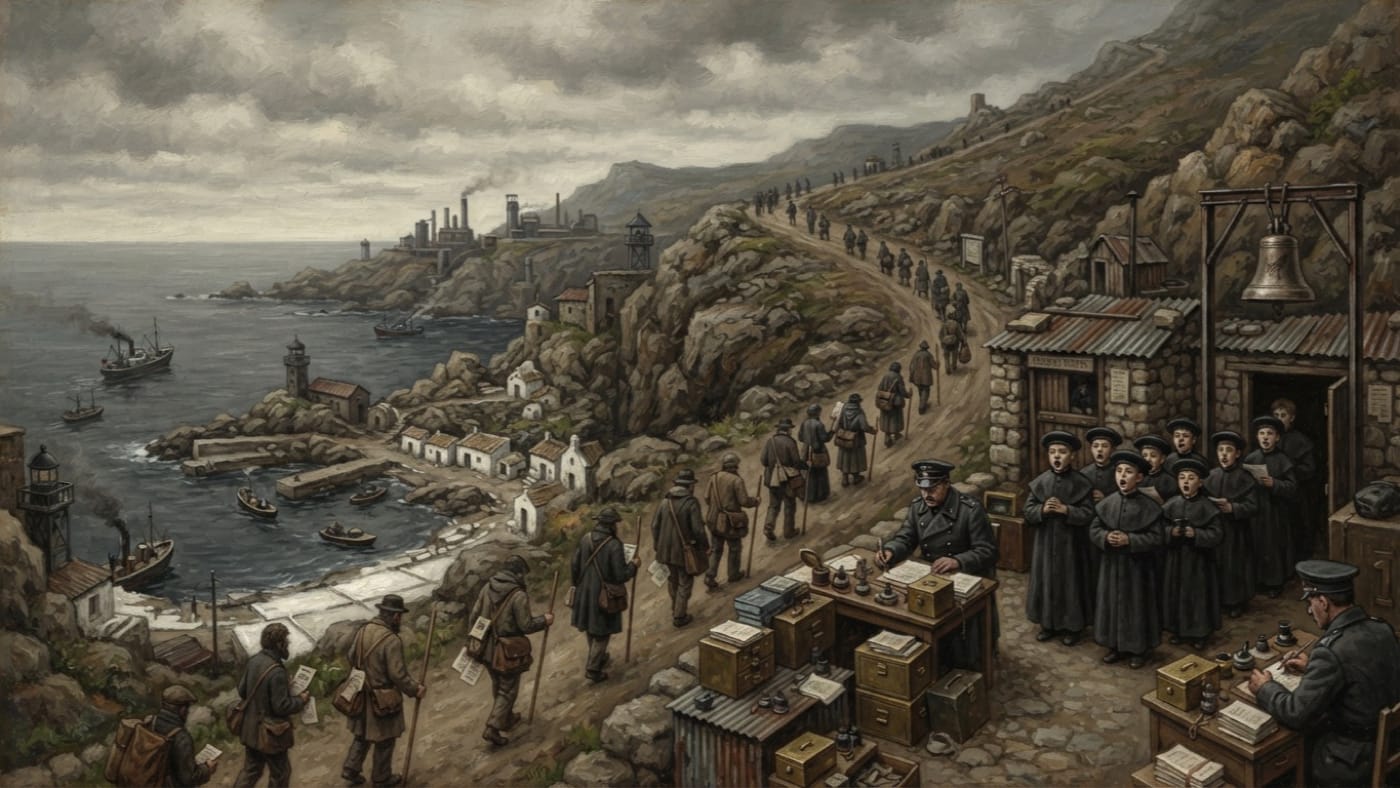
The Iberian coast holds no single charter, no capital and no boundary stone, and I will not invent one for the comfort of mapmakers. It is a place of work. There are salt flats white enough to blind a sentry at noon, fishing harbours that stink honestly of their trade, relic chapels set on headlands so the western sea can admire them, and coves cut into the rock so conveniently that one suspects the Creator anticipated smuggling. Between them run the shrine-roads. From the shore, those roads climb inland.
A clerk must learn that first. The coast is where traffic lands and leaves, and the holy destinations lie elsewhere. Cádiz gives the harbour its name in the ledgers. Seville and Santiago sit inland as great route nodes, with pilgrim columns moving toward them and limping back from them, footsore and freshly in debt. No unbroken beach-road joins them. Pilgrims who believed one did had bought a map, and the men who sold them maps later sold them escorts.
Every mile is counted. Ration-stones carved with the names of saints mark the way. Tithe-gates take coin and Creed together, and an interpreter who stumbles over a syllable can hold an entire caravan at the bar while its olives rot. Parish covenants keep the road in repair and are paid in absolution, which costs the Church nothing. None of this is lawful without a permit from the Bureau of Pilgrimage, which runs its southern business from Marseille. That French port takes in Iberian traffic and forgets none of it.
#On Licensed Passage
The Bureau meets the people of this coast through their work, so that is how they are best met here. The fisherman carries a harbour licence and a parish card, and he is suspected of carrying a third paper he never declared. The ferryman knows which tide carries a pilgrim and which carries a pamphlet. The gate-priest hears the Creed forty times before noon and becomes a connoisseur of bad pronunciation. Under an awning sits the broker, with a strongbox, a pen and a list of dangers he has not yet arranged.
A pilgrim landing here collects papers the way a hull collects barnacles. There is a Pilgrimage permit. There is a licensed token for each shrine on the route, stamped, corded and checked against a register. Each tithe-gate issues a chit, and a pilgrim who worked off a fee with a road covenant gets a labour certificate. Lose one document and the others turn to kindling. The gate-priest has no interest in your intentions, only in the gap in your papers.
For most of a century, one question mattered more than all the rest: insured or uninsured?
The insured pilgrim carried a slip tied with blue cord and stamped with a peregrine wing. At the mouth of a cove, men mending nets would look up, see the cord and go back to their nets. The uninsured pilgrim met the same men at the same cove. He found they were not, after all, fishermen. The two cases differed in outcome and in nothing else. Same road, same tide, same men.
#On Insurance and Intelligence
The Peregrine Cartel grew in this soil for the plainest of reasons. The coast had too many shrines, harbours and coves for one Bureau to watch. Wherever Pilgrimage's eye failed to reach, a man with a ledger could set up his desk. Its formal title was the Peregrine Mutual Assurance Compact. By A.S. 133 / 1843 CE it held most of the pilgrim insurance on the Iberian coast. By A.S. 150 / 1860 CE its clerks had moved into shrine courtyards, close enough to the gate-priests to share their bread. By A.S. 170 / 1880 CE no major column from Seville toward Santiago moved without a Cartel stamp somewhere in its papers, its baggage or its prayers.
Each policy promised safe conduct between two licensed shrines, replacement of stolen tokens, compensation for lost baggage, and burial for anyone killed by bandits. Compensation was rarely paid. Burial was the more reliable benefit.
Every policy was written in three copies. The pilgrim took the first. The second stayed at the local desk, with the purchaser's name, parish, declared valuables, premium and route risks entered beside it. The third went inland by courier to a counting room that no Bureau inspector found while the Cartel lived. None has found it since.
The arrangement worked because the threat and the remedy were filed in the same cabinet. Clerks, escorts and bandits overlapped, often within one family and now and then within one man. The coast supplied the scenery. A cove sheltered an ambush, a salt flat showed off a corpse, and a chapel stood ready to sell a candle for the soul of a pilgrim who had declined cover.
Choirboy retainers walked beside the insured columns. They sang Creed-fragments in clean high voices and carried blades inside their hymn-books. Three Bishops-Praetorial protected the Compact. Their names remain under seal, so every well-informed dinner table in Strasbourg knows them and no document admits it. One of the three secured the Compact's dock exemptions through intermediaries in Marseille. Those who know harbours can guess how much that was worth on a coast made of them.
War tolerated all of it. The coast lies far west of the Sagittal Line, and no Iberian salt flat has heard an eastern gun. Its value to the war lay in what passed through it. Cartel clerks knew which coves hid smugglers, which monasteries kept informants, which ferrymen ran couriers and which pilgrims were carrying more than devotion. War received copies, and the Cartel received silence in return. Competitors got contempt. The Bosporus smugglers called the Cartel's insurance crews "paper pirates," which they meant as an insult and which was in fact a job description.
#On the Jubilee Seizure
Every tenth year, Pilgrimage holds a Peregrine Jubilee. Every lapsed licence, rival guild and unapproved toll then falls under its review, and the review is usually carried out with axes. The Jubilee of A.S. 193 / 1903 CE fell on the Iberian coast like a tide that had read the timetables.
The Peregrine Wardens had held custody of the routes since the Harmonized Routes Edict of A.S. 123 / 1833 CE. They had waited seventy years for permission to use it here. They entered the shrine-courtyard desks before the clerks had warmed their ink. They seized policy slips still wet from the harbour air, cut blue cords by the bundle and carried strongboxes off by the cartload. Records logged the haul as seven partial registers, two cipher-books damaged by fire, and thirty-one choirboy retainers. Records admits the last figure may leave out boys hidden in fishing sheds and chapel lofts.
The principals were sorted with great care. Some went into Pilgrimage's new Iberian intelligence desk, where their talents now draw a salary. Some were immured. Two passed to War under escort and have since dropped out of every file a Doctrine archivist can open. The rest are accounted for by redaction. The bishops were disciplined under a sealed annex, which is the most severe punishment a bishop can suffer, since it is the one he cannot discuss.
The choirboys were stripped of their knives, examined for pitch and sent to the Bureau of Bells. A child who can hold a note while holding a blade can certainly hold a bell-rope.
#On the Roads After Regularisation
The salt flats remain. So do the harbours, the chapels and the coves, and so do the columns climbing inland toward Santiago with their tokens corded and their Creeds rehearsed. The roads are safer than they were, and they cost more to travel. Pilgrims complain, pay and walk on, and the ones who arrive alive give thanks to the Bureau. Gratitude comes easily from people who remember what the alternative looked like.
The Cartel is extinct in law, and its methods have taken holy orders. Premiums have become "risk-indexed route offerings." Escort fees have become "protective devotion surcharges." Testimony bought from innkeepers and ferrymen is now "voluntary waystation testimony," and the coast's coves are still watched, though the watchers have changed employer. Choirboy bodyguards are forbidden. Bells may assign boys to a procession for acoustic support, and the silhouette is the same.
Public notices of A.S. 194 announced that all Cartel intelligence networks on the Iberian coast had been destroyed.
Corrected. The networks were transferred and absorbed. Destroying useful information is waste, and waste is a sin while the Bureau still has a cabinet to put it in.
The wing-stamps were melted down and cast into a bell for a minor chapel outside Santiago. Pilgrims coming up from the coast now pray for safe passage beneath a voice made from the seals that once priced their fear. The bell rings true. I have seen its rate card.