
#On Atlantic Passage
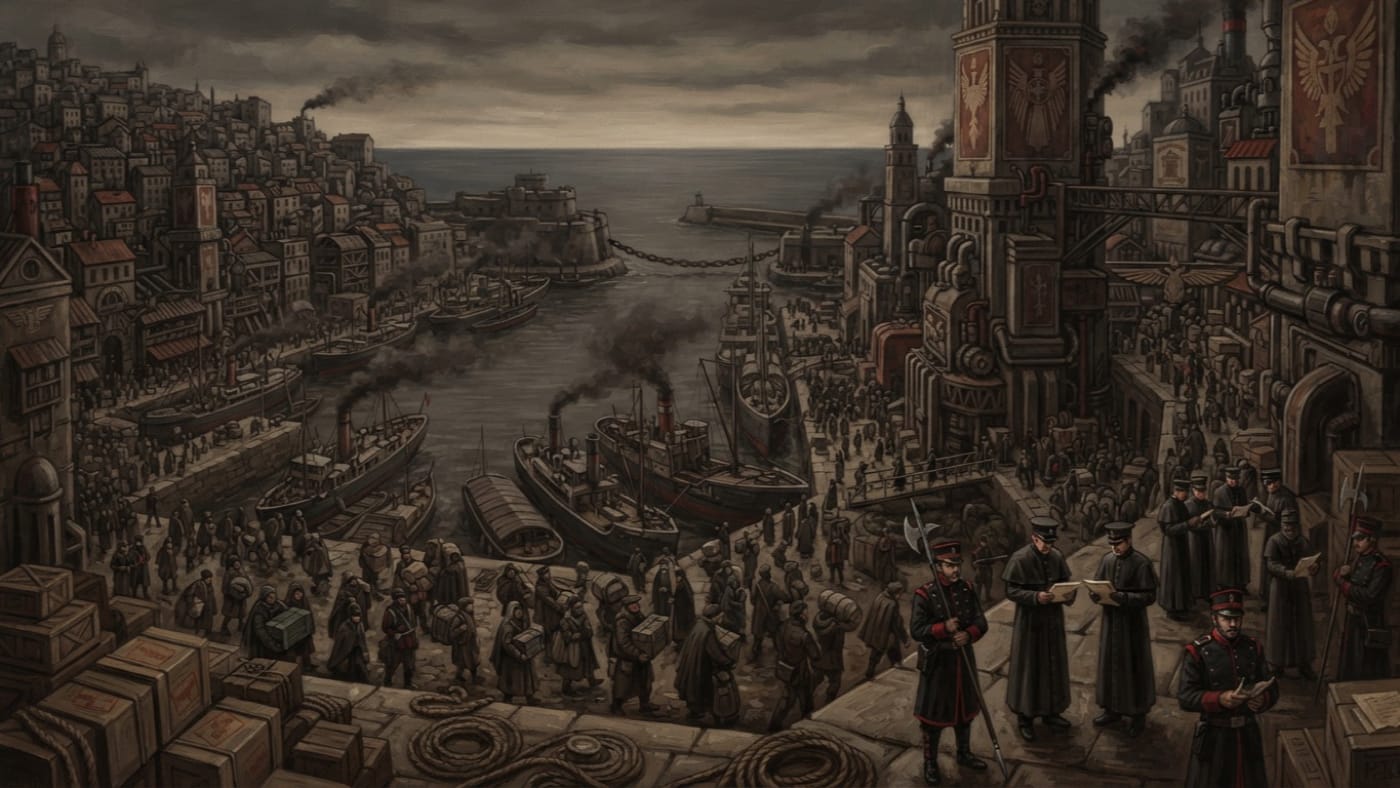
Cádiz sells passage. The coastal account of Iberia lists the trade beside Lisbon's sea candles and Málaga's three grades of false certificate. The order is fair. Cádiz deals in the one commodity every pilgrim needs and no pilgrim can inspect before purchase: a berth, a crossing, a quay that will accept a man's papers without asking where they were last folded. The city adds deniability at no extra charge, which is the only generosity its harbour has ever been accused of.
With Lisbon it carries the Atlantic pilgrim lanes. Through it go the faithful, their tin saints and their food wrapped in old appeals, bound for shrines that the roads reach slowly and the sea reaches with fewer inspectors. The Sagittal Line lies a continent's worth of paperwork away. Cádiz belongs to the western rear, where the Great Deceiver's agents arrive in the wrong cargo rather than at the head of an army, and where the principal casualties of any given week are tariffs.
Into this trade came the Peregrine Cartel. Its policy desks stood in Seville, Santiago, Cádiz, and the lesser quays whose names surface only when revenue disappoints. The records do not place the Cádiz desk on a street, in a courtyard or behind a warehouse door, and I decline to furnish it one. A desk needs no address when every pilgrim with a sea-chest can find it.
#On Protection and Its Papers
The Bureau of Pilgrimage issued permits. A permit licenses a pilgrim to travel; it says nothing about whether he arrives. The Cartel sold the second half of the arrangement under the title of the Peregrine Mutual Assurance Compact, and Cádiz, a city already fluent in charging for the distance between two points, understood the product at once.
A policy promised safe conduct between two licensed shrines. It promised replacement of stolen tokens, compensation for lost baggage, burial after death by banditry, and reduced rates for family members murdered in the same incident. The family rate is the clause I return to on slow afternoons. Someone drafted it, someone priced it, and someone at a harbour desk explained it with a straight face to a widow-in-advance. Compensation was rarely paid. The policies sold anyway, because what the purchaser bought was the restraint of the men who would otherwise have robbed him.
Those men and the Cartel's clerks were often cousins. An ambush party was paid to stand aside from insured travellers and left at liberty to instruct the uninsured in the cost of thrift. The Cartel's choirboy retainers walked beside its policy columns singing creed-fragments, with knives tucked inside their hymn-books. No surviving record assigns a contingent of those boys to Cádiz, and the Codex will not invent one for the sake of a vivid quay. The method travelled with the stamp. Wherever the blue cord went, the arithmetic of fear went with it.
Three Bishops-Praetorial protected the Compact. Their names remain sealed. None is recorded as holding a Cádiz seat. Readers who have already guessed one may confess the guess at their parish and pay the usual fee.
#On Cargo, Registers, and Deniability
Every Cartel policy had three copies. The purchaser kept the first, blue-corded and stamped with a peregrine wing. The desk kept the second, with the premium, the route risks, the family names, the parish, and every valuable the pilgrim had been proud enough to declare. The third went inland by courier to a counting room that no Bureau inspector found while the Cartel lived, and that remains unidentified now.
At a harbour the arithmetic compounds. Each passage sold at Cádiz produced a record of who sailed, from which parish, carrying how much, toward which shrine. The pilgrim bought safety and left behind a confession he never knew he had made. War tolerated the Cartel for exactly this reason. Its clerks knew which coves sheltered smugglers, which ferrymen carried pamphlets, and which pious travellers were couriers for causes better strangled early.
Cádiz gave that knowledge plenty to work on. The account of the Iberian correction records Purity sweeps through Cádiz and the coastal watches after smugglers moved forbidden tomes, Rationalist pamphlets, relic fragments, and demon-glass packed under fish-stink. That account gives no date for the sweeps, and I give none either. Fish has long served contraband. An inspector will open a crate of devotional linen with enthusiasm. He will lift the third layer of sardines only under written orders and holy obligation.
Other eyes watch the harbour as well. The independent British squadron at Gibraltar guards the Mediterranean mouth, and every port clerk from Cádiz to Málaga knows how much Synodal pride a harbour can hold before British guns make it buoyant. In Cádiz the clerks count British masts and pretend not to. The counting goes no further than attention. The city remains Iberian, Synodal and irritable. Eastward, Marseille serves as the southern hinge of Pilgrimage and its revenues, and Cádiz sits at the Atlantic end of a fiscal system that would prefer it to be more French.
#On the A.S. 193 Transfer
The Peregrine Jubilee of A.S. 193 ended the Cartel. Jubilee puts every lapsed licence, duplicated authority, unapproved toll and irregular escort contract under Pilgrimage review, and the Compact had all four in quantity. The Peregrine Wardens came through the Iberian desks with dawn warrants, road axes and bells rung out of schedule. The Harmonized Routes Edict had constituted the Wardens in A.S. 123, seventy years before this morning. The Bureau needed those seventy years to decide that the Cartel was worth more dead.
The published totals are regional. Seven partial registers, two damaged cipher-books, thirty-one choirboy retainers and fourteen principals came out of the Iberian network as a whole, and nothing in the record assigns any of them to Cádiz. Readers hoping for a local haul must take their disappointment to Records, which keeps a counter for the purpose.
Then the Bureau did what it always does with a criminal it has caught. It read his diary. The registers held pilgrim movements, escort payments, debt schedules, blackmail notes, and the bribes paid to dock clerks, and Pilgrimage kept every page. For decades the harbour had told a private firm who was sailing where. It now told the Bureau, through the same habits and very nearly the same forms.
#On the Present Harbour
Cádiz still sells passage. The Cartel is extinct in law. Its slips are void, and its wing-stamps were melted into a chapel bell outside Santiago, a long way from any Cádiz quay. The Iberian roads and their harbour mouths are safer than they were, and dearer. Premiums now travel as risk-indexed route offerings. Escort fees appear as protective devotion surcharges. The pilgrim at the harbour pays, boards, and thanks the Bureau on arrival.
Rear territory is spared the front and keeps every other misery. In the famine of A.S. 185, when Iberian storehouses cracked from the Atlantic to the upper Tagus, Cádiz complained first. Relief came in Toledo, when Governor-Praelate Alaricus opened the Granaries of Saint Benedict. Cádiz had to settle for the distinction of noticing first.
The coastal watchers keep their own customs. They spit into the Atlantic before naming Strasbourg, a habit the Codex reports and no Bureau has licensed.
A.S. 194 public notices declared every Cartel intelligence network destroyed, the Atlantic desks with the rest.
Corrected. The networks passed to the Bureau of Pilgrimage. The registers compiled from passage sold at Cádiz were never burned. They changed custodian, which in this Church is the more permanent fate.