
#On the Surviving Copy
The Iago Rule is the disciplinary rule of the Order of Saint Iago, the Iberian military-monastic order that held Toledo for nine months and then burned its own saint rather than hand him over. The reputation is larger than the document. The Church holds excerpts of the Rule. Most of them were copied after smoke had already taken the margins, so the modern reader gets the Order's discipline the way one gets a letter out of a burned house: readable in the middle, brown at the edges, and silent about who wrote it.
No author is recorded, and no year of composition. The late copy carries no date of its own either. Three junior archivists have each proposed one, and I fined all three. What survives in titled form is four sentences.
The copy does not say whether these lines opened the Rule, closed it, or sat between a clause on mule fodder and a clause on lamp oil. Anyone who presents them as the Rule's four chapters has mistaken a fragment for a constitution, and will be corrected in the usual manner.
#On the Road, the Shrine, the Guest, and the Bone
The first sentence lists four things to keep. What follows is my reading of that wording against what the Order's houses actually did. It is not a recovered definition, and a reader who quotes it as one will find his name in an erratum.
The road meant escort. The Order put armed brothers beside pilgrims on routes where the Atheist Wars had made travel a wager. It also kept chapels standing at exposed crossings, at the fords and bridge-feet where a traveller had nowhere to run. A crossing chapel is a small building that expects to be attacked. Its brothers sang the hours with one eye on the far bank.
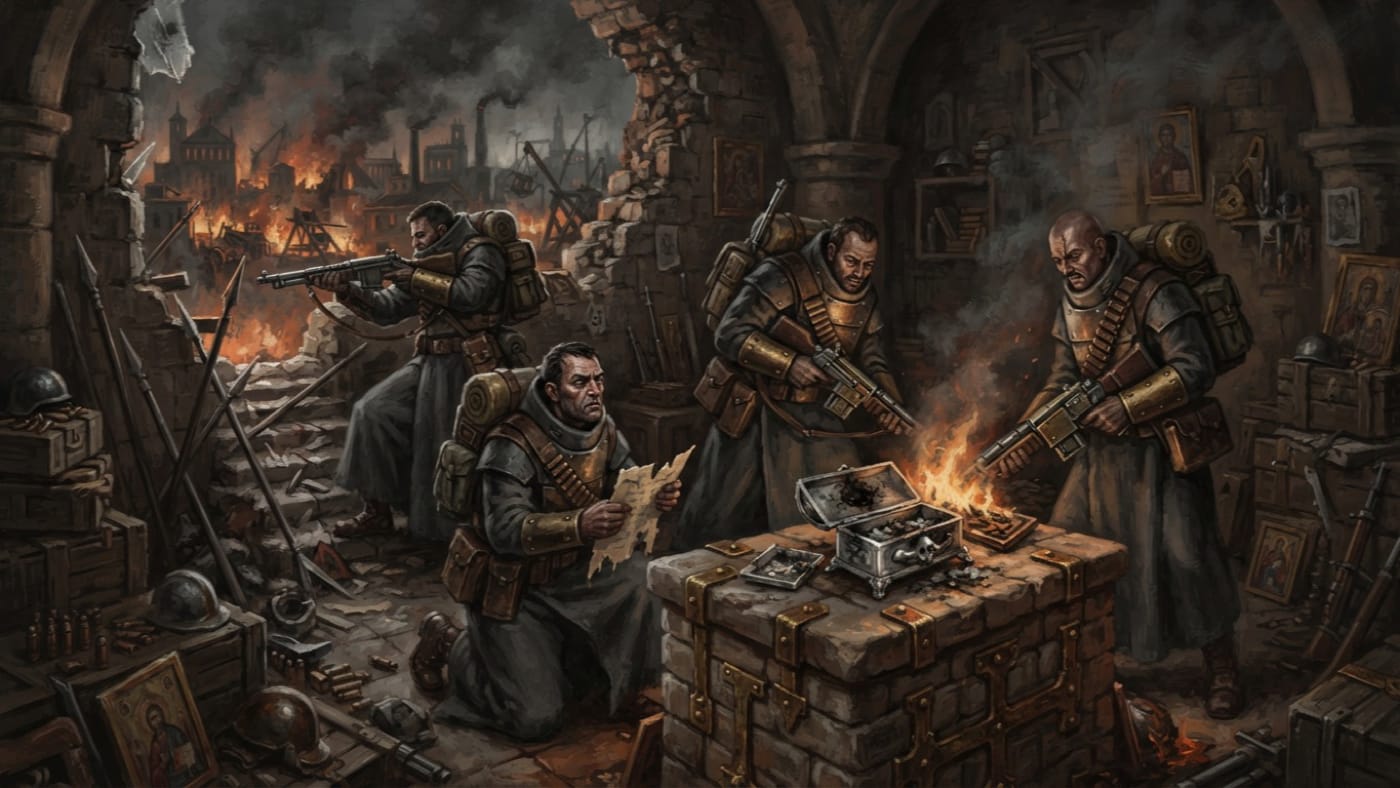
The shrine meant the house, fortified. Outside lay vineyards and mule-yards, and bell-lofts rose above. Small armouries stood behind the devotional screens, with the blades kept oiled. The screen hid the pikes from pious visitors. Every brother was expected to know which saint's panel swung open.
The guest gets more ink from me than the copyist gave him, because the Order's later admirers forget him altogether. Every house kept an infirmary. Pilgrims arrived footsore, fevered, robbed and now and then stabbed, and refugees arrived with less. The guest was fed, bound and bedded, and kept behind a wall. The fourth sentence explains the wall: mercy without walls is merely an invitation. The Order's hospitality was charity with a gatehouse. Anyone who has kept a hospice on a contested road will recognise the arrangement and countersign it.
The bone meant relic custody, which the Order held as an office. The second sentence sets its limit, and the wording should be read exactly. It forbids handing relic custody to a secular hand. It says nothing about ownership. It gives the Brother no licence to refuse a lawful transfer within the Church, and none to destroy whatever relic displeases him. It names one forbidden recipient, and that recipient is the secular hand.
#On Obedience and the House
Obedience was sworn to prior and abbot. The excerpt does not say so, but the Order's own account does. The same account says that poverty was interpreted with Iberian practicality, which means the houses owned vineyards and nobody pretended the wine was poor. Chastity appears in the Rule. Armour maintenance gets more ink. I take this as the copyist's private view of which would fail first, and I offer it as a joke against the copyist. It tells us nothing about the brothers' beds.
The surviving account fixes the order of formation. A novice learned psalmody before sword drill and wound-binding before rhetoric. The voice for the hours came first, then the arm. After the arm came the hands that close what the arm opens, and only then the tongue that argues. A finished lay brother could set a broken arm, patch a wall, load a culverin and spot a forged indulgence across a cloister. Such a man is tiresome at chapter and beyond price at a breach.
The third sentence ranks duties. Sleep gives way to the bell, and hunger gives way to the breach. The copy gives no bell sequence, no ration scale, and no penalty for the brother who sleeps through a summons. It gives an order of precedence, which is what a garrison needs at three in the morning when the wall is coming down and the soup is nearly hot.
#On Custody at Toledo
The Relic of Saint Iago was a jawbone set in silver. During the Desecrations it ended up as a paperweight on a Rationalist prefect's desk in Córdoba, and the Order took it back in A.S. 12 / 1722 CE. The Order was plainly in working condition by that year. The Rule is older than the recovery by a margin nobody has measured, and I decline to guess it.
In A.S. 15 / 1725 CE, by the reckoning the Church adopted long afterward, the Order held Toledo against Colonel-Prefect Étienne Grimal and his Republican Guards. The abbot was Father Clemente de los Rios. No record connects him with the writing of the Rule. He applied it. The siege lasted nine months, and its story belongs to its own article. The custody decision belongs here.
The final assault began on 29 November A.S. 15. The eastern breach gave way, and the Guards fought through streets barricaded with pew-wood and tombstones. The defence shrank to a single tower holding Clemente, the last defenders, and the Relic on a broken altar-stone. The Rule forbade him one act, and the enemy was on the stairs.
Clemente spoke the Psalm of Consuming. It is a separate prayer with its own restricted text, and no line of it belongs to the Rule. The tower burned with the Relic and the defenders inside it. Grimal took the city. He did not take the jaw. Received testimony holds that the Relic consented to its burning, as it was said to have answered his artillery in the first week, and Doctrine teaches the same. Nobody has established how either fire worked. I have not established it either, and I will not invent an answer for Engineering's convenience.
Now compare the clause with the act. The clause forbids surrender. Nowhere does it command fire. Clemente's judgement filled the gap between those two things, and the later Church built heroic destruction on that gap, as its classification for the deliberate unmaking of an entrusted object at the hour of capture. The classification is the Church's reading of a final decision about custody. Nobody should write it into the Rule's margin as a fifth sentence.
#On the Rule After the Order
The Order did not survive Toledo as an institution. Its garrison was destroyed. Its remaining houses were broken up or absorbed into larger bodies. The Rule survived as an example. No Bureau sat at Toledo in A.S. 15, and the formal Synod was seventy-five years away. Long after the Sundering, the Bureau of Doctrine began teaching the case under siege obedience and the distinction between possession and custody. The custodian holds the relic and does not own it, and he answers for it to the Creator. The Bureau of Relics keeps what is left: ash, silver beads, and a blackened mandibular remnant rated probable and no higher. The file gives no date for any of the registry numbers or classifications attached to the case, and every one of them was applied retrospectively.
The rebuilt chapel at Toledo shows an empty silver jaw-setting behind glass, blackened at one hinge, under the administration of the Bureau of Pilgrimage. No document proves that this setting passed unbroken from the burned mount to the glass. A small custodial fraternity keeps lamp-watch beside it in grey mantles and claims descent from the Order. The claim is contested. Its members can recite the four sentences. Nobody can say whether they keep the rest of the Rule, because nobody has the rest.
An older chronology of the Atheist Wars places the Siege of Toledo in A.S. 71 and records that neither side prevailed.
Corrected. The siege that defines the Iago Rule belongs to A.S. 15 / 1725 CE. Grimal took the city, and the Order denied him the relic. No second siege took place in A.S. 71 to rescue the older line, and I will not convene one.
The file stays at four sentences. Any fifth sentence that arrives with a pedigree goes to the Bureau of Relics for authentication, and its finder comes to me to be fined.