
#On the Palace and Its Paperwork
"Empires leave ruins. Governments leave minutes. Only the minutes survive a fire." — Drax, marginal annotation
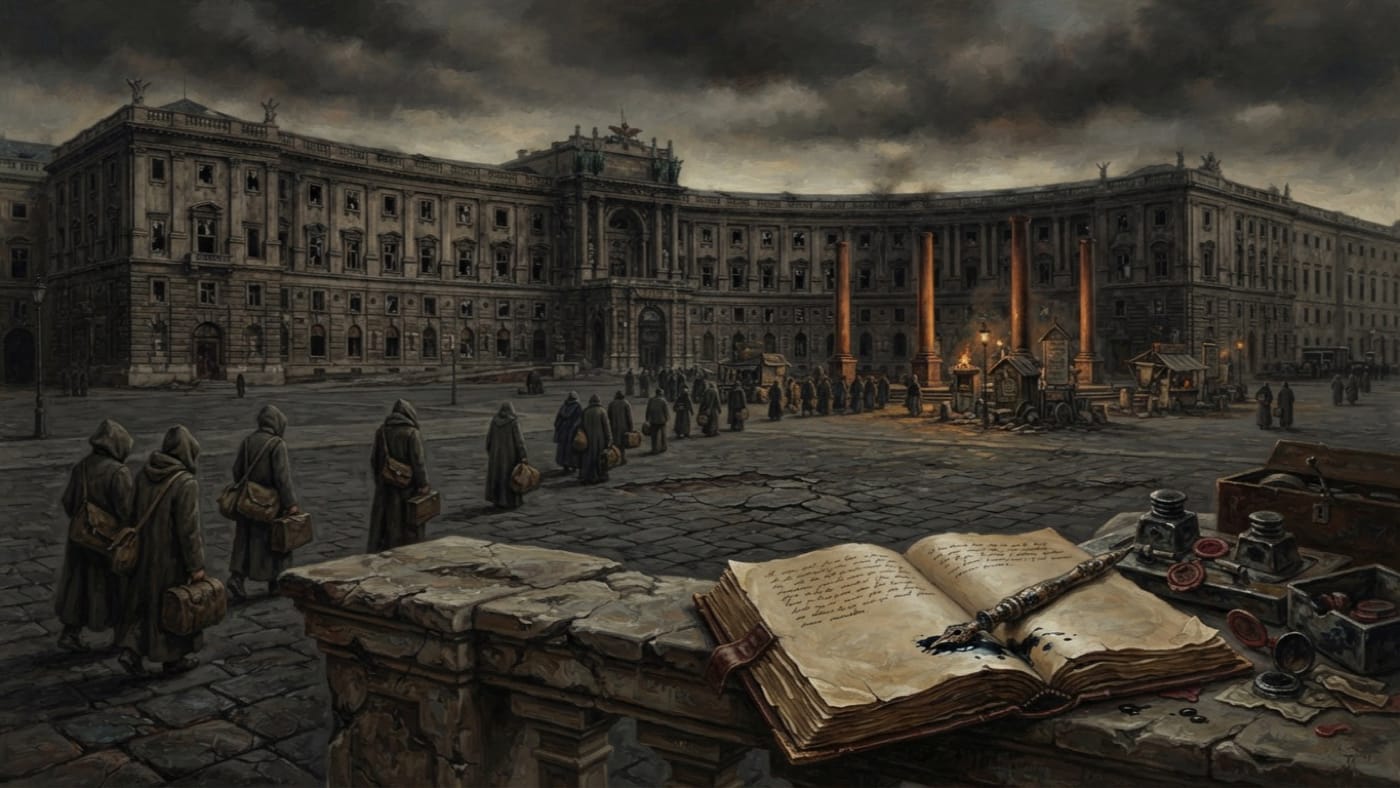
The Hofburg runs along the edge of the Heldenplatz in the shrine-ruins of Vienna. It is a long imperial front of soot-dark stone, and its windows have held no glass since A.S. 95. Emperors built it. The Ledger does not say which emperors, and the Rationalists who inherited the building were too busy measuring things to record whose roof they were measuring under. They took an emperor's house and put a committee in it. That is their entire political philosophy. I have read the long version, which runs to several hundred pages and says the same thing.
What interests me is what the building kept. A palace is an ordinary ruin. Every province of the Church has a burnt manor, a gutted residence, or a ducal hall with sheep grazing in the ballroom. The Hofburg differs in a way a clerk would notice before anyone else. When the authority that worked inside it vanished, its paperwork stayed behind. The desks remained. The minutes remained. A pen remained in the fold of an unfinished page, and the record of the palace's sealing says the pen was wet.
I am Warden of the Sacred Ledger. I have spent my life among the instruments of rule: the stamp, the docket, the minute-book, the seal pressed before the wax has cooled. I despise everything the Council of Nine believed. I recognise every object on their table.
#On the Seat of the Council
The Council of Nine governed from Vienna's Imperial Palace, and the Imperial Palace was the Hofburg. The Ledger cannot say when their administration first moved in. Rationalist government existed in practice long before it existed on paper, and the paper came at Regensburg. The Treaty of Regensburg gave the Republic its formal shape in A.S. 30 / 1740 CE and dissolved the Holy See of Vienna at swordpoint. The treaty was signed elsewhere. Its consequences were administered from here.
Consider what that administration involved. Nine councillors sat in rooms built for a dynasty's banquets and sent circulars to the Philosophical Prefectures. Every circular was dated, numbered and countersigned with a care I would admire in any other cause. They kept registers. They kept indices to the registers. Whatever else the Rationalists were, they were never sloppy with a file. This is the hardest thing for a Synodal clerk to forgive them.
In the same year, the Black Procession passed beneath their windows. Forty-seven saint-effigies, draped in mourning cloth, were carried through the boulevards and burned on pyres in the Heldenplatz, the square the palace faces. The fires gave light and no heat. Three citizens died of exposure beside them, and frost formed where the flames should have scorched the paving. The Rationalists published a chemical explanation. The windows of the seat of government looked straight down onto the pyres. Whoever stood at them that day had the best view in Vienna of the explanation failing.
#On the Ruin and the Reclamation
After the Sundering of 1 November A.S. 45, the Rationalist house began to fall in on itself. During the Great Retreat, which the Ledger dates to A.S. 48–65, Vienna's old relic-hoards gave the columns falling back westward a brief refuge. Relic-light holds a wall for a time. Vienna could not be held for long. Nobody recorded how the palace fared in those years, room by room. Ruins do not file damage reports, and their occupants are generally indisposed.
The older chronicles record that Vienna's civil order unravelled, that the Rationalist councils vanished, and that their records ended mid-sentence. I have read many ruined archives. In most of them that phrase is a figure of speech. In the Hofburg it describes the condition of a page.
The Synod came for Vienna in A.S. 95 / 1805 CE, five years after the Concordat of Strasbourg gave it a constitution to come with. The accounts of the Siege of Vienna disagree about its length and its ground, and those disputes belong to another entry. They agree on the essential act. Bishop-Warden Clemens Stahlhand struck down Althazar of Pest with the reliquary of Saint Aldebrand, and the witnesses swore the blow rang the marrow of the earth. According to the account preserved in the Vienna entry, it shattered every pane of glass still left in the Hofburg and cracked the Heldenplatz paving. The blow was struck outside the palace. The palace answered it anyway.
Inherited chronologies of the Ledger placed the Siege of Vienna, the blow of Clemens Stahlhand and the sealing of the Hofburg in A.S. 201.
The Siege, the blow and the sealing all belong to A.S. 95 / 1805 CE. A.S. 201 is the present year. The palace has been shut for a hundred and six years, which is long enough without a clerical error making it sound recent.
When Vienna was reclaimed, the Hofburg was sealed. The reclamation entry says so in one line. I have read that line more often than some psalms.
#On the Unfinished Meeting
The record is short, so I give all of it. The Hofburg was sealed with the Council of Nine's last meeting undisturbed. The pen lay in the final minutes, and the pen was wet. The Vienna entry adds that the last sentence of those minutes was never finished.
Everything else is missing. The record gives no date for the meeting and no agenda. It does not say how many councillors attended or what the unfinished sentence was meant to say. It does not say where the Nine went. In the copy that reached the Ledger, the minutes are described and never transcribed. I have asked for the transcription in writing. I received an acknowledgement of my request, which is the Bureau's way of saying no while keeping the paper.
I can read a minute-book, so I will say what a clerk sees. Minutes are written in a fixed order: the date, those present, the business, the resolution, the signatures. A sentence breaks off in the middle of the business for only a few reasons. The speaker stopped speaking. The minute-taker was called away. Or the room itself came to an end, by whatever means rooms end. The first two are commonplace. I have broken off minutes myself, usually because the Bureau of Tithes had entered the room. None of the three explains the ink.
Ink dries in a minute or two on the nib and a little longer in the fold of a page. The reclamation found it wet. Whatever interrupted the Council's last meeting, the pen was still behaving as though the meeting were about to resume.
A second document must be laid beside the first. A later custody report, recorded in the margin of the Vienna entry, states that the Bureau of Records collected the pen, that it is held in the Vault of Silences, and that it has not dried. I have seen that report. I have not seen the pen. The report gives no date of collection, no chain of custody and no inventory number that I am permitted to quote. The sealing record leaves the pen on the page in a sealed room. The custody report puts it in a vault. Both describe it as wet, and only one of them can be right about where it is. Neither office has offered to settle the matter, and I have stopped asking at the counter.
As for the Nine, I have heard every answer the taverns of the Corridor can supply. Some say they fled east. Some say they never left the table. Some offer explanations involving the Great Deceiver, and the Bureau of Doctrine has views on each. The Ledger has accepted none of them. The file is open. I will not close another office's file with my own conjecture, however elegant the conjecture would be.
#On the Palace Among the Living
The Vienna outside the seal is busy. It is a Zone 3 shrine-town on the Central Corridor, west of the Sagittal Line, where supply traffic and pilgrim traffic share the same streets and quarrel over the same inns. The A.S. 200 census counted about ninety thousand souls living around the ruins. The Bureau of Pilgrimage keeps its Corridor headquarters here. Convoys bound for the eastern passes take on water and paperwork. Pilgrims cross the Heldenplatz to the warm basalt columns raised where the cold pyres once burned, press their palms to the stone, and turn around to face the palace.
They see the façade, the soot and the empty frames. Few look long. A ruined cathedral invites prayer, and a ruined treasury invites rumour. A ruined seat of government invites nothing in particular, which suits those who sealed it. The pilgrims buy their miniature columns and go home. The shutters behind the empty windows stay closed.
Which Bureau holds the key to the Hofburg is a question I have also put in writing. The answer is in transit.
I will say this for the Rationalists, once and in the margin, where such things belong. They kept their minutes to the last line they were able to write. Their Republic is gone and their coin is worthless. The Council of Nine is a heading in another office's file. Their pen, wherever it is, is still wet.