
#On the Hall at the Bend
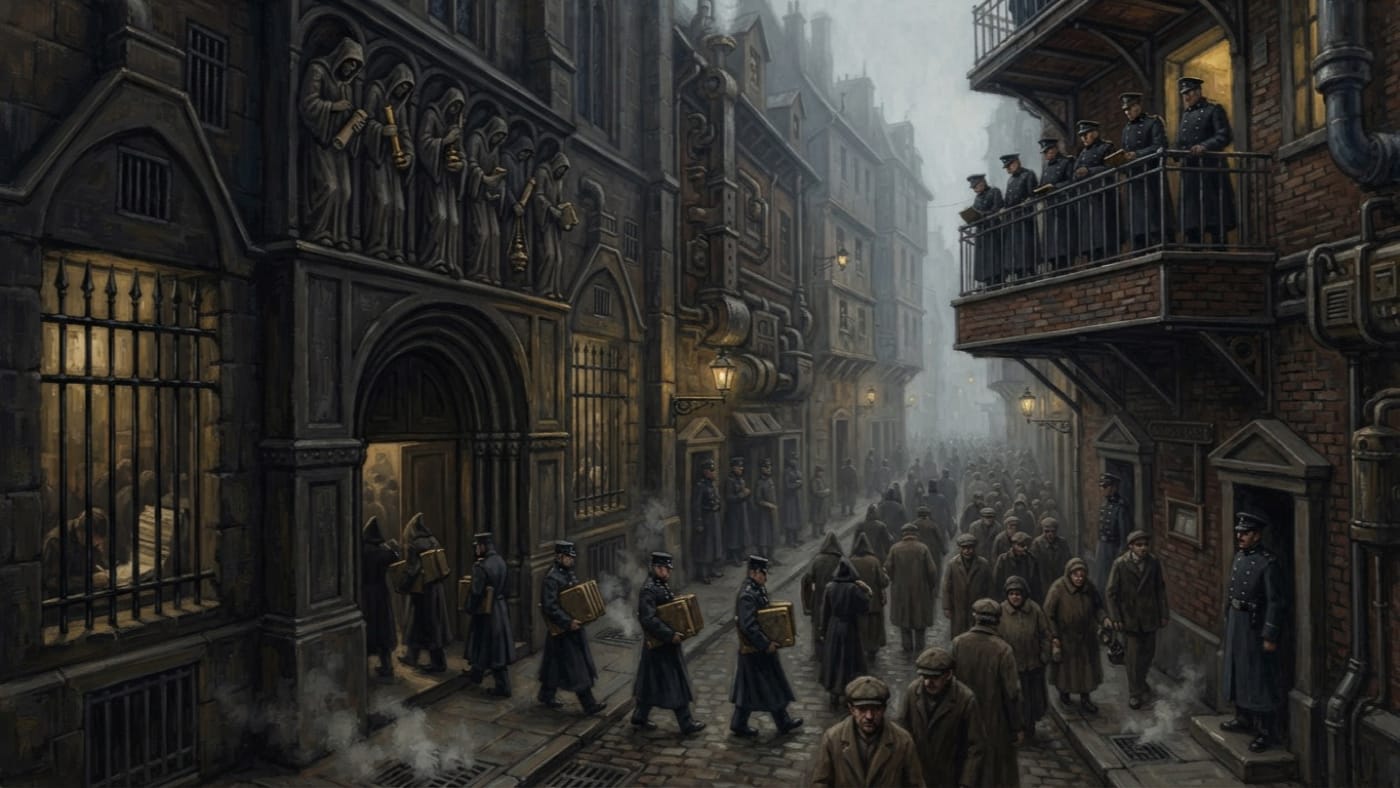
The Synod meets in the Hall of Confessions. The Hall sits at the central bend of the Sanctum Mile, the white corridor of Strasbourg where the stone of the Cathedral, the Bureau houses and the administrative courts crowd together like magistrates who have been made to share a bench. The street narrows at the bend, enough that every delegation going to the Hall has to pass beneath the balcony of the Bureau of Doctrine. They go in single file or close to it, watched by whoever Doctrine has put at the rail that morning.
I have made that walk with a folio under my arm. It felt like being proofread.
The Mile has wider stretches for its processions and grander façades for its foreign envoys. It spends no width on the Hall. People reach the bend on the papers the Mile accepts: permit, service order, custody, funeral licence or a place in a procession. Reaching the bend proves that one of those papers was in order. None of them gives the bearer a seat in the Hall.
Nobody has explained the building's name in my hearing. Records holds no founding confession filed under it, no sermon of dedication and no builder's account, at least none I have been allowed to read, and I have read a great deal I was not allowed to read. The Hall is known by what it is used for. Its age, its patron and the year of its first session have not been established, and I will not invent them to suit a guidebook.
#On the Carved Witnesses
The Synod sits beneath carved saints. I cannot give their names because the Hall's record gives me none. I will not give their number either, because counting saints in print invites someone in Heraldry to ask why the number is what it is. No folio I have handled names their sculptors or dates their installation. What the stone does supply is posture. The heads are bowed, the hands hold whatever the carver judged fit for holiness, and the eyes rest on the floor where councillors stand to speak.
The clerks sit behind grilles. I will not diagram where the grilles are set. A speaker in the Hall knows that two audiences are present. The saints above have heard everything and repeat none of it. The clerks behind the iron hear everything and write it down.
The effect on oratory is immediate. Councillors who bellow in refectories lower their voices in the Hall. They do it out of arithmetic rather than humility, because every syllable they spend will be entered, and entries are paid for later. A man may survive a foolish speech and still be ruined by the clerk who took it down. The saints have never ruined anyone. They hold their candles and their palms and their carved books shut, and whatever they think of the motion before the house, they keep to themselves.
#On the Voices Entered
A word spoken in the Hall passes through three conditions.
When it is spoken, it lasts as long as the breath behind it and the memory of whoever was awake. Once entered, it lasts as long as the vault stays dry. It reaches the public only after someone with the authority to do so has decided what it meant.
The first condition belongs to the speaker and the second to the clerk. The third belongs to the Church, and the Church takes its time.
I should be precise here. Being precise is what the State pays me for, and I bill for it separately. Across the Synod as a whole, the Bureau of Records keeps what has been written, Doctrine rules on what writing signifies, and Purity deals with anyone who prefers a different meaning. Those are the Bureaus' general offices, set out in their own ordinances. None of those ordinances is a rule of the Hall. I cannot tell you in print which Bureau the clerks of the grille answer to. No ordinance I can cite describes how a speech becomes a page, who reads the page afterwards, or how long it survives. I know that the voices inside are recorded. I know what it costs a man when his own words come back to him in a clerk's hand, three years later, read aloud by a stranger in a cold room. What happens between those two facts I leave to the people paid to keep it.
The distance between what is said and what can be preserved is ordinary, and every archive in the Church lives in it. The Hall makes it architecture. Saints above, iron to one side, a narrow street outside, and between all three a recorded silence that a quill keeps breaking.
A visiting abbot once asked me whether the Synod's debates were ever published. I told him the Synod publishes conclusions. Debates are for the grille, and the grille does not take subscriptions. He thanked me and went home to his province. I hope he found it still there.
#On the Authority Convened
The Synod that meets in the Hall is the formal Synod, constituted at the Concordat of Strasbourg in A.S. 90 / 1800 CE. Before the Concordat the city was governed by a provisional council, working by about A.S. 50, and by offices that grew up around it. That was a real government, but it was not yet the constitutional body. The Concordat dates the Synod. It does not date this building. I cannot say whether the provisional men ever sat in the Hall, or what they called it if they did.
The founders did not live to see the Concordat. Kratz died in A.S. 88, and Augustinus had died before him. Every word ever spoken in the Hall under the formal Synod's name was spoken by their successors. Anyone who tells you otherwise is selling an engraving.
Strasbourg has more than one room of government. The Bishops-Praetorial keep a constitutional chamber of their own elsewhere in the capital. I have heard jurists argue through whole evenings about which room outranks the other. No ordinance settles the question, and no sensible Hieromnemon joins that argument in public. The Hall is where the Synod meets. I have no other jurisdictional claim to make for it and will not lend it one.
The Codex plate on Strasbourg, sealed A.S. 201, styled the capital "a city that has not slept in fifteen centuries" and let the reader suppose that the Synod had ruled from it for that span.
Corrected. The stone is old and the Synod is not. Its formal constitution dates to the Concordat of A.S. 90 / 1800 CE. Provisional offices gathered in the city some four decades earlier. Neither date fixes the age of the Hall of Confessions, which remains unestablished. The fifteen centuries belong to the masonry and to the paperwork's opinion of itself.
#On Those Who Hear the Bells
The voices inside are entered on the page. The crowd outside hears bells.
The difference between those two audiences is the whole design of the bend. Inside, government speaks to itself before carved witnesses and recording clerks. Outside, the same government shows itself to the city as bronze and interval. A citizen standing at the permitted edge of the Mile cannot tell you what was moved, opposed or carried. That citizen can tell you the hour. The Bureau of Bells keeps the civic time of the capital, and the capital has accepted the arrangement. In my experience nobody has ever rioted over an hour.
The street around the Hall belongs to the Mile and follows the Mile's rules. Patrols keep their rhythm and curfew keeps its bell. Inspection niches sit beside doorways, with a clerk in each who can tell a courier from a supplicant at forty paces. The sight-lines are cut for processions. The Triune Knot is set into bronze along the whole route, polished until a careless sleeve becomes a matter for Heraldry. Delegations pass under Doctrine's balcony, go through the Hall's doors and come out again, and the crowd watches them as it watches weather. The motions themselves never reach the street.
Three buildings east of the Hall stands the Prison of Questions, officially the Administration of Clarification. It is a separate house with its own door, its own keys and its own ordinances. No record I have read gives it any business with the Hall beyond sharing a street. I report the distance because distances are facts, and facts are my trade. Anyone curious may walk it and count the doorways.
#On Its Present Service
As of A.S. 201 the Hall of Confessions remains in Synodal service at the central bend of the Sanctum Mile, inside a precinct that is fully active, patrolled and policed down to its doorways. The Synod meets there. The clerks keep to their grilles. The saints keep their counsel, which is more than can be said for some councillors I could name and, being prudent, will not.
The street still narrows and Doctrine still keeps its balcony. Outside, the bells still ring. A Masks and Seals officer told me, without being asked, that the Hall's doors have never once been opened to the crowd during a session. I thanked him and entered it in my notes, and now it is entered here as well.