
#On a Coast Prepared for Ships
Calais was two years old in A.S. 71, if a fortress may be dated like an infant, and it had been built against the wrong enemy. The offices that later registers file under the Bureau of War requisitioned the chalk headland in A.S. 69, because the Channel had begun returning fishermen with their vocabularies rearranged and cargo manifests dated weeks ahead. Strasbourg sent engineers. The engineers cut gun galleries into the white cliff and angled every embrasure at the surface of the water, where any sensible enemy arrives by hull. The coastal chapterhouse followed in A.S. 70. That is the name the later registers give it, and its plaster was still damp.
Nobody aimed a gun downward. Beneath the galleries lay sea caves, quarry cuts, smugglers' boat tunnels and the flooded seams of older workings. The Chalk Redoubt sat on all of it the way a magistrate sits on a chair whose legs he has never inspected.
#On the Three Alarms
The Breach began in west-hush. Outsiders take the word to mean calm weather, which is how outsiders drown. West-hush is the harbour holding its breath: no wind, no lap at the pilings, and on that night, by the account preserved in the coastal file, even the harbour chains stopped clinking.
The record keeps three alarms in order, and the order traces the line of attack.
The first came from the Net Quay, where children saw lamps moving under the water with no divers attached. They told their elders. Their elders sent them to bed.
The second came from inside the cliff. A chalk miner found his tunnel filling with black brine from the ceiling. The sea had come in from above him, and a man who sees that loses his faith in geology.
The third came at the boat-tunnel locks, which opened inward against the tide and returned three watchmen. They were upright and walking, and they were already drowned.
#On Eleven Hours in the Chalk
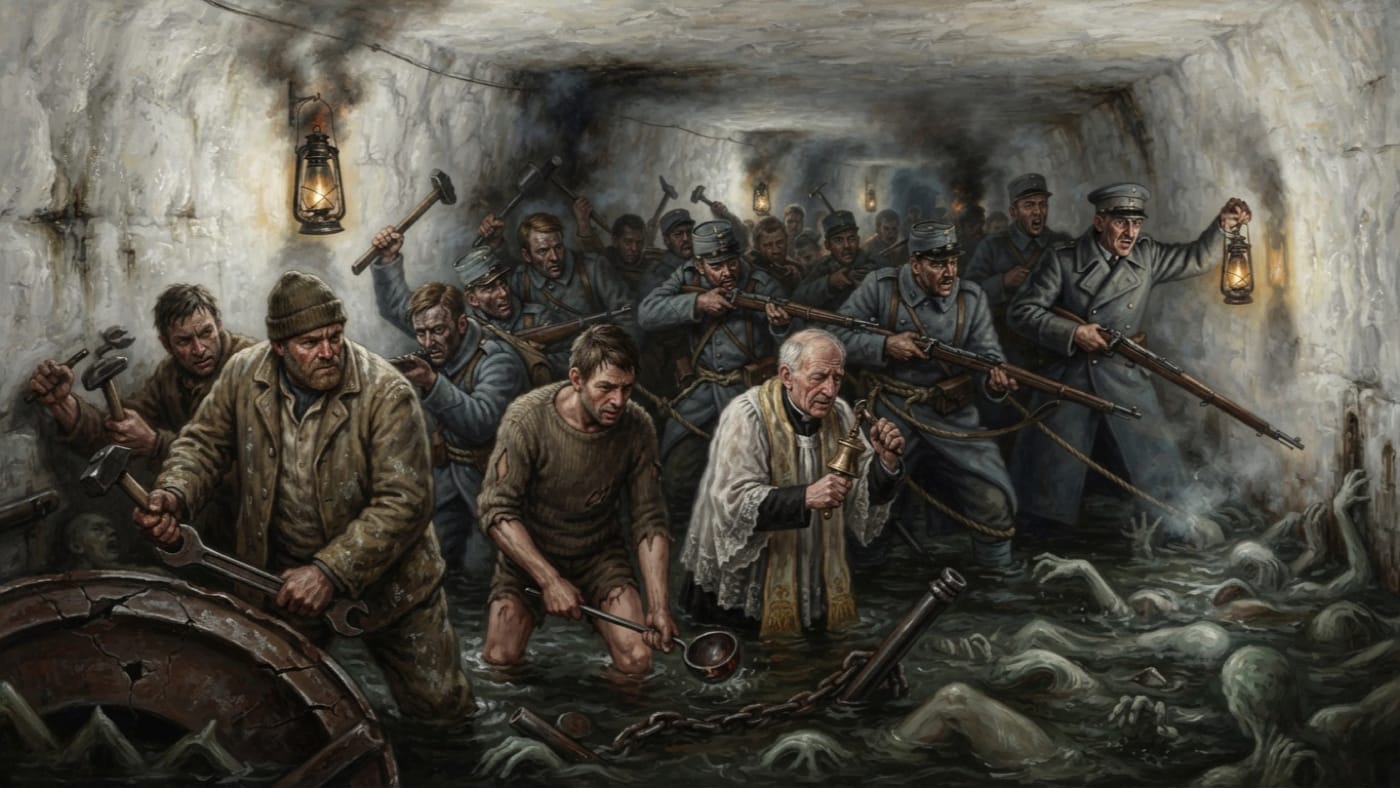
Then the caves broke, and the garrison went down to fight the sea in its own corridors.
Survivors called it eleven hours in a throat. They fought by lantern-light through flooded chalk passages, on stairwells where water rose without wetting the walls, in quarry cuts too low for a man to stand upright and too narrow for two to pass. Men tied ropes to their belts so that the living could find their way back and the dead could be found at all. Powder went damp in the horn before anyone could pour it. Orders shouted down a tunnel came back up it altered.
The garrison had brought the wrong arithmetic. Men fired rifles into shapes that, by their own report, parted around the shot and closed again behind it. I record this as an observation from one night in one body of water and decline to promote it into a law of nature. The men in that tunnel were in no condition to conduct ballistic trials. Since then the Bureau has treated every frightened sentence from A.S. 71 as technical specification when that is convenient and as hysteria when it is expensive.
The water climbed. It took men at the stair-foot, in the side galleries, and in locked rooms where the keys stayed dry in their pockets. Hundreds drowned. The figure is "hundreds" because no clerk came out with a complete roll, and I will not supply a total that the night itself refused to keep.
COASTAL INCIDENT ABSTRACT — A.S. 71 (later copy) Officer commanding lower galleries: ████████████ Entities engaged, estimated: ████ Garrison dead, final count: █████████ Copyist's note: "Originals water-damaged. Do not reconstruct."
One testimony survived because the man in it kept talking. A Tribune-Chaplain, unnamed in the file, recited the Litany of First Earth in a flooded passage. He was answered in the voice of his dead mother, who asked why he had buried her facing east.
#On the Instruments of Necessity
The thing that drove the Undertide back was noise, of a peculiar and unlicensed kind.
Someone began striking a signal bell in rhythm. The record does not say who, and I have stopped expecting it to. Others joined in with whatever lay to hand: cracked cannon rims, powder ladles, and one chapel handbell carried down from above. These were not instruments. They were inventory. Men without shoes beat out intervals into the dark with the water at their shins, and the things in the caves withdrew.
Afterward the survivors could not remember the sequence. The later Gunline Choir has never reproduced it. Every bell-chart since kept at Calais claims descent from that night the way a bastard claims descent from a duke: by assertion, and without paperwork.
A Bureau of Bells training sheet describes the A.S. 71 repulsion as "the first formal coastal choral artillery action."
Corrected. The men in the tunnel held ladles and a cracked rim. Emergency bell practice was regularised in A.S. 72, and the Choir was certified in A.S. 92. The word "formal" entered the account two decades late, together with the certificate.
The chapel handbell was later confined in the Index Damnatus for excessive acoustic efficacy without license. When it entered the Index, and on whose order, is not of public record. That is fitting. Nobody recorded who rang it either.
#On the First Writing
The entities withdrew into the caves. The water fell. The harbour went still again, and fog came in over quays wet with more than brine.
On the exposed cliff between the Gun Galleries and the Crownline, the Script Wall wrote for the first time.
The sentry Haller had been posted to the midnight watch to observe the chalk for seepage. It was a sensible order, since the cliff had spent the evening leaking the sea. Instead of seepage he saw letters forming in the condensation: fourteen names. He had no reading protocol and no roster, and no superior was within shouting distance. His only instruction was to watch. He read the names aloud.
By morning six of the fourteen had drowned in calm water. Eight lived.
Those six belong to the morning after. They are not to be folded into the Breach's hundreds to fatten either figure. Nor may Haller's reading be told as a rescue, though Calais tells it that way to its children. Eight people survived a reading, and six people died after the same reading. The relation between voice, survival and stone was unresolved that night, and it has stayed unresolved on every fog night since, whatever the number of readers Calais lines up along the chalk.
Coastal digests compiled in A.S. 83 date the first Script Wall writing to that year.
Corrected. A.S. 83 is the year of the first standardized reading register. The Wall first wrote in A.S. 71, on the night of the Breach, and one sentry read it with no form to fill.
#On Hauling the Dead
The retreating water left bodies in vents, cisterns, quarry cuts and locked rooms. Someone had to go in after them.
The first descents were made by quay workers, chalk miners, net haulers, condemned smugglers and a bell-rigger. They knotted ropes at the waist, tied oilcloth over their mouths, and carried lanterns sealed in glass jars. They had no brass, no pump and no throat plate. Those came generations later, along with the tariff. The Undertide Divers trace their corps to these people, and the early annals call the dives voluntary acts of pious recovery. Some of the divers were under sentence, and at least one had been promised remission of a salt debt. At Calais, piety usually enters the record after coercion has done the hauling.
What they brought up was not only human. Pale, hardened remains of the things in the caves lay cooling on the Net Quays while officers argued about whether to burn them, bury them, or pretend they had not noticed.
#On the Offices That Inherited the Night
Calais built itself out of the Breach in stages, and the stages should not be collapsed into one heroic morning.
Emergency bell practice was regularised by A.S. 72. In A.S. 74 the Teeth were raised at the harbour mouth from iron, chalk-lime and those recovered remains, on the advice of the Bureau of Alchemical Standards. The barrels that had held what the divers brought up grew into a quarantine regime that later became the Undertide Pens. In A.S. 83 the Wall received its register. In A.S. 84 the Salt Tribunal was ratified, and from then on every dive earned a ledger line. In A.S. 92 the Gunline Choir was certified and issued rank tables for a victory first won by men holding ladles.
Each office took its portion of that night as an inheritance and had the inheritance notarised. The improvisers received nothing that survives, and the drowned received a figure that is not a number.
One hundred and thirty years on, the Redoubt still faces west across the water and the guns still point at the surface. Below them the caves have been mapped, roped, belled, quarantined and taxed. They have never been closed.