
#On the Place in the Northern File
A city entered in the Codex because a survey reached it.
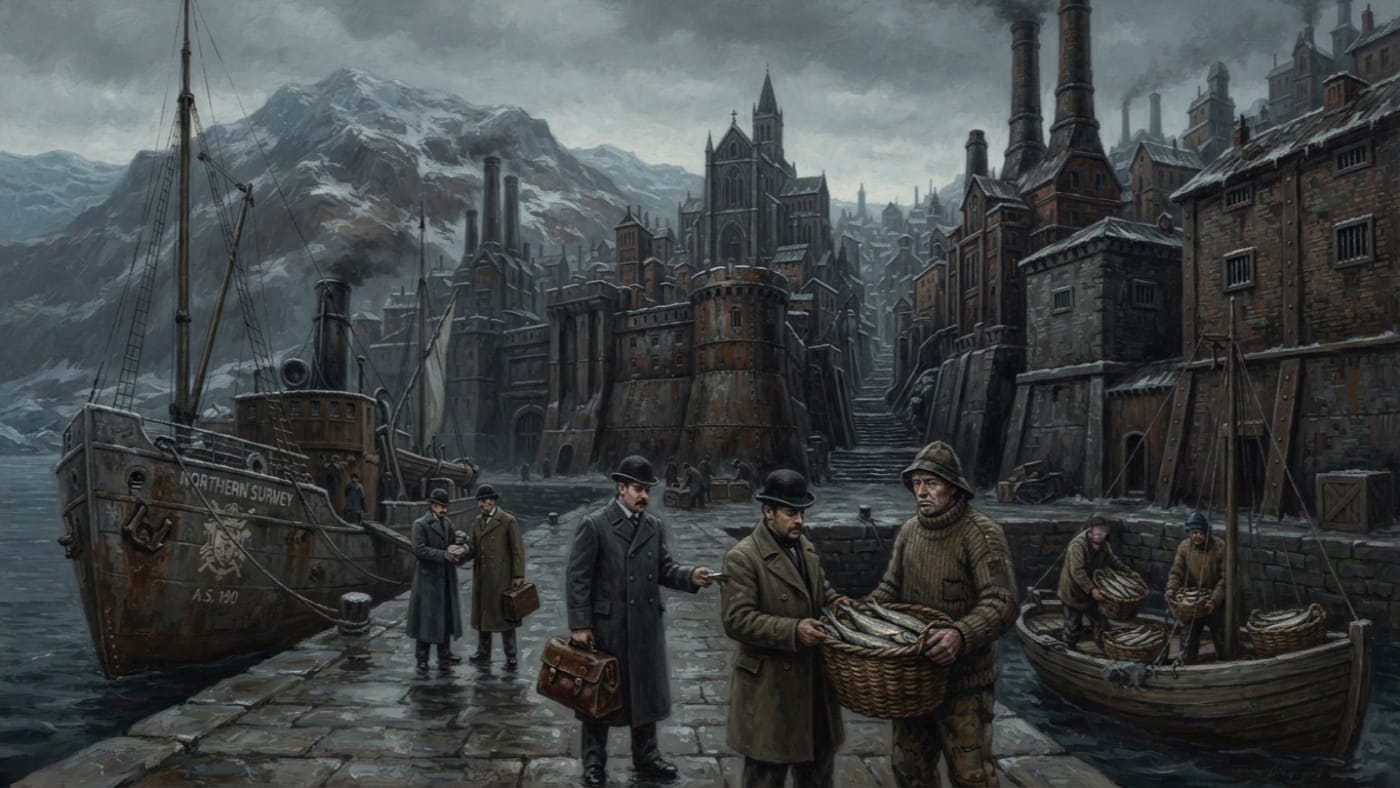
Gothenburg appears in the files of the Bureau of Doctrine for one reason: a southern survey arrived there. The Bureau's northern drawers hold no charter for the city, no census of its parishes and no plan of its harbour. They hold a single sentence of travel. In A.S. 190 the Northern Survey reached Gothenburg, surveyed two fishing villages, accepted fourteen gifts of dried herring and returned to Strasbourg. A doctrine was once propped on that sentence. The prop gave way.
Southern map-rooms place Gothenburg on the Swedish coast of the Fractured North, within Zone 8. The Bureau has accepted that convention because nobody in Strasbourg has been asked to defend it. The city can be reached. Ships go there. Clerks go there when ordered, and they come back. That is the whole of its distinction in our files, and it is the distinction that spoiled the file. In the summary, a place the Survey could reach was mistaken for the region the Survey had been sent to examine.
#On Authority at the Northern Approaches
What a southern seal can open, and what it cannot.
The Lore Book records that the North keeps the faith without the Synod keeping it on the North's behalf. Wardens are few, and each family enforces the Covenant as zealously as a tribunal. Devotion to the Creator is constant there. Submission to Strasbourg is another matter, and the North negotiates it separately through clan moots, elder councils, harbour compacts and the elected captains of the Winter Watch. None of these regards a southern seal as the end of a conversation.
I record these as patterns of the region. I certify none of them for Gothenburg. The Bureau holds no roll of the city's elders, no name of a Prior attached to it and no compact bearing its harbour-mark. A southern investigation arriving there in A.S. 190 would have met some authority, since every settlement above the Danish straits keeps one. It would have learned that authority's name only if the authority chose to give it.
A southern investigation can establish only a short list of things in such a place: whom it spoke to, what it was shown, what it was given, and when it turned for home. It cannot establish what was withheld. The Bureau of Records has never ruled a column for that. The northerners have never needed one.
#On the Northern Survey of A.S. 190
The particulars, entire. They do not take long.
The surviving account is the one kept in the Codex entry on the Virtue Generals. I give its particulars in order, because order is the only dignity they have.
The Survey reached Gothenburg. The account names no ship, route, season or officer. It does not say which Bureau sponsored the expedition, and I will not guess. A guess entered in the Codex becomes precedent by the next quarter-day.
The Survey surveyed two fishing villages. Neither is named. The account gives no distance or direction from the city, and it does not say whether the villages lay within the city's customary reach or merely within an afternoon's walk of wherever the Survey lodged. Two villages. I have read Bureau reports on a single misprinted hymnal that ran longer than the surviving account of both.
The Survey accepted fourteen gifts of dried herring. The record says fourteen gifts. A reader who turns that into fourteen fish has done arithmetic on behalf of an absent clerk, and a reader who turns it into fourteen households or fourteen bribes has done worse. In a coastal settlement of the North, dried herring is what a household gives a guest who has come a long way and will soon leave again. It is hospitality of the most ordinary kind. Entered in a ledger beside a negative finding, it is also the most eloquent line in the report.
The Survey then returned to Strasbourg and reported its conclusion: no evidence of heretical activity.
I do not dispute that conclusion. In two villages, the Survey found nothing it could enter under heresy. The finding is accurate, and I would defend it before any tribunal the Synod convenes. It is accurate in the way a weekday pew-count is accurate. The error came later, from the hands that carried the finding south and set it like a found relic on the altar of a larger claim.
This Codex once held that the Northern Survey of A.S. 190 conclusively debunked the Exile of Temperance.
The Survey reported no evidence of heretical activity in what it actually surveyed: one city reached and two fishing villages examined. That finding cannot be enlarged to cover Scandinavia. A clean page from two villages certifies two villages. The earlier statement is withdrawn. The finding stands at its proper size.
#On the Exile in the Report
Why the Bureau wanted the finding at all.
Condemned testimony, preserved in the Lore Book and in the interrogation records gathered under Standing Order 44-D, describes the Exile of Temperance. The Exile is said to be a wanderer of the frozen North who neither hungers nor thirsts, and who teaches balance in place of obedience. The Bureau of Temperance has never feared the hunger. The Bureau files, catalogues and occasionally honours a fasting holy man. What it objects to is the teaching. Obedience asks the Bureau for the measure. Balance asks the measure to justify itself. Private judgment that has learned to weigh a ration soon learns to weigh a writ.
A Survey that came back from the North with a clean page offered the Bureau of Doctrine something rare: a refutation with a place-name attached. That place-name was Gothenburg.
The record does not place the Exile there. No testimony I have found puts the figure in Gothenburg, records an encounter in either village, or credits the city with a shrine, a following or a single heretical verse scratched on a net-loft wall. I say this plainly because the opposite error waits for the careless reader. A negative finding that was overstated does not thereby become a positive one. Nothing shows that the villagers hid anything, or that the herring bought anyone's silence. Who or what the Exile is, whether it exists, and on whose side it walks if it does: the Bureau holds all of these open under Category Two condemnation. The Survey closed none of them.
#On the Limits of Inspection
How far a survey can see from a harbour.
The Survey went north only as far as a ship could carry clerks in reasonable comfort, and its finding holds only to that latitude. Every attributed account sets the Exile walking the frozen wastes. A reachable harbour is not the frozen wastes. A survey that kept to one city and two villages within its compass examined only the outer court of the question.
Beyond such places, the Bureau's reach thins quickly. Moots answer to their own elders, and Watch captains report to the moots. Where Priors are tolerated at all, they serve at the settlement's pleasure. In the North, local knowledge is held the way a family holds a lamp through the long dark: close at hand, and kept for use. A southern clerk with fourteen gifts in a satchel has been made welcome. Being welcomed is a different matter from being told.
The fjord bells are instructive here. The Bureau of Bells has documented northern peal practices that it can neither regularise nor explain, and the parishes concerned have answered its letters with perfect courtesy and no compliance. Nothing in the file ties such a bell to Gothenburg, and nothing records an acoustic incident during the Survey's visit. I cite the bells only as an example of a northern habit: what is asked is answered, and what is not asked stays home.
The Bureau's later northern attempt has to be kept separate. In A.S. 193 an operative was returned to Bastion-Königsberg in a fishing boat, carrying a polite note that asked the Bureau to send no further visitors. That was a separate expedition, with its own failure and its own return. It never passed through the Gothenburg file, and it proves nothing about what the Survey of A.S. 190 saw or missed. What it proves is that the North can send a man home with a note no Strasbourg linguist could read.
#On the Present Standing of the Record
The finding kept, the use withdrawn.
The finding stands. The Survey found no evidence of heretical activity where it looked, and the Codex continues to say so, at the finding's proper size.
The doctrinal use of that finding is withdrawn. Standing Order 44-D, issued in A.S. 134, condemns the Virtue General doctrine on its own grounds, and those grounds never needed Gothenburg. The order's revision of A.S. 196 came six years after the Survey and owes it nothing. In A.S. 199 the Bureau of Rites classified northern liturgical practice as Concordat-Variant, Category B — Locally Adapted, Non-Heretical. That ruling concerns how the North prays. It says nothing particular about Gothenburg, and it does not lift a single clause of the condemnation of the Exile. A reader who takes tolerance of northern liturgy as acquittal of a northern wanderer has made the Survey's mistake from the other side.
Gothenburg keeps its place in the Codex as the city the Survey reached. No other entry about the city has been found.