
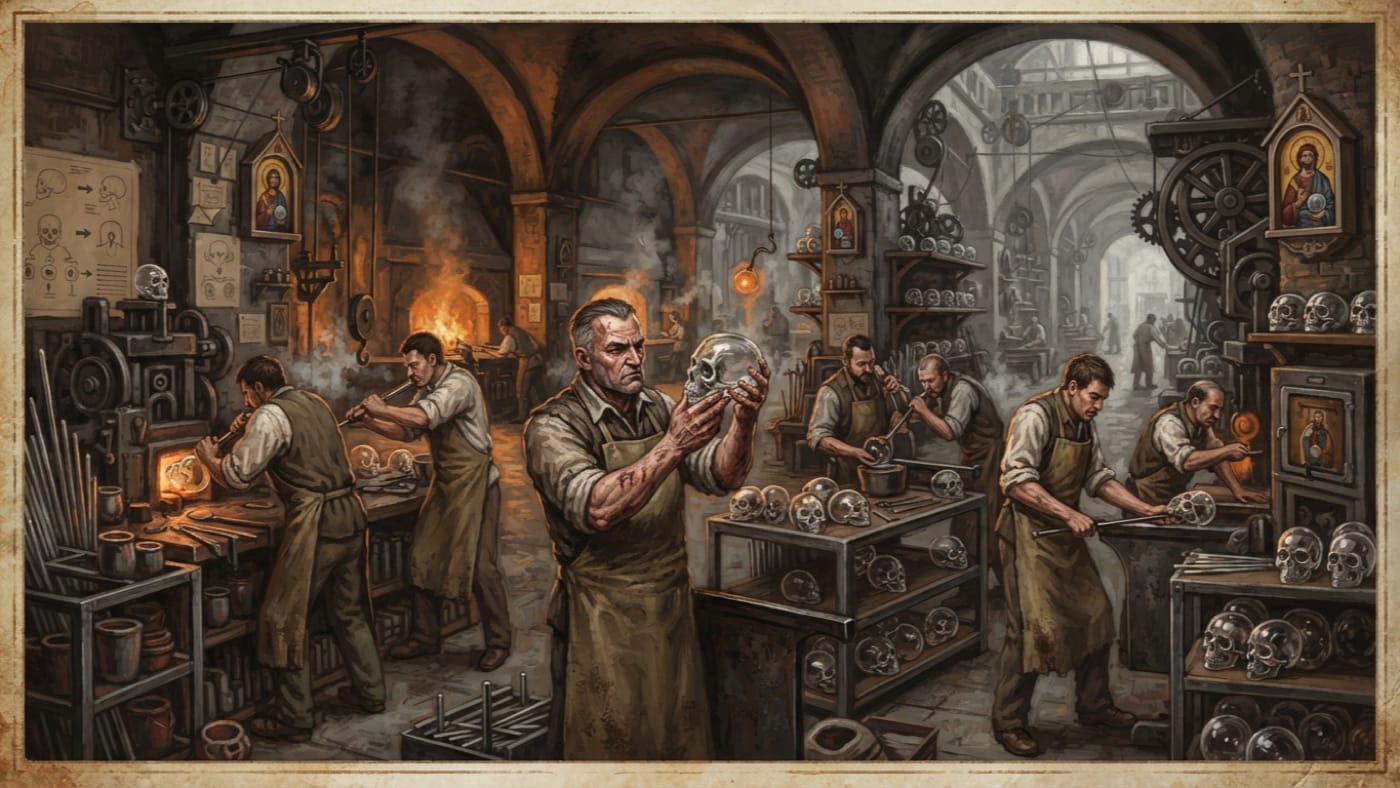
#On the Glasswright's Station
In this Codex, a glasswright is a licensed artisan whose furnace work ends up on a street corner, looking at children. The same lanes and the same blistered hands produce lamp-glass, reliquary panes and chapel lenses, and I do not slight any of them. The trade has its entry here because of one commission: the hollow glass crania that crown the Glass Skull Stacks. The Pillar-Keepers maintain those Stacks at bridgeheads, ration courts and school gates, wherever the Synod wants a citizen to meet a warning before breakfast.
Three hands handle the work. The glasswright casts the empty skull. A Bureau clerk sends the name and the order. The Keeper climbs, fits, inks and certifies. Glasswrights decide nothing about guilt, and they are paid on the understanding that they never will. They supply the vessel the sentence is poured into, much as the potter supplies the urn and is not asked about the deceased.
The Keepers' own account speaks of glasswright guilds in the plural. It also mentions glasswright foremen, and glasswright lines that a lucky custodian may marry into. I have found no reliable record of charters, masters, ranks or seals, and I will not invent one for the pleasure of a tidy column.
#On Castings and Custody
A Stack unit is a hollow glass cranium, cast to take ink and to be replaced. Being replaceable is its whole virtue. A stone statue must be quarried, carved and argued over. A glass skull can be swapped before the morning bell when a name is added, struck off, or cracked by a thrown stone. The Keepers' history says the Stacks spread after the early bastion riots because they were cheap. The glasswright's furnace is where that cheapness acquires a face.
The ordinary licensed casting leaves the workshop blank. The hagiographers can say what they like about breath and names; the unit still travels to the depot empty, wrapped and counted. Keepers call a fresh shipment new teeth. Keeper history also records a later refinement in which certain names were sealed inside the glass itself, to frustrate graffiti. Where that practice holds, the name reaches the glass before the glass reaches the Keeper. Someone at the bench has then handled a sentence they were never meant to read.
Custody begins at the depot. The Keeper logs the damage on the old unit and draws the keyed pin. The Keeper then cuts and renews the seal-wire, seats the replacement, inks and checks the inscription, checks the alignment, relights the lantern and certifies the route. The glasswright performs none of these acts. The workshop's liability survives the handoff all the same. A hidden crack, a seam filled with resin to pass inspection, a unit delivered without its seal: on the ladder each looks like the Keeper's fault, and at audit each becomes a question for the workshop.
Two kinds of defect must be kept apart. A physical defect is a flaw in the glass. An administrative defect is a flaw in the paper. Examples are a mis-inked name, a seal the Bureau of Records cannot trace, or an unsealed skull installed during audit season, which Keepers call an "open mouth." A physical defect is answered with a replacement. An administrative one may be answered by the Bureau of Purity, which prefers to deal with persons.
#On Velek's Patronage
Saint Velek the Clear-Eyed is the ratified patron of licensed glasswrights of approved severity. The glasswrights share him with Pillar-Keepers, municipal custodians and Glass-Listeners. Ratification is a status granted by the Bureau of Doctrine. It certifies that a saint is useful. His biography belongs to another department.
The authorised vita makes him a glasswright attached to a Purity yard and calls him a glasswright-executioner. That hyphen has done more for the trade's self-regard than any wage settlement. The workshops cite his first recorded miracle with professional interest. A condemned name would not hold ink, so Velek warmed the casting over charcoal, pressed his thumb to the inner curve and breathed one word into the hollow. The name held. Glasswrights tell the story as a lesson in surface preparation.
He is shown with a glass orb in his left hand and a branding iron in his right. The iron reads LOOK UP. REMEMBER DOWN. In the oldest woodcuts the orb has a bubble near its centre that bends the engraved pupil behind it. Later devotional printers polished the bubble away, and Keepers chalk it back onto depot walls. Any working glasswright can tell you which version a craftsman made. The other was made for pilgrims.
Workshop tradition, repeated in provincial pamphlets, holds that Velek invented the Glass Skull Stack programme.
Corrected. Civic Doctrine codified Visibility Standard 7c in A.S. 143. Velek did not invent the programme. The glasswrights have been informed. They keep lighting the candle.
#On Listening Glass and Suspect Work
Velek is also credited with listening glass: castings said to catch, hold and give back sound too regular to blame on the wind. Keeper superstition and half-burned guild notes give the method. It calls for sermon-clear glass, bone ash and a cooling chant, with a name spoken into the hollow as the glass passes from red to black. I record the recipe as reported. No licensed workshop I have audited admits to the chant. Several admit to the ash, which they say costs less than sorting sand and is nobody's business.
The Bureau of Engineering denies the technique exists. The Bureau of Bells denies it has jurisdiction. Purity holds the relevant appendix in custody and says nothing. In Purity, saying nothing counts as a full sentence.
Glass-Listeners use the Velek cup further down the chain. It is a thumb-thin glass bowl held against an iron rib of the Stack while the Listener sets their teeth on the rim. The procedure recorded in the saint's dossier sorts what they hear. A condemned name calls for replacement and an uncondemned name calls for an inquisitor. If the Listener hears their own name, the manual prescribes silence, resignation and confession. Each of those outcomes comes back to some workshop as an order for glass. A glasswright whose unit was the one singing learns to stand very still while it is discussed.
Keepers have a phrase for a replacement that looks too clean, sounds too sweet, or carries a seal no Records clerk remembers issuing: Velek touched it. The phrase proves nothing. It is an accusation with a halo, and it reaches the workshop faster than an invoice. A foreman who hears it said of their yard's output has about a day before someone asks who cut the seal.
#On Workshops Under Watch
The glasswright foreman works at the most exposed bench in the trade. Keepers list foremen among the people one bribes to avoid ruin, along with the clerk's runner and the patrol captain. The company tells you what the foreman controls: the supply and timing of replacement units. A Keeper who runs short of glass in riot season ends up with a dark Stack, and a district with a dark Stack goes feral. Keepers count glass shortages among the known hazards of a route. A foreman who can find one more skull at midnight is courted like a confessor and audited like a smuggler.
The workshops have other watchers. The Circle of Stained Proof, a circle of the Lantern Brotherhood, claims glasswright lanes and shrine workshops as its territory. Its members enter as buyers and stage their seizures in front of an audience. They press a wax teardrop seal onto the lintel of a shop "selling under watch," and they can close a workshop at dawn by sealing its doors. I once saw a teardrop on a lintel in Strasbourg. The shop sold lamp-glass. The Circle teaches that a window can be a sermon or a mouth. Apparently a lamp can be one too.
These honest sufferers should be kept apart from the demon-glass polishers, who finish contraband shards for people who buy forbidden sight. Officially, their material does not exist; in practice, it is taxed. It has no lawful place in a Stack. Any licensed glasswright caught melting it into civic castings would find out how fast a ratified patron stops answering.
Demand does not slacken. Names are added faster than they are struck off, crowds keep throwing stones, and the wind finds every seam. From Mainz to Strasbourg, the Stacks need sound castings and accountable hands. The glasswright supplies the castings and prays never to be asked about the hands. The Index Damnatus keeps growing. The furnaces stay lit.