
#On the Flemish Country
Flanders is wet. Every account of it starts with that and none can avoid it. The province lies in the western heartlands (Unregistered), well behind the Line and its guns, in a flat country of ditches, sluices, low fields and parish steeples. Each steeple can see the next, and each parish keeps its own ledger. Bruges and Ghent are the points a clerk uses to find his bearings. The Bureau of Records has never been asked to fix where Flanders ends, and I do not propose to volunteer the service. Where it begins is easier. It begins at the first parish where the ground gives under the boot.
This is not frontier country. The war is far away. The people are baptised, counted, tithed and dull, and the Synod loves them for it. They are also great walkers. The damp parishes send pilgrims out the way other provinces send out wool, and these are people with harvests to bring in, debts to pay and a parish priest who expects them back. They leave from administered country and they walk through administered country. Every mile they cover has an office responsible for it.
#On the Private Roads
Before the Bureau of Pilgrimage, Flemish pilgrim traffic belonged to the Brotherhood of the Blessed Foot. It was one of eight private pilgrimage guilds. None of them held a charter worth the wax it was sealed with, and each treated some stretch of the Church's roads as its own property. The Brotherhood's stretch ran through the parishes.
What exactly a Flemish walker got from the Brotherhood, the surviving record does not say clearly. The Bureau's account says it clearly enough. According to the Bureau, the Blessed Foot charged tolls at crossroads it did not own, on routes it had not built, for protection from threats it could not name. I repeat the charge with pleasure. I also note who brought it. The Bureau of Pilgrimage was accusing a rival of selling passage for money, and it later took over the sale.
The walker's position was simple. A parish woman bound for a shrine two provinces away had no map, no escort and no standing anywhere outside her own parish. A man stood at the crossroads, and he wore a badge. She paid him. If a second man stood at the next crossroads, she paid him too. This was the private devotional sector at work. I have never heard anyone describe it fondly, apart from the people who collected the money.
Nobody has established where the Brotherhood came from, who founded it or when, or where its house stood, if it had one. Its master has no name in any record I am willing to put my seal to. I give the guild the same consideration it gave the faithful, and I give it less.
#On the Harmonized Routes
Three dates matter here, and I give them in order, because the order is the argument.
In A.S. 120, at Belgrade, the forces of the Great Deceiver broke against the Danube, and the Bureau of Doctrine proclaimed a miracle. The faithful believed it and started walking. They came from Lyon, from Iberia and from the damp parishes of Flanders, and they headed for Belgrade, the bastion-shrines and the reliquary cities. Nobody had issued them permits, and nobody was collecting fees from them.
In A.S. 121, three rival guilds sent their processions to Santiago de Compostela on the same feast day. Each one charged the pilgrims for the same road. Forty-one people died in the Riots of Santiago. The Blessed Foot appears nowhere in that record, and I will not put it there. It did not need to be at Santiago to be judged by what happened there. The riot proved to the Synod what eight private toll-keepers on one continent would lead to sooner or later.
In A.S. 123, at Strasbourg, the Synod ratified the Harmonized Routes Edict. The eight guilds were absorbed or dissolved, and their road authority passed to a single Bureau. Of the eight guild-masters, three signed, three refused and two fled. The record treats them as a group, and so do I. It does not say which of those groups the master of the Blessed Foot joined, and I am not going to guess at a dead man's fate.
For the Flemish walker, one thing changed. The man at the crossroads lost his badge, and a clerk took his place. The fee was still charged. Now it was published.
The Harmonized Routes, by which eight rival pilgrimage guilds were crushed and folded into a single Synodal monopoly, took place in the year 238.
The year 238 has not yet happened. The descriptive compendium that gave this date was relying on the future. It also does not fit the superseded A.S. 38 in earlier Bureau filings. The Edict was ratified at Strasbourg in A.S. 123 / 1833 CE, which is also when the Bureau of Pilgrimage was founded. The Belgrade miracle that set the pilgrims walking happened in A.S. 120, three years before the Edict. Some accounts squeeze both events into one year. They should not.
#On Licensed Passage
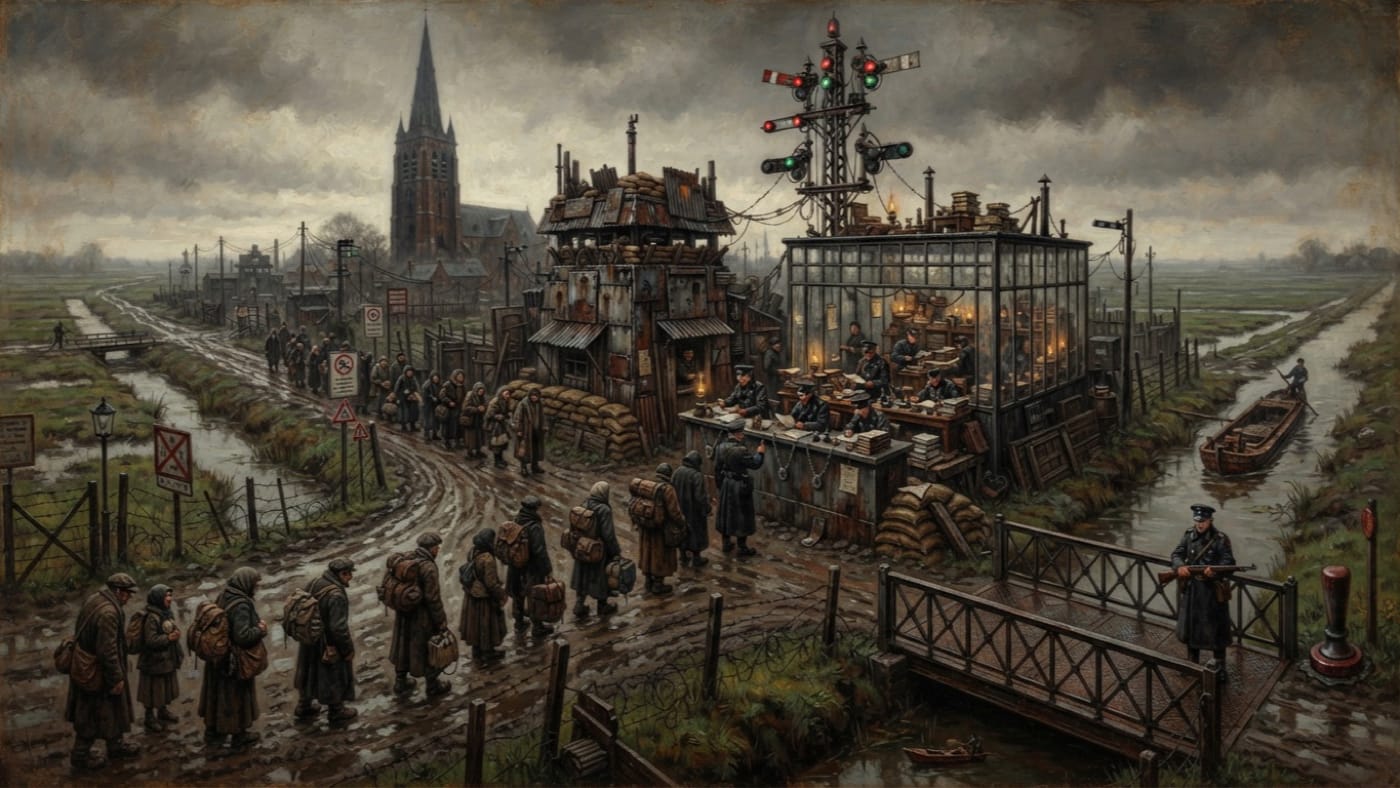
A Flemish pilgrim now leaves home the way a document leaves an office. She is inspected at every stage, she is charged a fee, and she can be stopped and held up at any point.
First she needs a route, and the Bureau sets the routes. The road she would choose and the road the Bureau has licensed are often different roads. When they are, the Bureau's road is the one she walks.
Next she needs a token. This is a small stamped disc that has to be worn where anyone can see it. Tokens come in three grades. Bronze covers shrine circuits inside a single province. Silver covers the designated inter-provincial routes, the Road of Saints. Gold gives access to the war-bastions and the reliquary cities, and it costs about what a tradesman earns in four months. The token records where she may go. It does not record where she comes from. There is no Flemish token. The Bureau treats a walker from Flanders exactly like a walker from anywhere else, and that is the point of having one Bureau.
On the road, she has to show the token at every inspection. At the waystation desks and tithe-gates, a Route-Stamper examines her token and her papers and makes her recite the Creed. If her recitation fails, she does not pass. The Route-Stamper is paid partly by commission, so it pays him to find something wrong. Peregrine Wardens patrol between the gates, and each of them carries a seal that can cancel a road-licence on the spot. Along the way stand ration-stones carved with saints' names, where she is expected to kneel.
Other Bureaus have their own claims on her. The Bureau of Records has her name and parish on file. The Bureau of Tithes wants its share of whatever she spends. The Bureau of Purity watches for any conduct the Index condemns. None of these offices sends her a bill on its own. Every one of them still costs her days on the road.
A bronze token only covers one way. The token she walked out on is no good for walking home, so she has to renew it at the point of return. Her harvest is waiting for her, and so is her parish priest.
#On the Cities and Their Devotions
Ghent runs on its canals and its ledgers. Records keeps clerks there, and canal trade flows through the city. That means more paper and more seals than an ordinary parish ever sees. Ghent also claims Saint Sabina, who tended the wounded at the Massacre at Saint-Malo in A.S. 10. Long afterwards, the Bureau of Mercy declared her its founder. No Bureau of Mercy existed at Saint-Malo, and no formal Synod existed for another eighty years. Mercy claimed her regardless. A Bureau does not need to have been present at something in order to claim it.
Bruges is held by the Synod. It is best known in my office for how its stonemasons were dealt with. Purity exiled three generations of them for carving grotesques it judged heretical in their symmetry. I have no idea what heretical symmetry looks like, and Purity does. That is why Purity is in charge of it. The Bruges masons were not walking for devotion. They walked because they had been banished, and they needed papers like everyone else.
The Candlewick Palatinate is thought to lie somewhere near the Bruges–Ghent canals. The registry gives that location tentatively, and so do I. Candlewick is its own city, with its own industry and its own troubles, and it makes the wax seals, sanctioned inks and watermarked paper that the whole Synod uses. A Flemish pilgrim's licence may well have been sealed with wax that came from a few miles away from her home. She still pays the full fee for it.
Antwerp is the Synod's port on the Scheldt. It deals with Dutch merchants and Dutch money and stays wary of both. Further north lies the independent Netherlands, and the Bureau's tokens are worth nothing there. The term "Low Countries" does not give the Bureau authority over anyone. It only describes how high the ground is.
#On the Present Condition
As of A.S. 201, Flanders still sends out pilgrims. The parishes are still wet and the walkers still go. What has changed is who controls their departure. The Bureau of Pilgrimage now does. A Brotherhood used to keep a man at the crossroads, and the Bureau now keeps a desk there. The Bureau answers to the Synod, and the man at the crossroads answered to nobody.
The Bureau has not ended the hardship, and it never claimed it would. It has published the hardship, priced it and stamped it, and it renews the hardship at the point of return. Pilgrims who could not walk to Belgrade in A.S. 120 without paying a stranger now cannot walk to their nearest provincial shrine without paying the Synod. Doctrine calls this harmonisation. The parishes call it the Bureau. Both names are correct, and only one of them goes on the official form.