
#On the Manual's Authority
"Rejoice by permission."
The Bureau of Festivals keeps a great many documents. It keeps permits, ribbon registers, script seals, vendor schedules and the long, damp accounts of costume wool. Only one of them goes into the plaza with its Chorus-Masters, and that book gives its own purpose as "the administration of sanctioned emotional release within doctrinally approved parameters."
I have read that sentence forty times. Neither repetition nor wine improves it.
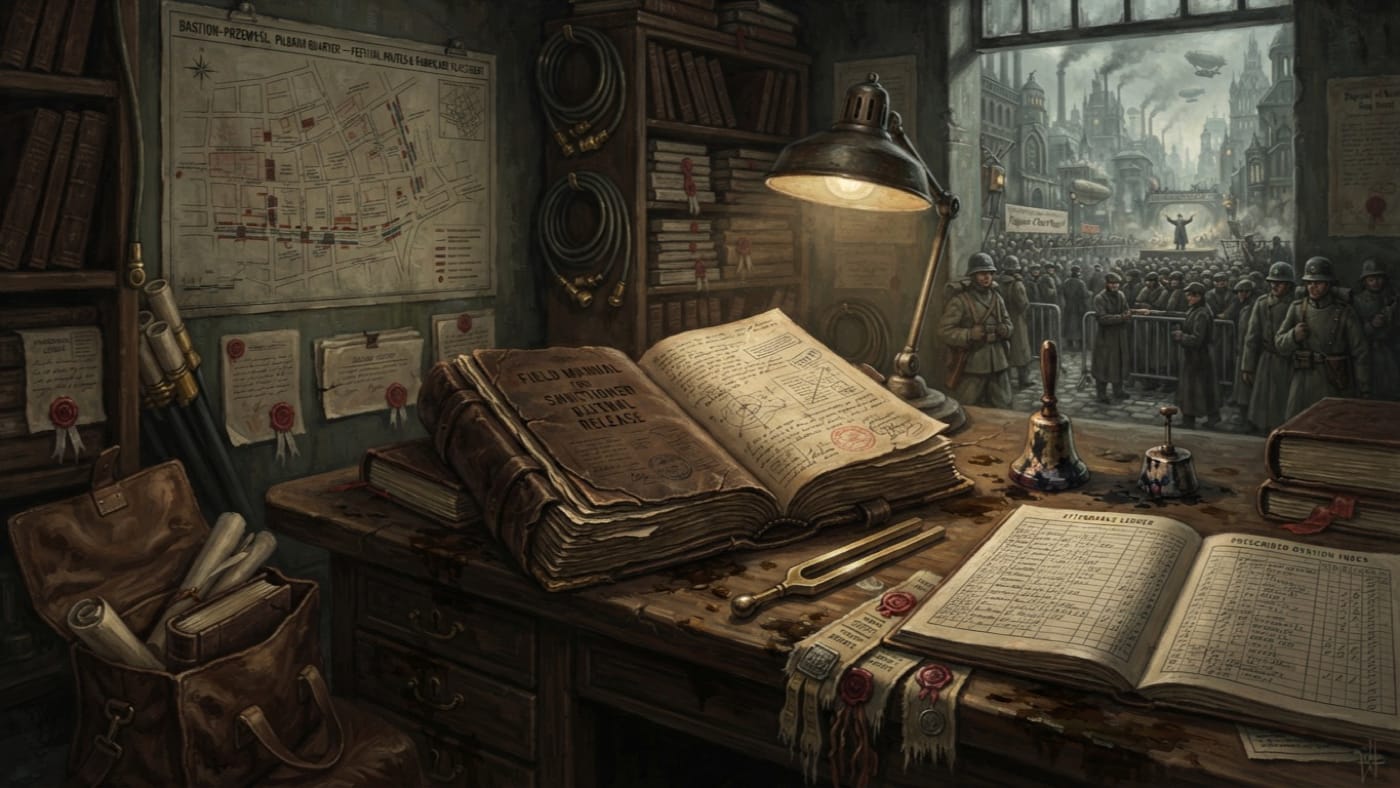
The Field Manual for Sanctioned Emotional Release has been revised eighteen times since its first edition, which makes the copy in a conductor's satchel the Eighteenth Edition. Each revision answered a crowd. The Bureau does not tell the public which crowds, and the Codex will not pretend to know. The manual belongs to the purpose of the Bureau's charter, sealed in A.S. 72, a generation before the Concordat of Strasbourg gave the Synod its formal shape: to give the faithful enough festivals, costumes and plays that despair never ripens into rebellion. Records has not said when the first edition left the binder. I do not supply what Records withholds.
The book rests on a distinction that the Bureau considers obvious and that the populace has never once grasped. A people may be relieved. A people may not be allowed to discover that it can relieve itself. The first is morale. The second is a crowd with momentum of its own, and the Bureau defines that as an emergency.
Doctrine approves the scripts. Purity polices what may not be sung and the ways it may not be sung. The Bureau of Bells owns the air that carries any of it. None of the three wrote the manual. All three read it the way a creditor reads a will.
#Before the First Cue
"Barricades before blessings."
It is a working book, and the work it governs starts long before the first note. I give the sequence here as the profession practises it. I have watched it in converted chapels from Strasbourg to the pilgrim roads, and I make no claim that the order below reproduces a numbered clause.
The script arrives from Doctrine under seal, and the Chorus-Master reads it twice: once for sense and once for danger. Every refrain is tested against the Index Damnatus for prohibited phrasing. Every emotional climax is checked to confirm that it drains into a creed recitation the way a gutter drains into a sewer. A joke that lands too well is cut. The profession calls this "cutting the second laugh." The first laugh is entertainment. The second becomes a slogan.
Harmonic sanitation comes next. Ranges are tuned and risky intervals are banned. The tuning fork is polished until it can face an inspector who stops a rehearsal, demands a random stanza and strikes the fork on the lectern for emphasis. The Bellwardens must grant acoustic permission, because a festival that sounds over a scheduled peal has trespassed on the air itself. Patrol captains bargain over crowd corridors and vendors bargain over stage access. The speaker-lines are calibrated until their hiss sits under the chorus.
Then come the barricades: where they stand, which way they lean, and which exits stay open. The profession has a saying, and it is the only one in its repertoire I cannot fault. Panic kills faster than doctrine.
The rehearsal hall smells of hot lantern air, incense, sawdust and brass polish, with damp wool underneath like a bad conscience. A singer who improvises is corrected with the chorus rod. A singer who improvises twice is replaced. Preparation is finished when the performance holds nothing that could surprise anyone, the performers included.
#The Measurement of Release
"Give them crumbs, not bread."
I will grant the manual one real difficulty, since I grant the Bureau of Festivals very little else. It has to produce warmth that can be switched off. A crowd must laugh enough to go home lighter, and not so much that it stays.
The instrument is the cue bell or clicker, and behind it the Chorus-Master's beat-counting fingers. Laugh here. Kneel here. Chant here. Fall silent here. Applause is not discouraged. Applause is scheduled. The published duration for a patriotic hymn in a bastion garrison is fourteen seconds. A comedic interlude on licensed premises gets seven, palms only, no stamping. Those figures apply to particular occasions and set no universal tariff on human feeling. The Bureau has other figures and will tell you them when you need to know.
Attendance Auditors do the measuring against a four-hundred-entry index, and every serious conductor keeps the Prescribed Ovation Index on the table beside the manual. If the applause runs seven seconds past its prescription, the festival may be classed "Excessive in Spontaneous Emotion." I have never met anyone who could tell me whether the seven seconds, the four hundred entries and the Index's four points of tolerance make up one arithmetic or three separate grievances.
Everything goes into the attendance ledger: heads, cheers, silences and incidents. The ledger is filled before the stage is swept, and the Bureau would prefer it filled before the audience has finished remembering.
The copy in a conductor's satchel is the Eighteenth Edition.
The Bureau records eighteen revisions since the first edition. It has not confirmed that any revision counts as an edition, or that the copy now in use carries a number at all. The Prescribed Ovation Index prints its edition on the cover. The Field Manual does not. The Warden regrets lending the manual a dignity that its own binders withheld.
#Ending the Performance
"No unscheduled encore."
Every Chorus-Master learns the Riot of the Third Encore in their first week at the Festival Conservatory of Strasbourg, and every one of them learns it as a lesson in stopping.
In the pilgrim quarter of Bastion-Przemyśl, during a licensed Pageant of Saint Rupert, an audience demanded a third performance of the closing hymn. The conductor granted it. The crowd surged, the barricades collapsed inward, and dozens were crushed against the stage. The singers kept going, because nobody had given them the signal to stop.
Records has sealed the year. The conductor's name has been struck out with the thoroughness that Erasure Notaries reserve for an instructive example. I have no wish to unseal the one or restore the other, and the Codex does neither.
As far as practice shows, what the manual took from Bastion-Przemyśl was the discipline of termination. The conductor ends a performance by signal, with the chorus silent before the crowd has decided whether it wants more. No further singing follows the closing hymn. Singers leave by a separate route and do not mix with the audience afterward. Exits stay clear. Above all, once the final beat has passed, the crowd may not carry on singing unaccompanied. Conductors call this "never feeding the chorus." The superstitious among them tell of an unaccompanied chant that "found its own harmony." They also tell of the Unhymn Incident, when a popular melody drifted off-key and was said to have "opened" something in a crowd. Doctrine traces harmonic law to that incident. I attribute nothing further to it.
#The Practitioners' Exceptions
"Laughter is a loan; repay it in obedience."
Between the manual's text and the plaza lie three methods that every conductor knows by name.
The controlled heckle is a field practice so common that it hardly counts as a secret. Planted respondents in the crowd laugh on cue, shout approved lines and smother any chant that threatens to keep itself going. A good shill turns a hot crowd into a call-and-response that ends in the creed. A bad shill starts the riot.
The encore tax allows one more chorus on condition that the whole audience recites the Creed first. The crowd gets its song and the auditors get their recitation. I cannot certify whether the manual names this bargain. I can certify that auditors log the creed with evident relish.
No further singing follows the closing hymn.
Further singing remains available in exchange for creed repayment, at the conductor's discretion and subject to the auditor's arithmetic. The profession forbids an encore granted without that repayment, and any singing the crowd undertakes on its own account.
Joy laundering is the third method, and the one that is denied. It means hiding a real human truth inside a doctrine stanza, so that the audience receives one honest moment in Bureau packaging. Doctrine has investigated it for forty-one years without a single conviction. The investigators attend the festivals, and the festivals do to them exactly what they were built to do to everyone else.
The Pure Conductors read the manual as a list of prohibitions. Their compliance scores are flawless and their audiences leave hollow-eyed. The Mercy Maestros read it as a list of minimums and spend their careers under review. A city given only the first kind sinks into grey despair. A city given only the second risks another Seville, where in A.S. 153 coordinated laughter ended with the laughers' tongues. The Bureau deploys both and calls the result "competitive orthodoxy."
Whichever reading the conductor chooses, the cost is the same. Follow the manual long enough and you count beats on your fingers at supper and flinch when a child laughs in the market. Unscheduled joy starts to sound like an incident report.
#Present Application
The manual is in use today in bastion plazas and on the pilgrim circuits, whose plays have been standardized into the same modules from city to city. It is used in the trench morale shows of Zone 4 and on licensed premises where curfew-fog tavern runners know to the minute how long a song may last before the Bells reclaim the night. Its eighteen revisions travel in stiff paper with ink-stained margins, carried next to the permit sash, the tuning fork and the cue bell.
At the end of each night the conductor files the ledger, burns the rejected lines, locks away the costumes and washes both hands in ash water. The profession says this removes the applause. I have watched the procedure many times. The applause comes off. The ash does not.