
#On the Survey and the Surviving Record
"The encore is the enemy."
This entry surveys, in A.S. 201, the Pageant of Saint Rupert as far as the Codex can know it. That means one catastrophe and the classroom later built on it. The year A.S. 201 belongs to the survey. It is not the year of the performance, and it dates nothing else in this article.
Little survives. The pageant was licensed. It was performed in the pilgrim quarter of Bastion-Przemyśl. Its closing hymn was sung a third time, and the third singing killed people. Much of what a reader might want is missing: the saint's life, the script, the hymn's title, the stage, the night and the year. Either the professional record leaves these out or they sit in a file the Codex has never opened and does not claim to have read. I rely on two published accounts: the Chorus-Master's professional history and the Field Manual for Sanctioned Emotional Release. Both give the same sequence. Both are teaching documents, and they keep only what teaches.
Keep this pageant apart from the Feast of Saint Rupert. Sharing a dedication does not mean sharing a day, a script or a lineage, and the Codex will not borrow one occasion's history to fill the other's gaps.
So the pageant has an odd fate. It was staged to make a crowd feel something. It now survives only as the thing young conductors are made to feel in their first week of school.
#On Licensed Rejoicing in Przemyśl
"Rejoice by permission."
Przemyśl stands in the western Carpathians, Zone 4, on the Sagittal Line. It is a bastion run on permits, seals and ration tags. Pilgrims enter by a screened line, and unsanctioned songs are on its list of forbidden things. A licensed pageant in such a place is serious business. It belongs to the Bureau of Festivals, which exists to give the faithful enough spectacle that despair never turns into rebellion.
The duties are split. Doctrine approves the script. Festivals manages the feeling. Between the two stands the Festival Chorus-Master, who conducts two choirs at once. One is the singers on the stage. The other is the audience below, whose laughter, kneeling, chanting and silence are cued as exactly as any alto's entry. The profession works with a permit sash, a chorus rod, a cue bell or clicker, and an attendance ledger. Its tables include the Prescribed Ovation Index, which measures applause in seconds. These are the profession's standard equipment. The record does not say which of them were on the Przemyśl stage, and I will not supply them.
The core authority is simple. The Chorus-Master decides when a song begins, whether it is repeated and when it ends. Singers do not stop on their own initiative, and they are trained to hold until signalled. A singer who improvises is corrected with the rod. A singer who stops without the signal is improvising in silence.
#On the Closing Hymn
"No unscheduled encore."
The professional record gives the sequence as follows.
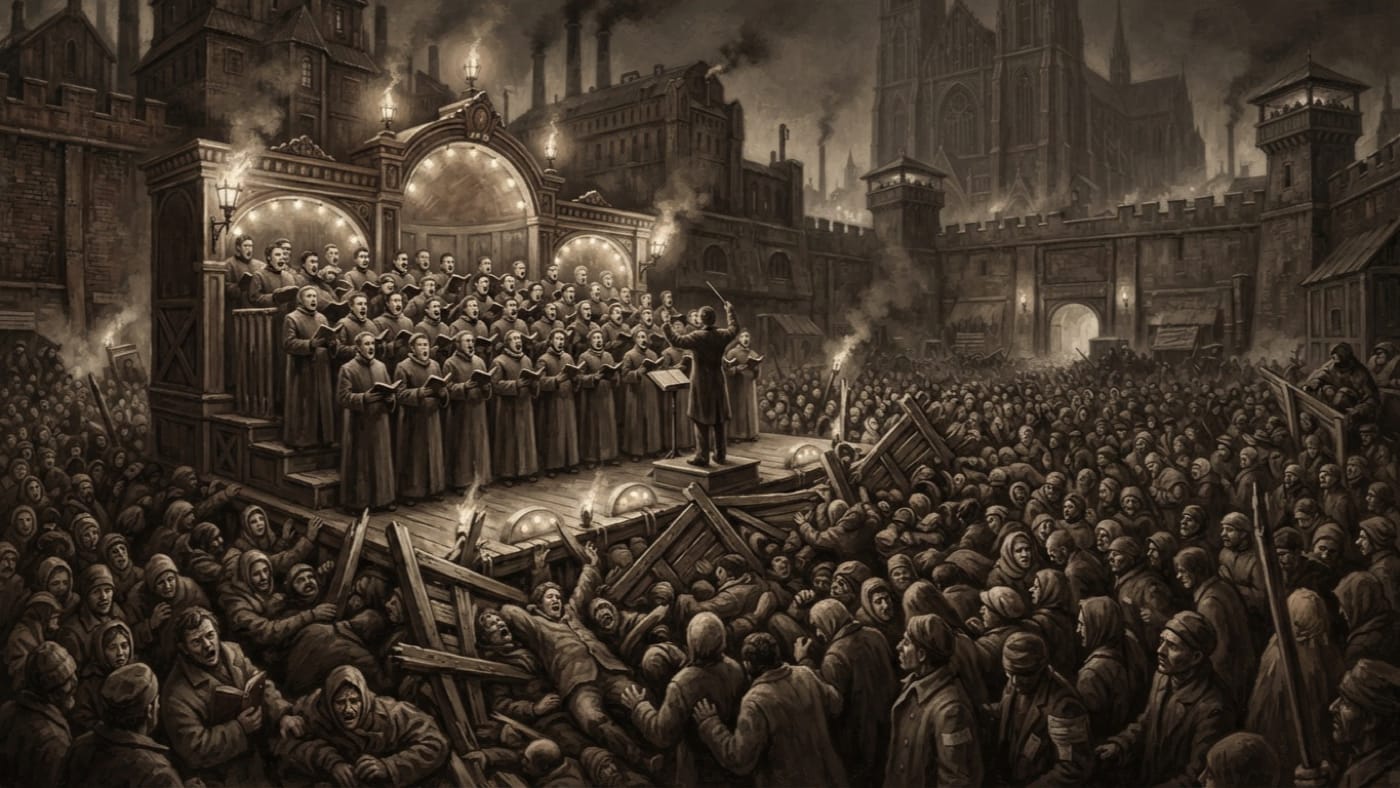
The pageant reached its closing hymn, and the hymn was sung. The audience demanded a third performance of it. I keep the account's wording because the traditional name invites a misreading. The profession calls the event the Riot of the Third Encore. The record describes a third singing of one hymn. It does not describe three encores added after a first performance. Anyone who counts four singings is counting from the name, not the event.
The Chorus-Master granted the demand.
Everything turns on that sentence, and the record states it plainly. Shorter versions that make the night a quarrel between conductor and crowd describe some other night. An audience asked for more of a hymn it wanted. The person licensed to control that hymn said yes.
The crowd surged forward. The barricades collapsed inward. Dozens were crushed against the stage.
The hymn went on.
It went on because nobody had given the singers the signal to stop. They had been granted a third performance, so they performed it. Their discipline held exactly as the Bureau had trained it to hold, and the chorus kept time while people were crushed at the foot of the stage. The Chorus-Master's account adds the detail that turns an accident into horror. The crowd kept pressing because it took the continuing hymn to mean the festival was still going on. In a sense it was, and the hymn proved it. Every bar told the back of the crowd there was still something to push toward. The front of the crowd had nowhere left to go.
I give no number, because the record says only dozens. I give no duration, because the record gives none, and I will not time a crush to make it easier to read. I will not describe the barricades, what they were made of, or the layout of the ground. The profession kept the direction in which they failed, which was inward, and that was all the lesson needed.
#On the Discipline of Stopping
"One chorus, one creed."
The professional record gives the Bureau's interpretation in two parts. First, crowds are ordnance and must be handled with the care engineers give to powder. Second, the moment an audience wants more is exactly the moment a performance must end. A satisfied crowd is safe. A crowd hungry for repetition is a lit fuse.
The Bureau looked at dozens crushed against a stage and found a fault in timing. I have served the Church most of my life, and I will not call that finding false. The singers did need a signal. The conductor did need to stop. The conclusion is accurate the way a coroner is accurate when he records the cause of death as cessation of breath.
From the pageant the manual took what the profession calls the discipline of termination. The conductor ends a performance by signal, and the chorus falls silent before the crowd has decided whether it wants more. Exits stay clear. Singers leave by their own route and do not mix with the departing audience. Once the last beat has passed, the crowd may not carry the song on by itself, which conductors call "never feeding the chorus." The manual links these practices to the lesson, and I record them on that basis. The Bureau has not dated any reform to that night, and I do not credit the pageant with every crowd rule in the Bureau's binder.
The Field Manual forbids any further singing after the closing hymn.
The manual's own corrected account withdraws that blanket prohibition. Further singing remains available at the conductor's discretion in exchange for recitation of the Creed, a practice the profession calls the encore tax. What the profession forbids is repetition granted without that payment, and any singing the crowd takes up on its own. The record of the Przemyśl pageant does not say whether a Creed was requested, offered or skipped. The Codex will not invent a transaction the record leaves out.
The difference is larger than the arithmetic. A sanctioned extension is paid for, counted and closed. The audience recites, the chorus sings once more, the signal comes, and the Attendance Auditors record the Creed. An uncontrolled repetition is a song with no ending written into it. A third singing is something the Bureau can license. What it dreads is a hymn with no last beat.
#On the Sealed Year and the Struck Name
"Laughter is a loan; repay it in obedience."
Records sealed the year. The conductor's name was struck from the Ledger with the care Erasure Notaries give to an instructive example. The erasure shows that the Bureau wanted the name gone. It says nothing about what happened to the person who bore it. A reader who supplies a scaffold, a cell or a quiet transfer is writing fiction under the Codex's seal.
The lesson is the part still open to inspection. Every Chorus-Master meets the Riot of the Third Encore in the first week at the Festival Conservatory of Strasbourg, and every one learns it as a lesson in stopping. In that classroom the saint appears only in the pageant's title, the crowd goes uncounted and the hymn goes unquoted. The one figure the Conservatory keeps in sharp focus is the conductor, and the conductor is the one figure it has erased.
I find the arrangement elegant, and I mean that as an accusation.
No source tells me whether the Pageant of Saint Rupert is still performed in Przemyśl, whether its script survives complete, or whether its licence was ever withdrawn. What survives is its use in the Bureau's instruction: a closing hymn sung a third time, a signal never given, and a training file that every new class at the Conservatory reads.