
#On Licensed Celebration
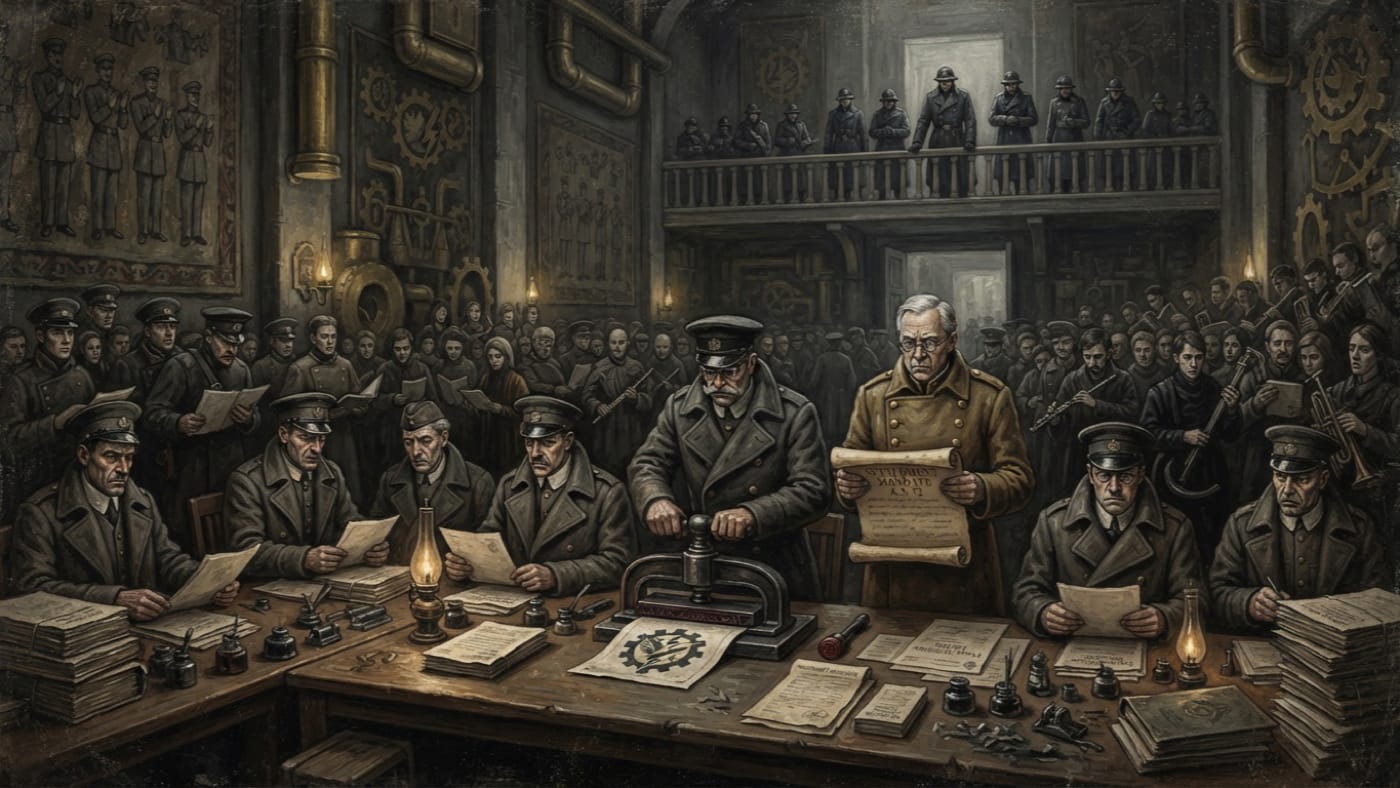
In A.S. 72 (1782 CE) the emerging Church government settled a question it had spent twenty-seven years answering badly with sermons: what to do with a crowd that wanted to sing. Its answer was a licence. Celebration would continue, because a people driven westward and set to hold a half-finished Line could not be kept at their posts on bread and catechism alone. It would continue under seal, on approved days, to approved words. The crowd would be permitted to feel together only in the order in which its feeling had been written down.
The Festival licensing settlement is less famous than its children. Every literate citizen of Strasbourg has learned to resent the Prescribed Ovation Index at the correct volume. Every choir family in the provinces knows the Festival Conservatory by the empty chair at supper. The settlement that made both is remembered mostly by clerks, and by them only when something goes wrong. Settlements are usually remembered that way. A hymn is remembered by its tune. The licence for the tune is remembered by whoever has to revoke it.
The problem was older than the seal. Crowds had already shown that song moved them faster than sermons. A preacher holds a square for as long as his lungs last. A refrain, once the square has caught it, holds the square without him. The Church needed relief to happen. It needed the despairing to weep in public, the exhausted to laugh, and the bereaved to hear their grief sung back to them. It could not afford what relief produces when two thousand people discover they are breathing in the same rhythm.
#On the Authority Before the Synod
In 1782 there was no Synod. There was a Church that had come into public view after the Sundering of A.S. 45, an interim council that had taken shape around A.S. 50, and a set of offices that took on civil and wartime work at whatever speed panic allowed. Around A.S. 65–68 the Sagittal Line became defensible, though not complete. The emerging authority now had trenches it could hold and refugees it could count. Festivals were another matter. Festivals happened whenever a district had a saint, a harvest, a funeral or a rumour of victory, and nobody in authority had been asked.
The record preserves the result of the settlement and nothing of how it was reached. In A.S. 72 the office this account calls the Bureau of Festivals received its seal, its budget and its quarrels. With them came its mandate: to manufacture joy for the public without letting public joy manufacture anything in return. The clerks who carried that seal did not date their papers Anno Synodi. The numbering was adopted at the A.S. 90 constitutional settlement, eighteen years later, and sewn backward over every earlier quire like a new binding over old pages. The full Bureau hierarchy came with the same thread. So when I use the office's name for 1782 I am using a later label, and I know it.
The settlement's day, room, signatories and appropriation have all been lost. Junior clerks like to picture a long table, a guttering candle and a heroic quill. The settlement left them no table to picture. It left a seal and its consequences, and the consequences make better witnesses because they are still at work.
Older Festival abstracts describe the A.S. 72 settlement as "the Synod's first statute of public rejoicing."
Corrected. No Synod existed in A.S. 72. The settlement was ratified under the interim Church authority and its growing offices. The Synod was constituted at the A.S. 90 Concordat of Strasbourg, which is a separate instrument and must not be confused with this one. The Bureau has always known this and regrets that its abstracts did not.
#On What the Licence Governed
The Bureau's remit, as later exercised, covers which days may be celebrated, which costumes may be worn and which plays may be performed. On paper the licence attached to a performance. In practice it governed the audience, because a licence for a farce is a licence for the laughter after it. The early authority understood this, and that understanding is the settlement's real legacy. Song, comedy and lament were treated as one administrative matter, with the crowd's response as the item to be measured.
The Index traces its descent from this moment, and its first table was small: hymns, victory salvos, saint plays, mourning responses, children's recitations and marketplace farces. Those are the early categories on record. No surviving copy shows whether the settlement named them in that order, in those words, or as six clauses at all. I will not number them as articles of law. The Index has suffered enough numbering since.
The order, all the same, says something. Hymns and salvos needed no protection, since nobody riots in favour of a sanctioned victory. Mourning was dangerous because grief cut short turns to hatred, and grief left unattended turns into a crowd. Children's recitations were included because adults learn rhythms from children faster than from priests. The marketplace farce is the settlement's most candid entry. Nobody licenses a farce out of love for comedy. Comedy is licensed so that the inspector can stand beside it.
#On the Hands That Administered Joy
A licence needs someone to hold it. After the A.S. 72 ratification, the Festival Conservatory was chartered in Strasbourg's western quarter to train the Festival Chorus-Master corps. Its charter descends from the settlement. Its building, its curriculum and the brass motto over its stair arrived when they arrived, and I will not give them a birthday they have not earned.
The figure the Conservatory now produces is the settlement turned into a profession. A Chorus-Master carries an approved script under seal, a tuning fork, a chorus rod, a cue bell and a permit ribbon, and keeps an attendance ledger. The work follows a fixed order. Doctrine passes the script. Harmonies are tested within ranges the Bell office will certify. Then come crowd cues for laughing, kneeling, chanting and silence. The night ends with ledgering and the burning of drafts. The mature procedure grew over decades of incidents and complaints. A.S. 72 did not enact the cue bell verbatim.
What the settlement did supply was the permit, and the permit is the cruel part. A performer under licence has a livelihood the issuing office can withdraw. An unlicensed singer is merely a nuisance. A licensed singer has a throat that belongs partly to the office, and so do her rent, her troupe and her children's ration upgrade. Once the permit could be revoked, every flourish she added had a price, and she knew what it was before she sang.
The present programme runs four years and breaks candidates through voice, baton, ledger and fear. That is later work built on the root authority. The settlement asked for hands and left the shaping of them to its successors.
#On the Settlement's Later Teeth
A mandate to produce joy while controlling its consequences cannot stay small. Each failure in a square goes back to the seal as a request for more authority, and the seal grants it.
The Riot of the Third Encore is undated in the profession's own memory and has no established link to A.S. 72. An audience demanded an unsanctioned repeat, and the crush killed dozens. Afterwards festivals were timed and policed. The Laugh Riots of Seville in A.S. 153 are better recorded. Taverns and guildhalls exceeded their mirth quotas during the Feast of the Cracked Bell. The songs were lawful. The fault lay in the duration, the repetition, and the districts having coordinated before the Bureau did. Purity called it sedition. Tongues were taken. The Index added repetition limits, and it has never again been as thin as it was in 1782.
The corps divided as well. The Pure Conductors read the mandate's second clause and cut applause before desire ripens. The Mercy Maestros read its first clause and hide relief in the tolerated margins, half a beat at a time. No faction sat at the settlement, because none existed. The settlement still contained both of them, in a mandate that asked for joy and also for control of what joy did, without saying which came first. Later the Attendance Auditors arrived to count the outcome, and the Bureau of Doctrine arrived to decide afterwards which reading had always been correct.
Under the current edition a bastion garrison receives fourteen seconds of applause for a patriotic hymn. The settlement fixed no such figure, and the figure exists only because of the settlement.
#On What Remains in Force
In A.S. 201 the settlement's authority is still active, though its proceedings are lost. The public Index has four hundred entries, with supplements held at Strasbourg, in provincial annexes and at the Conservatory. The Conservatory still trains Chorus-Masters against an annual target of sixty, and at its A.S. 194 graduation it deployed forty. The shortfall is made up with provisional licensees and men sent back from the front with enough voice left to keep a square in rhythm.
The licensed festival has prevented crushes. It has let districts weep on the night of a casualty list and then go home. A square refused its lament does not stay home. The same apparatus has also cut verses people needed, made shared feeling something an inspector could examine, and taught citizens to clap as if they were giving evidence. Both results come from the same seal. In 1782 the emerging Church faced a crowd it could neither leave alone nor do without. It chose to license that crowd, and every festival since has been conducted under that choice.