
#On the Destination Denied
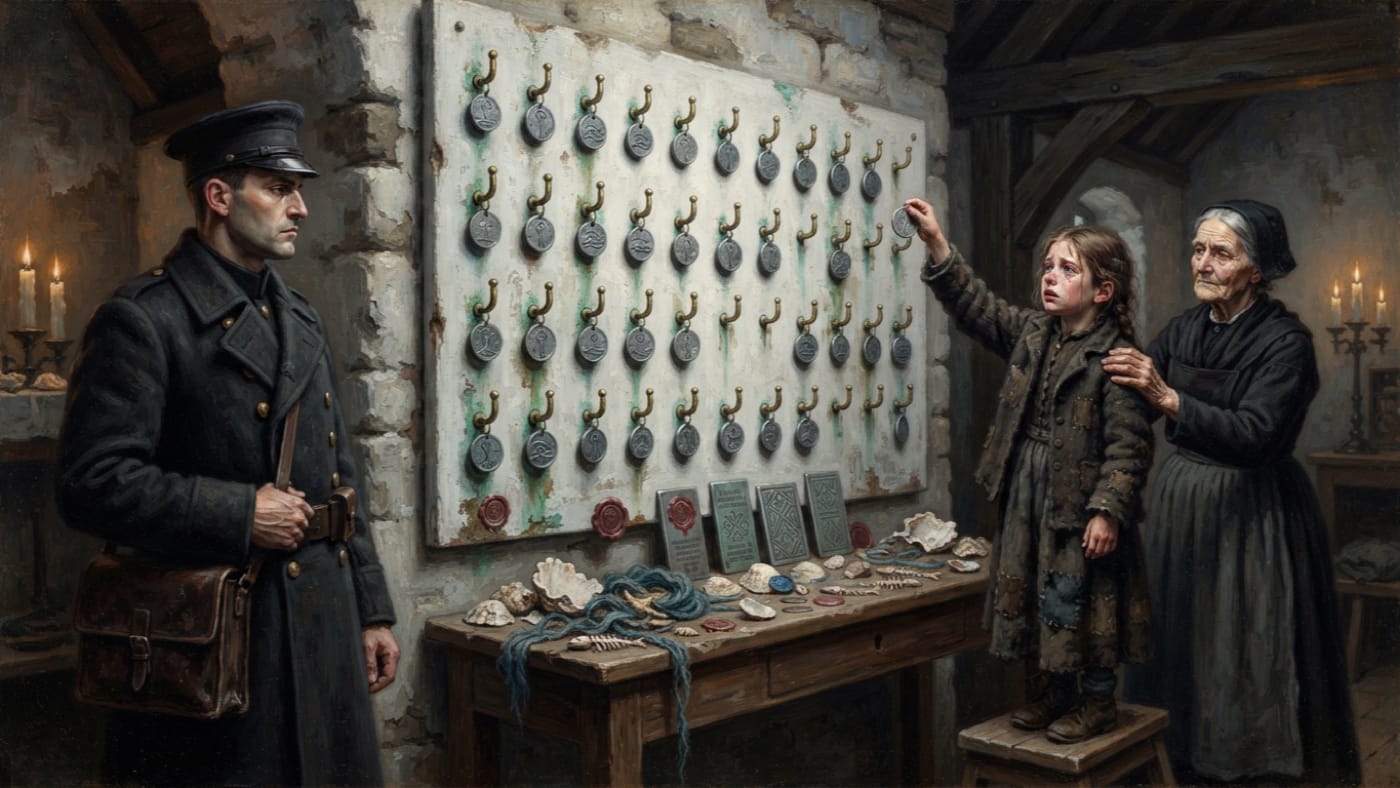
Behind the altar of the Chapel of the Tide hangs a white panel, and on that panel are forty-three small brass hooks. For most of the year nothing hangs on any of them. Visitors who came for a relic leave disappointed. Visitors who came for an icon complain about it, usually to me, in writing. The hooks are the relic. They keep the count of a procession that never came.
In A.S. 10 forty-three pilgrims set out from Dinan for this chapel, carrying the Reliquary of Saint Matthias under the banner of Saint Hermas. They were going to Saint Clement of Brittany, whose small whitewashed shrine stands on the marsh road beyond Saint-Malo and smells of salt, tallow and old wool. Their road passed through the Porte Saint-Vincent. At that gate the Republican Guards halted them under the Rationalist authorities' secular assembly law. What followed was the Massacre at Saint-Malo. That event has its own folio, and I will not crowd it here.
The register keeps three columns. Thirty-one certified dead. Seven wounded witnesses. Five consumed absences. The third phrase is a filing category, devised for names that came with no body and no deposition, and it tells us only that the Ledger could not find those five. The columns add up to forty-three. The gate tolls for thirty-one. The chapel hangs forty-three. Doctrine has never mixed up the two sums, and neither should you.
#On the Office and Its Eve
Clement was a saint before anyone in Strasbourg could spell him. His Breton cult is older than A.S. 0, and the fishermen, salt-cutters and widows of the coast kept his chapel for generations without help from a single clerk. After Saint-Malo the cult was regularised, which is the Church's word for the moment a parish devotion gains a continental audience. In A.S. 14 Clement's secondary observance was yoked to the Saint-Malo office and given the name it still carries, the Empty Arrival. This happened alongside the early ecclesiastical recognition of Saint Margaux.
Mark the year. A.S. 14 falls four years after the gate and seventy-six years before the formal Synod's constitutional settlement of A.S. 90. The Bureaus that now administer the rite did not yet exist in their present form. They ratified the arrangement later and have behaved ever since as though they wrote it. Records calls this continuity of custody. I call it arriving after the service and claiming the front pew.
That leaves the question of the day. The Martyrology of Saint-Malo keeps its memorial on the fourteenth of Corvus. Popular calendars once put Clement's feast on the same day, until the Bureau of Doctrine ruled in A.S. 92 that the Massacre keeps the day and Clement keeps the eve. The Empty Arrival is now held on the eve of the Saint-Malo memorial, so everyone who reaches the chapel that night is early for an atrocity. The Bretons consider this good manners.
The Dinan procession set out on a fixed feast of the old calendar, and the Empty Arrival keeps that feast's date to the day.
Withdrawn. No deposition by the seven wounded witnesses fixes the day or month of the procession. The fourteenth of Corvus is a liturgical assignment, and placing Clement on its eve was a liturgical courtesy of A.S. 92. Neither measures anything that happened in A.S. 10. Readers who have been calculating anniversaries are directed to stop.
#On the Forty-Three Hooks
On ordinary days the panel stays as it is: white, yellowed by candle smoke, forty-three hooks in their rows, the brass going green around the screws. In Brittany the sea gets into everything, theology included. Pilgrims on the coastal road stop to look. Some count the hooks. Most count twice, because a row of empty places is harder to keep in the head than a row of objects.
On the eve of the memorial, each hook receives one pilgrim token. Children chosen from the registered families of Dinan hang them. Dinan is the town the procession left, and it has spent every year since sending its young to the chapel to finish a walk that someone else began. The clerks care about the registration far more than the children do, which is how you know it is administration.
The children are told not to cry. They cry anyway. The instruction is repeated every year with the confidence of an official renewing an expired licence, and every year it expires again, usually before the first row of hooks is full. I have read the defences of the rule: composure, dignity, the steadiness proper to a sanctuary. I have also watched a girl of perhaps nine reach up to a hook above her head, miss it twice, and get it on the third try with her lip shaking. No canon in the Church could have made that motion more correct.
The tokens stand for pilgrims, not corpses. The thirty-one hang beside the seven who were carried home bleeding to give their testimony, and beside the five whom the register lists as absent. Each token hangs at the same height on the same brass, the dead next to the wounded. Nowhere else in the Breton calendar is a witness ranked level with a martyr.
The rite is equally strict about the living. On that night the nave fills with people who have walked the licensed road, shown their papers and reached the chapel. Their arrival is not what the rite commemorates, and the panel makes that plain. Forty-three people were refused this room. Several hundred are admitted every year. The hooks keep the difference.
The Martyrology divides the work of Saint-Malo among its saints. Father Gaël supplies the refusal, Margaux the remembered face, Sabina the service, and Hermas the banner. Clement receives the destination. It is the only office in the set that asks its saint to do nothing at all, and Clement carries it out with perfect Breton discipline.
#On the Licensed Road
The Bureau of Pilgrimage licenses the Brittany Coastal Route under the designation Grey-Clement-43 and issues a grey token stamped with a crozier, a wave and the number forty-three. People confuse it with the older tin wave-disc stamped with a crozier and a fishbone, which Breton pilgrims bought for pennies long before Strasbourg had heard of the chapel. Pilgrimage would rather they didn't. The disc is a devotion. The grey token is a permit. Most pilgrims carry both: the disc under the cloak where the saint can see it, the token in the hand where the warden can.
The work is divided as neatly as any reliquary inventory. Pilgrimage decides who may walk the road. Doctrine decides what the walk means. The Bureau of Records keeps the permits, the meanings and the complaints about both, bound in the same calf. Each Bureau is sure it holds the important piece. Each has a seal to prove it.
The old devotion survives underneath, stubborn as limpets. Breton mothers still tie blue thread around a child's wrist before any road, the Clement road included. Fishermen still leave chipped shells on his altar before sailing past the reefs. These are physical things: wool you can snap with a thumbnail, shell you can cut a finger on. As far as my files show, no Bureau has yet found a way to license a length of wool, and I would not bet against them in the next century.
Clement remains patron of interrupted journeys, failed arrivals, and petitions delayed by weather, war or Pilgrimage procedure. The third cause is printed in the Bureau's own route tables, in the Bureau's own type, without a trace of embarrassment. This is either great humility or great inattention. I have met the compilers, and I know which.
#On the Entry That Remains Disputed
The Saint Clement file contains one document that every Bureau handles with tongs.
An account in the file, by an unnamed writer, states that the chapel ledger for A.S. 10 carries an entry made after the massacre, in a hand no local clerk would own: "FORTY-THREE ARRIVED." The same account says the page was sealed, unsealed and sealed again after a Records examiner counted forty-three wet footprints between the threshold and the altar on a dry morning. The account adds that the prints were scrubbed, waxed, covered and denied. Nothing in the file establishes who wrote the entry or what made the prints, if prints there were.
Doctrine has no position on the page and has issued that position in writing. Records keeps the page, as it keeps everything, in a box marked retained pending clarification that nobody has asked to open. Pilgrimage has never mentioned it in any route table, and its silence is plainly not ignorance. The five absences stay where the register put them: in their column, unexplained, counted with the rest.
The panel is still white. The hooks are still brass. On every ordinary morning they are empty, and the sacristan dusts each one.