
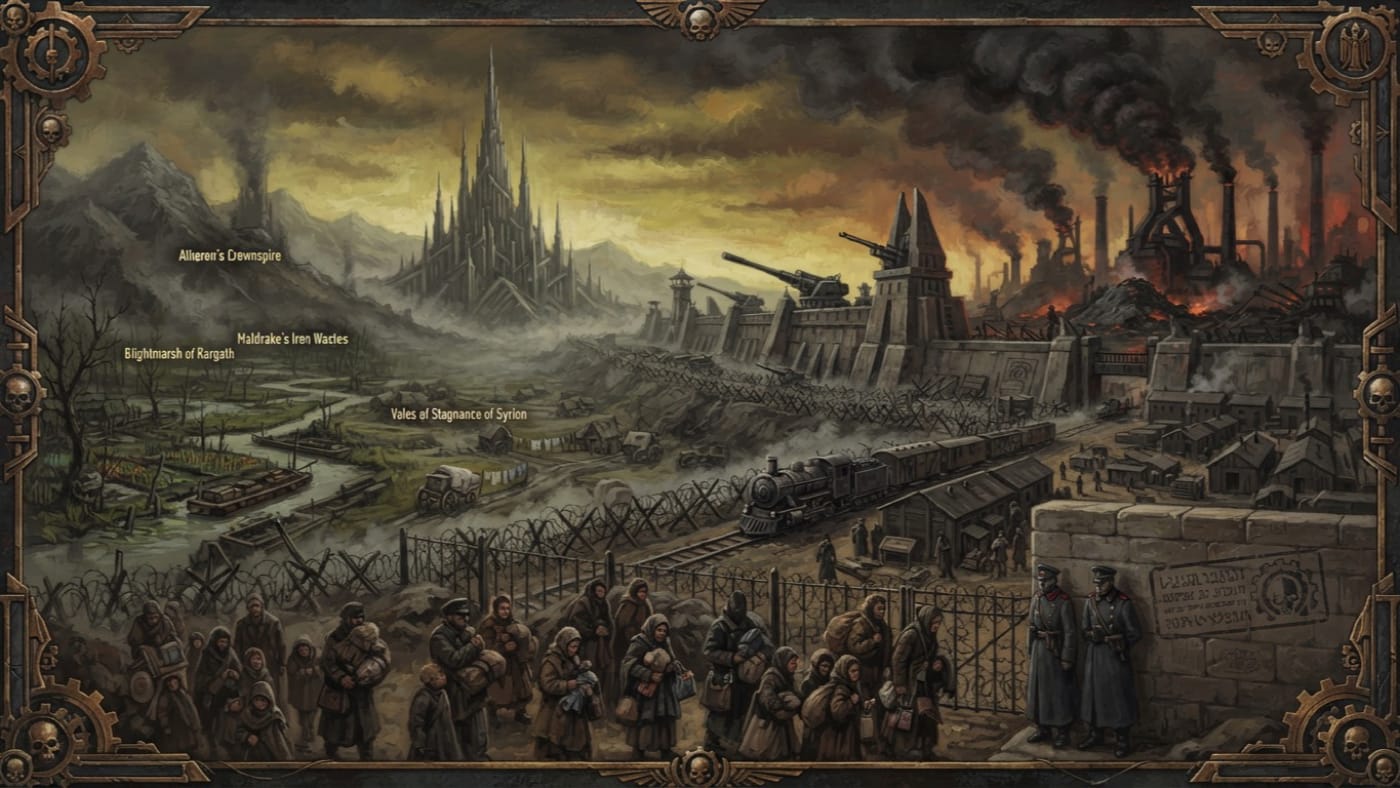
#On the Name and the Lands
"Eastern Kingdoms" is a phrase the Bureau prints under engravings and the clergy pronounce at Vespers. Like most phrases that survive in both places, it is more useful than exact. No Eastern Kingdom ever sat in council with its sisters. There was no crown of the East and no federation. There were jurisdictions: princely seats and municipal charters, bishoprics and abbey lands, mining concessions, Rationalist prefectures, and river tolls held by families who could no longer remember which emperor had granted them. Serbia and Thrace, the Danubian and Hungarian plains, Wallachia and Moldavia, Macedonia and the Transylvanian approaches: the designation puts them all in one drawer because the Ledger keeps a drawer for the dead, and they died in the same decade.
The modern survey uses other words. Most of that country now lies in the Charnel Lands, Zone 6, beyond the contested strip of No-Man's-Land. The Balkans are where the breach began. The three names overlap without coinciding. Any clerk who uses them interchangeably will be corrected in red ink, by me.
#On the Roads Before the Silence
Picture the country as its carters knew it. Grain moved west and south off the black-soil plains in ox-carts and Danube barges. It passed through market towns whose squares were laid out for weighing wheat. Wine came down from the hill villages and salt came up from the pans. Mountain monasteries kept bees, ledgers and the bones of their founders. In the Saxon villages the fortified churches kept the grain itself, behind walls a parish could man. Mines drew silver and gold out of the Transylvanian ridges. Military roads older than any living authority ran from garrison to garrison, and a courier with good horses could carry a letter from Belgrade to the Bosphorus inside a fortnight.
Rationalist administration reached these lands before the Treaty of Regensburg gave it a Republic to serve in A.S. 30, and it did what it did everywhere. Monastery granaries became prefectural stores. Abbots became tenants. Relics went into crates addressed to the academies, and some of those crates arrived.
Then came the omens, each filed separately and each misfiled: the Year Without Dawn in A.S. 32, the Red Flood in A.S. 34. In A.S. 38 came the Eastern Silence. Letters stopped. Caravans left on schedule and arrived nowhere. Refugees came out of the hills describing forests that had moved in the night, churches blackened between Compline and Lauds, and fog that filled a valley and gave it back altered. The prefects called it plague and drew a quarantine cordon. They were very good at cordons.
#On the Breaking and the Retreat
On 1 November A.S. 45, All Saints' Day, 1755 by the suppressed reckoning, the Sundering opened the East. Doctrine holds that a continent which had stripped its own altars met the wound unarmed. I set my seal to that interpretation, and I remind the ungrateful that it remains an interpretation. The mechanism belongs to files I am not authorised to quote.
The garrisons went first. Novi Sad was overwhelmed before its guns were loaded. Skopje's garrison fell in the same season. At Debrecen, by the established account, Kargath consumed the rations of a hundred thousand men in a single night, and the Second Army walked west chewing its own straps. On the Iron Plains fire fell from a clear sky on divisions advancing at regulation pace. It kept falling until there was no regulation left to advance by.
Flight came long before any retreat deserving the name. Families loaded carts with what families load: bedding, a grandmother, the parish register, the saint's finger in its tin box. The Bureau's later periodization dates the Great Retreat proper from A.S. 48 to A.S. 65. In its first year, on Kalnik Ridge in the Croatian highlands, priests and conscripts carried the reliquary of Saint Isidore against the vanguard of Wrath. The forty-three survivors testified that the relic blazed and the enemy recoiled. The ridge held long enough for the road behind it to empty.
The West did not recover overnight. The hidden Church came into public view after A.S. 45, unevenly, one parish at a time. An interim council governed from about A.S. 50. By about A.S. 65–68 a defensible Line stood, still unfinished, and its practices were standardised over the following years. The formal Synod had to wait for the Concordat of Strasbourg in A.S. 90. The refugees shaped all of it. Their relics stocked the first reliquaries of the front. Their registers fed the first musters. Their customs of bell and vigil, carried west in carts, hardened into rule.
#On the Dominions That Replaced the Map
Whatever the schoolroom maps suggest, the East was never cut into seven tidy provinces. Beneath the Great Deceiver, the Seven Sin-Generals hold rival dominions whose margins bleed into each other and change hands. Each has taken an existing human country and bent its habits to a vice.
Hunger and fire hold the south. Kargath works the Thracian wetlands and the Black Sea approaches. His Blightmarsh rots grain in the sack and water in the cistern, and his Cauldron Citadel draws barge traffic up rivers that once carried wheat. Some fields in his country stand heavy with crops no patrol is permitted to eat. Maldrake has made Thrace into the Iron Wastes: slag where the pasture was, furnace weather, and forges fed with enslaved labour. The two of them press Bastion-Constantinople together, and despise each other while they do it.
Stillness and debt hold the middle. Syrion's Vales of Stagnance face Bastion-Shipka. Whole villages there are found preserved, tables laid, bread unspoiled, the inhabitants mislaid somewhere in the week. In the Balkan foothills his drifting fields meet Maldrake's heat, and the men caught between them report hours that burn without passing. Velmora holds Wallachia, Moldavia, eastern Romania and the gold-vein approaches opposite Bastion-Sibiu. Her country looks most like the old one. Counting-houses open on the hour. Relief is sold on credit and loyalty on terms. Her quarrel with Kargath is the quarrel of a hoarder with an appetite, and the borderlands between them starve in two directions at once.
Height and hollowness hold the mountains and the river. Atheron crowns the eastern Carpathians opposite Bastion-Przemyśl with spires, the Crownspire the highest of them. He sorts captured populations into ranks and punishes anyone who leaves theirs. Morwen works the western Balkan and Danube approaches opposite Bastion-Irongate from her Palace of Echoes. She hollows towns until only their façades remain and they speak in borrowed voices.
Velkara holds no frontier. Her Shattered Courts are a nominal seat. She does her work in ports, infirmaries, courts and officers' quarters, on both sides of the wire.
The land suffers worse than any battlefield. Miracles take their price from the faithful who invoke them. Sorcery takes its price from Creation. Every working east of the Line has drawn something out of soil, river or air. This is why Wallachian fields fail after a single harvest, why the Drava runs yellow-grey, and why a road surveyed one season measures differently the next.
#On Those Who Remain
The East is inhabited. That fact embarrasses the map more than any demon.
Market towns under Velmora still ring a noon bell and still weigh grain, though the scale is owned and the weigher indentured. Labourers in Maldrake's forges were born there, the children of captives, and know no other trade. Fugitives in the Lantern Warrens of Skopje trade tallow and forged papers with anyone, including us. At Novi Sad people live in the grave-rings around the fallen core and rent space among the dead. Some serve the enemy willingly. Some serve because the alternative is the pit. Some have been altered in the body until their own mothers would turn them away.
None of them has been relieved of choice. A Wallachian debt binds the purse, the road and the harvest, but the debtor's soul still answers for itself. A Skopje parish once watched a debtor ring the bell against his own contract. The parchment burned, and his heart burst with the toll.
Refugees who come back are met at the wire. They are questioned, scrubbed, given a provisional number, and held in pens until a Purity examiner certifies that the person who left is the person who returned. Many are certified. Some wait years. Some children arrive with their grandmothers' names in their mouths and no grandmothers, and Records has never agreed which column they belong in.
#On the Present Condition
As of A.S. 201 the Sagittal Line holds from Bastion-Königsberg on the Baltic to Bastion-Constantinople on the Bosphorus. Its seven bastions, Königsberg, Brest, Przemyśl, Sibiu, Irongate, Shipka and Constantinople, stand on the country's natural ramparts: the Masurian Lakes, the Bug, the Carpathians and Transylvanian Alps, the Iron Gates of the Danube, the Shipka Pass, and the strait. Most of the old eastern country lies beyond them, though not all of it. Constantinople is held. Sibiu stands on Transylvanian ground. Belgrade is contested. Skopje survives in its warrens. The southern supply corridors along the coast still run.
Earlier editions of this Codex, including the overview of the Age of Heresy, described the trenches as stretching "from the Carpathians to the Aegean."
The Line runs north to south, from the Baltic to the Bosphorus. The Carpathians stand at its middle, and the Aegean is a supply lane. The engravers responsible have been reassigned to cartography, where they will be supervised.
The Ledger enters the Eastern Kingdoms as temporarily occupied. They have been temporarily occupied for one hundred and fifty-six years. The Bureau of Records sees no reason to change the wording.