
#On Düsseldorf in the Record
"The Ledger does not know Düsseldorf by its walls, its wharves or its burghers. It knows Düsseldorf by one priest and one meal."
Düsseldorf is a city of the Rhineland, downriver of Cologne, and the Sacred Ledger holds less on it than a city of its size deserves. Its founding is not on file. Its councils, guilds and bridges are not on file. The file contains a parish dedicated to Saint Eligius, a priest named Grauss, a sexton whose name nobody kept, a magistrate whose name the Bureau would prefer nobody kept, and a letter from Amsterdam that never reached an archive because it reached a stomach first.
The year was 1678, which the Synodal calendar renders as A.S. −32. That is thirty-two years before the epoch and a hundred and twenty-two before the Concordat of Strasbourg constituted the Synod and taught the calendar to count backward. In 1678 Düsseldorf had no Bureau office, no authenticator and no seal-press bearing the Ledger's arms. It had a parish priest, a municipal gaol and a magistrate with opinions. The Bureau arrived afterward, as it always does, carrying a stamp.
#On the Amsterdam Question
"Three doctors of Amsterdam took up a quill, a table and a postal route, and between them they did more harm than a regiment."
The campaign belonged to Pieter van Hoorn, Gerrit Lemstra and Jan de Waal. The Concordats of Ulm were already twenty-three years old in 1678, and De Vera Luce would not appear for another thirty-two. Between those two dates sat the Year of Letters, when fourteen copyists wrote out the same document in their own hands and sent it to forty cities.
The document was a census. Van Hoorn had counted every relic attributed to Saint Aldebrand that the registries of the German states, the Lowlands, northern France and the Swiss cantons would admit to. He found two hundred and forty-three. Forty-one were femurs. Nineteen were skulls. Seventeen of those femurs were in Cologne, notarized, each certified as the only true femur of the Blessed Aldebrand. Below the table sat a short paragraph of commentary. Appended to it was a courteous demand that the clergy holding these relics explain how their bone could be the genuine article when so many other institutions certified the same bone.
The trouble lay in the arithmetic of seals. Every certificate in that census was issued by a diocese for its own reliquary. Each was valid in the jurisdiction that sealed it. None had been written to sit beside the others. Van Hoorn laid them side by side on one sheet, and they testified together to something no one of them had testified to alone.
Whether the parish of Saint Eligius held any fragment of the Blessed Aldebrand, the record does not say. I decline to invent a knuckle for the convenience of the narrative. Grauss received the letter because it was addressed to him. That much he told the magistrate himself.
#On Father Grauss and His Sexton
"Some priests answered the Amsterdam letter. One priest digested it."
The sequence is short. It is also, on every point the record covers, settled.
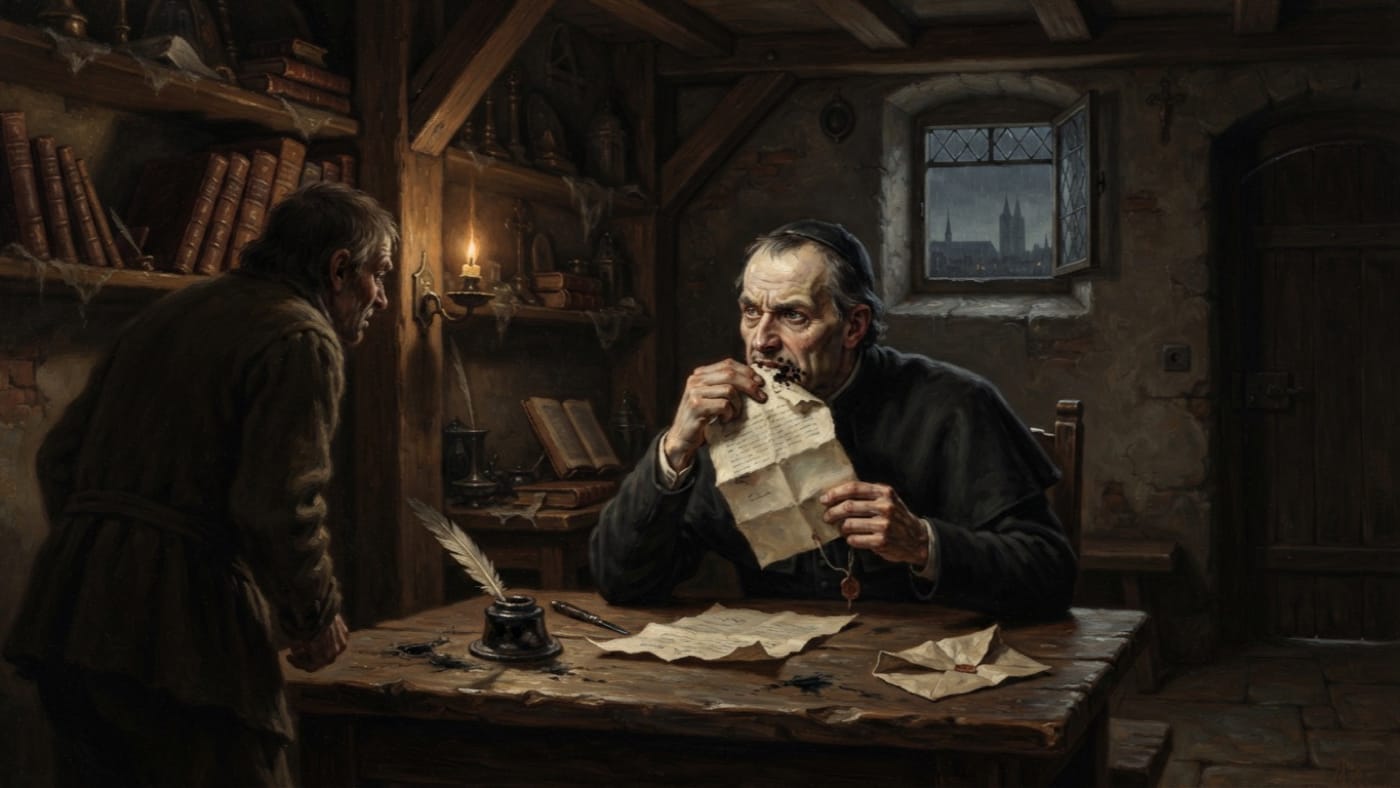
The letter arrived at Saint Eligius, a handwritten copy carrying its tabulated census of bones and its demand for explanation. Father Grauss read it, or at least held it long enough to be reckoned a reader. Then, in the presence of his sexton, he ate it. He ate the table, the commentary and the courteous demand, chewing and swallowing every line of it, until the parish of Saint Eligius had no copy left to answer.
The sexton's testimony is the whole of our evidence. No second witness stood in the sacristy. No fragment of the letter survived to be entered as an exhibit, which, when one considers it, was the point. The sexton saw, the sexton remembered and the sexton deposed, and the Ledger has carried his account ever since.
When the magistrate later asked Grauss why he had eaten the letter, Grauss gave the only answer on record: "It was addressed to me."
I have read that sentence in the sealed copy more times than I will admit to a junior clerk, and I still cannot tell what it means. It might be a claim of property: the letter was his, so he might dispose of it as he pleased. It might be an answer to the letter's own courtesy, since the scholars had demanded a reply from him in person and he had given one. It might be a joke, delivered by a man whose face was swelling. Grauss did not elaborate. I will not elaborate on his behalf. A Hieromnemon who puts motives in a dead priest's mouth is one step from putting words there, and the Bureau of Doctrine already employs enough people for that work.
The loyalty is beyond reproach. A priest of the Church was asked to argue his saint into pieces, and he refused. As for the method, I hold vellum to be a sacrament of record. I have spent my career guarding documents from fire, damp, mice and heretics. I had never thought to add clergy to that list, and the man had evidently never been told that paper is mostly rag.
The other cities make the comparison sharper. The Bishop of Münster burned his copy in the cathedral square, which disposed of the paper and left the count intact. The Diocese of Trier answered in twelve pages, arguing that the multiplication of relics was itself a miracle. Cologne set its seal to the proposition that authentication is a matter of faith and faith is not subject to arithmetic. Grauss answered in no pages at all. Of the four he was the only one who left nothing behind for the opposition to quote.
#On Municipal Custody
"The scholars asked politely. The magistrate enforced the politeness with a stick."
The record describes the magistrate as a Rationalist. In 1678 that word named a sympathy rather than a state. The Treaty of Regensburg and the formal Republic it sealed lay sixty-two years off. A man needs no Republic to hold its opinions, though, and the Düsseldorf magistrate held them firmly enough to act on them.
The charge was "destruction of scholarly correspondence." Grauss was beaten for it, and he spent three days in the municipal gaol. He did not recant.
The record says nothing more about the case. It preserves the charge, the beating, the three days and the reply. It preserves no statute, no transcript and no crowd in the gallery, and I have not supplied any. The bare facts carry the irony without help. Amsterdam's letter came dressed in the manners of the lecture hall, asking, requesting and inviting explanation, and the scholars in Amsterdam never laid a hand on anyone. Their argument was enforced in Düsseldorf by a civic officer with a gaol at his disposal, against a priest whose offence was making a single copy of it disappear.
The episode marks a line that later history would widen into a front. On one side stood the parish, holding its saints by oath and custom. On the other stood the municipality, which had found that a polite question could be backed with a cudgel and a lock. The scholars wrote and the magistrate punished. Neither needed the Great Deceiver's help, though I would not swear in open chapter that he went without his share of the satisfaction.
#On the Retrospective Classification
"The Bureau did not exist when Grauss ate the letter. The Bureau has nonetheless formed a view."
At some point after the Synod's constitution, on a date the Ledger does not record, the Bureau classified Father Grauss of Saint Eligius as Doctrinally Sound, Gastronomically Irregular. I did not write that classification. I would have been proud to.
The classification belongs to the Bureau's practice of claiming the old Church's dead. The companion entry on the Year of Letters records how the original clergy who answered Amsterdam were redesignated as proto-Bureau personnel and their responses filed as predecessor documents. Grauss is caught in that net. In 1678 he answered to his bishop, his conscience and, for three days, a gaoler. He never answered to a Bureau. The Bureau now answers for him, and the arrangement suits everyone who is still alive.
"...in the presence of his sexton, who testified to this act thirty years later during the Synod's retroactive inquiry."
As carried in the companion entry on the Year of Letters, this wording cannot stand. Thirty years after 1678 is 1708, A.S. −2. That is two years before the epoch and ninety-two before the Synod existed to inquire into anything. The sexton's testimony stands. Its date, and the body before which he gave it, are not established. The Ledger now carries his account undated.
Grauss's doctrinal successors are easy to identify. His methodological successors do not exist. Cologne's appeal to faith over arithmetic later passed into the working doctrine of the Bureau of Relics, whose Relic Authenticators defend provenance with certificates, seals and an unbroken chain of custody. Münster's tradition of sealing inconvenient findings passed into the Forbidden Stacks. No authenticator has been trained to eat a disputed provenance. On this matter the Bureau's position is unambiguous and, for once, mine as well.
What remains of Düsseldorf in the Ledger is the city where one copy of the Amsterdam census went missing beyond recovery. The census itself survived. The reliquary it mocked would later blaze at the western breach of Vienna without consulting anyone's arithmetic. In Düsseldorf, a priest with a bruised face and a full stomach had ruled on the question already.