
#On the Ruin, and What the Low Water Shows
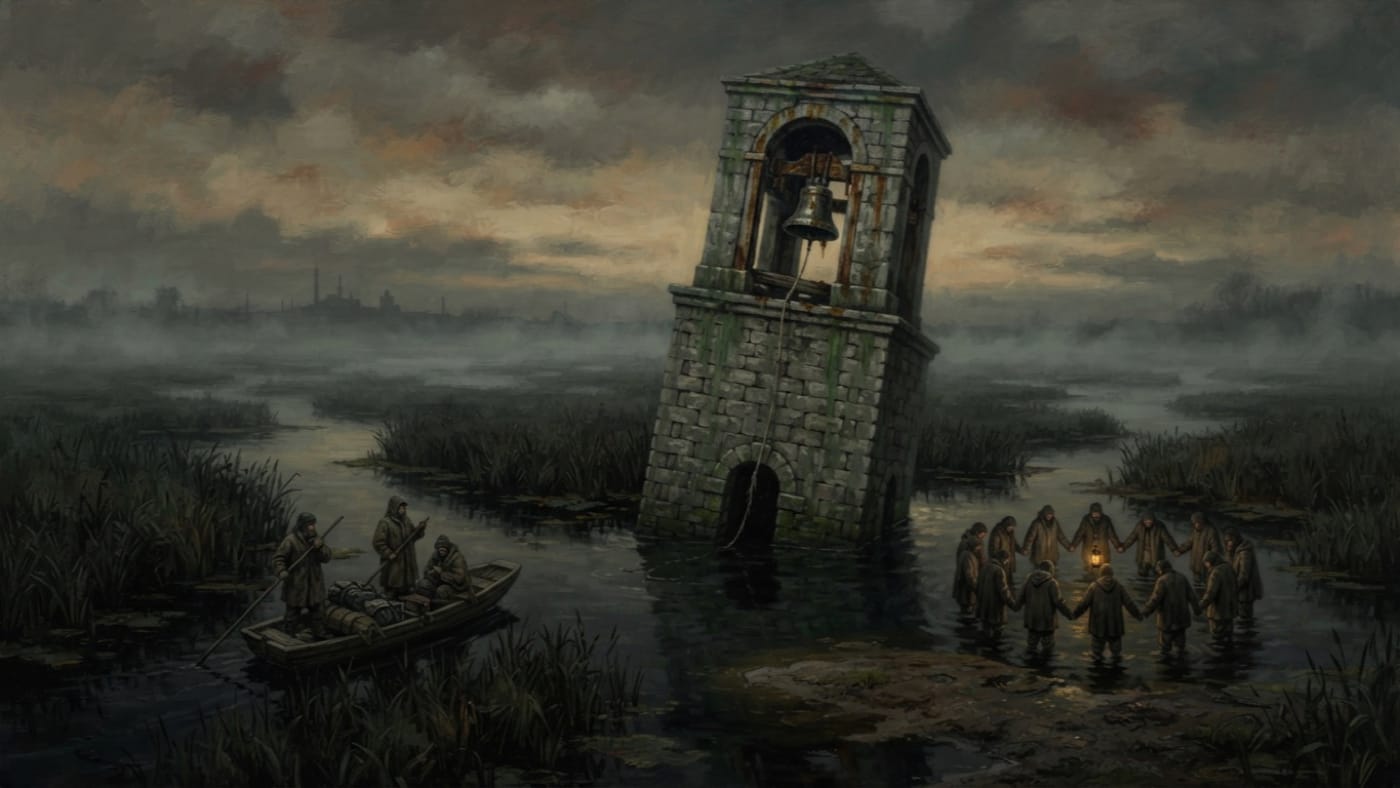
East of Bastion-Shipka, where the Phocis Marsh Corridor stops pretending to be land, a small stone church survives that the marsh has not yet finished swallowing. The Codex calls it the Drowned Shrine. The fisher-folk call it the same. It is the only point on which the Synod and the stilt-hamlets have ever agreed without a tithe-collector in the boat.
It was a way-shrine, the smallest office the Church keeps. A way-shrine is a roadside station where the passing faithful kneel between one village and the next and have their road commended to the Creator by whatever saint holds the dedication. This one had a saint, and the marsh has taken the name. The Bureau of Records holds no recovered fragment of it. Nobody else does either, though there is some enthusiasm in the stilts.
The tower is the part most often seen. It is grey stone gone green at the courses, and it rises out of black water and reed with the stiff uprightness of something built to be noticed from a road that no longer exists. When the water falls, the rest comes up by degrees. First the edge of a stone foundation shows, then the broken walls of a partial nave, and then the nave floor, under a skin of peat-dark water where the kneeling was once done properly. Reed beds close in on three sides. Fog lies flat across the channels. The light in that country is the colour of a ledger left out in the rain.
The Communion dossier records the bell as corroded past function, the rope as long rotted, and the tower's interior as flooded to the belfry floor. I set those descriptions down as the dossier gives them. I have added no alloy, inscription or measurement, and I have added no relic list, because the file contains none and I will not furnish a drowned building with an inventory it never kept.
#On the Drowned Country, and the Custody of Records
The ruin belongs to Old Phocis, the fallen kingdom whose basin lies under the marsh-water. Before the Sundering of 1 November A.S. 45 (1755 CE), that basin held villages, fields, a market town and the roads that ran between them. The dedicated Shipka survey calls the shrine pre-Synodal, meaning older than the Concordat of A.S. 90 (1800 CE). The Communion dossier goes further and places it in the valley before the Sundering. Both statements are entered here. Neither supplies a year of building.
Regional record ties the drowning of the basin to the years after the Sundering and to the Night of a Thousand Lamps. The stilt-hamlets keep that Night as legend. Records keeps it as an unclosed folio. No register says when this particular roof went under, who last rang the bell before it did, or when the first surveyor rowed out and wrote the place down. The country went under, and the shrine went with it. The Ledger will not pretend to know which spring.
What Records does know, it has stamped.
The restriction does not work. Records has no boats. The marsh-folk have boats and disregard the restriction, as they disregard most things issued in triplicate from a dry building. They are tithe-owing citizens of the Synod. In practice they are fishers and reed-cutters who have spent generations learning which channels hold a hull and which take it. Nobody has explained to them that a ruin they row past every morning is now a protected document, and nobody has the means to.
#On the Bell That Is Heard, and What the Instruments Will Swear To
The fisher-folk say the bell tolls on windless nights. They say it in their particular cadence, the Old Phocian habit in which a sentence seems to arrive slightly before the speaker finishes it. They say it without embellishment, which troubles the clerks more than any embellishment would. Several have also reported figures kneeling in the sunken nave. The reports do not say who the figures are, and the Codex will not supply names. There is no established identity, no classification and no doctrinal ruling on them. There are only the sightings, entered as sightings.
Testimony alone would have earned the shrine a line in a folklore register and nothing more. The Bureau of the Hourglass made it worse. Hourglass instruments have recorded low-frequency percussion events that coincide with the reported tolling. The instruments establish an acoustic event, and that is all they establish. They do not show that a bell moved. They do not place the sound's origin with precision, name any hand on any rope, or describe any mechanism, and they say nothing whatever of purpose.
Weigh this against the dossier's description: corroded bell, rotted rope, tower flooded to the belfry floor. Something percussive is happening in that water on still nights, near enough the shrine that the fishermen point at the tower. The Ledger records the coincidence and the instruments' silence on everything beyond it. I have been Warden of the Sacred Ledger long enough to know that a gap in a record is also a record. I enter this one with the same hand as the rest.
#On the Circles Kept Within Sight
The shrine's place in the Bureau files comes from its neighbours. Since the Bureau of Purity classified the Somnolent Communion Cells in A.S. 196 (1906 CE), the stilt-hamlets have been watched for a particular kind of gathering. Seven to twenty marsh-folk link hands at the water's edge and face inward toward a lantern trimmed to an amber stub. Their breathing grows shallow, and after an hour no one can shake them out of it. Some have been found at dawn standing waist-deep in black water with their hands still joined. The full account of the practice belongs to that dossier. Its relevance here is geographical.
Three confirmed circles formed within sight of the Drowned Shrine. A fourth is suspected and unconfirmed. It reportedly stood on a sandbar that appears only at exceptionally low water, directly above the submerged nave. The word unconfirmed stays on that entry until somebody earns its removal.
Purity has drawn no conclusion beyond proximity, and the Codex draws none. The shrine has not been shown to be a headquarters, a mother-cell, a necessary altar or the fountain of every circle in the marsh. Circles have gathered within sight of it. The rest is in the redacted correlation below, and it stays redacted.
[EXCISED — BUREAU OF PURITY] A correlation has been noted between reported bell-tollings and the formation of new cells. Strength of correlation: ████████████. Temporal sequence: ████████.
The temporal readings belong to the circles. Hourglass gauges carried near active cells register drag of the low-grade kind found in the outer Vales of Stagnance, with seconds thickening and minutes slow to proceed. In the worst incidents the drag lingered for hours after a circle was broken. A Station Two field note filed in A.S. 200 (1910 CE), later than the original classification, adds Adept Meryth Vesk's finding that the signature is similar to Syrion's catalogued emissions but not identical. She reads this to mean that the cells produce a stillness of their own. That is her interpretation, and the Bureau of Doctrine has asked her to retract it. She has not. None of these readings were taken from the bell or the nave.
A Bureau of Purity assessment attributed the cells to a single itinerant agitator, designated "the Lanternist," whose capture was considered imminent as of A.S. 198.
The Bureau has withdrawn the Lanternist hypothesis. No unifying organiser has been identified in the stilt-hamlets. Readers who came to this entry hoping for a keeper of the shrine, a bell-ringer or a founder of circles will find that the file names none.
#On the Present Condition, and Whose Problem It Is
Every Bureau that has looked at the Drowned Shrine has found a different object.
Records sees an archaeological site to be preserved and has restricted access to it. Hourglass sees a place where percussion is logged against testimony and drag is gauged at nearby circles, and it keeps both its instruments and its reservations. The patrols out of Station Two carry dispersal equipment under Commandant Gaius Tarvor's authority: flares, handbells and the sanctified noise the Bureau of Bells developed for use against Sloth. They break circles where they find them. They have no orders concerning the tower. Doctrine sealed the classification of A.S. 196. It has since ruled heretical the question of whether the marsh-folk worship Syrion or are becoming like him, and the ruling is stamped and filed.
Purity regards the structure as a problem for the Bureau of Engineering. Engineering has declined to act. It cites the logistical difficulty of demolishing a submerged structure in contested marshland during an active Sloth-seepage event, and a budget that does not stretch to it. On the subject of Synodal resources, at least, Engineering's reasoning is sound. No demolition, excavation or remedy has been carried out. The shrine stands, or floods, as it did before any of them looked.
The Sagittal Line at Shipka is measured in mud, and the shrine lies on the soft side of that measure. Purity's assessment of A.S. 201 (1911 CE) declares the Communion phenomenon contained. In that assessment's sense of the word, the shrine is contained too.