
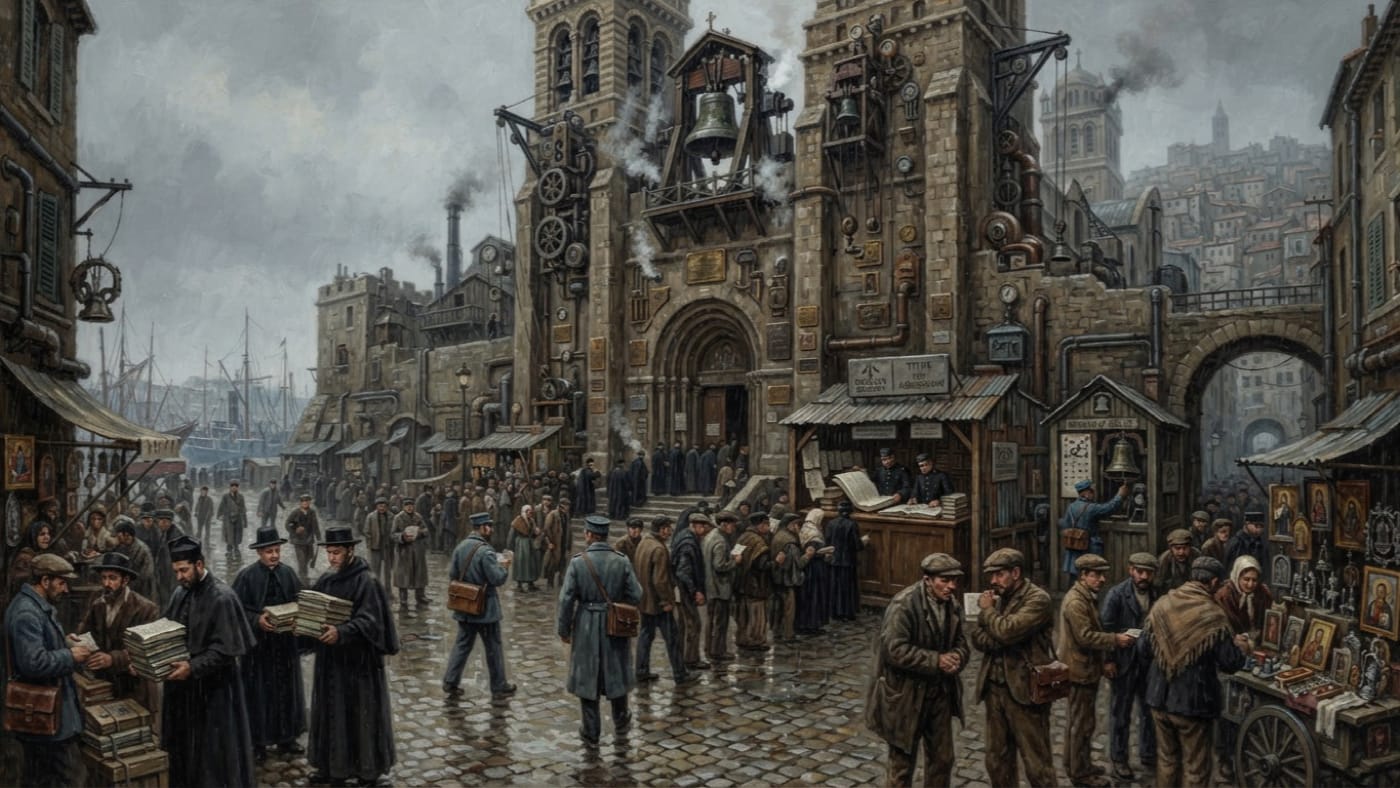
#On the Diocese and Its Reach
In this Codex, and in every quayside quarrel worth the ink, the Diocese means the ecclesiastical jurisdiction of Marseille. It is the body of parishes, pulpits, registers, dues and souls that claims the Cathedral of Saint-Victor as its own, and it finds every morning that eight other parties claim the cathedral too. No rival matches the Diocese for the antiquity of its pretensions. Several rivals beat it for punctual collection.
Under the Church's administrative doctrine, a diocese is two things at once: a spiritual province and a supply district. Two instruments draw its edge. The first is the reach of its bells. The second is the density of its ledger. A household lies within the Diocese if it can hear the cathedral over its own quarrels and if its names are entered in the Great Ledger of Souls. Doctrine calls this a body mapped by Providence. Records calls it a column ruled by clerks. Records owns the ruler.
Before the Sundering of 1 November A.S. 45, the hidden Church already kept its own parish books. After the Sundering the Church emerged into public life unevenly, one port and one parish at a time. Its offices multiplied under the interim council of about A.S. 50, the Common Allegiance followed in A.S. 55, and the Black Decrees came three years later. The Council of Worms ratified in A.S. 87, and the Concordat of Strasbourg gave the formal Synod its constitution in A.S. 90. From that settlement onward the dioceses of the Church were governed within the Synod. No file I am prepared to sign gives the year in which Marseille's own books were first sealed under that order. No survey I would trust gives the Diocese's perimeter either. Marseille is a port. Its parishioners leave by sea.
An earlier Doctrine chronicle recorded that the dioceses were yoked beneath Synod command at the Council of Cologne in A.S. 226.
Corrected. The later Council and Edict of Cologne sat in A.S. 100, ten years after the Concordat of Strasbourg had settled the formal Synod. The First Council of Cologne met for nine days in September A.S. 27. It adopted none of its seven proposed articles and yoked no diocese to anything. What it left behind was a narrow procedure for voluntary contact and request. The chronicle's own year falls twenty-five years after this survey. Doctrine does not license prophets.
#On the Chapter and the Other Claimants
The parent register lists the owners of Saint-Victor as the Creator, the Diocese, the Bureau of Bells, the parish chapter, the city of Marseille, and four further Bureaus that each hold an hour, a transfer or a levy. The list is accurate. Its proportions are not. These parties do not hold equal shares under any settlement in my possession. Each holds a function, and each defends that function against the rest.
Episcopal responsibility follows the general model of the Church. A Bishop-Praetorial is styled Custos Animae, Keeper of Souls. He governs a province's spiritual life, answers for its quotas of faith and of revenue, and sits in the Assembly of Thrones, where liturgy is debated at a volume that reaches the street. The Assembly's roll records who holds Marseille's throne in A.S. 201. This survey names no one and charts no succession of Procurators, Legates, Vicars or Wardens beneath that throne. Inquisitorial mandates and the Bureau of Purity cross every such chart in any case, and they cite authority older than the chart.
The cathedral chapter runs the daily business. Its canons license frontage, admit guides, accept devotional trade and settle access whenever two Bureaus want the same nave on the same afternoon. The city keeps its streets, its watch and its opinions. The Bureaus keep their hours. The Diocese keeps the claim beneath all of these: the souls entered, the dues owed, and the parish that resumes when the Bureaus have gone home.
#On the Souls Entered
A diocese reaches a household through paper. Births, baptisms, deaths, confessions and assessments go into its registers as witnessed entries. Under the general practice of Records, the scribe confirms identity from papers, witnesses and earlier entries, writes the line, seals it, and copies it into the district index. Confession abstracts come in by the sack. Parish returns come in damp. Wax is warmed, scraped, pressed and counted aloud by two clerks, because one clerk counting alone is a temptation.
An entry carries consequences. Across the Church, dues are assessed against the register, passage depends on it, and entitlements are released from it. A fisherman's family exists for the Creator by baptism and for the Church by its line in the ledger, and the second existence costs money. The Bureau of Tithes assesses what the entries owe. Its association with the Salt Dues, the regional surcharge that southern ports pay with their usual grace and their usual swearing, puts the assessor in the same lanes as the confessor, a few doors apart.
Two witnesses can make a corpse. One missing witness can keep a dead uncle drawing rations for a decade. The registers of Marseille hold the same mixture of truth, convenience and spelling as every other register in the Church, with salt damp added.
#On Tolling and Movement
The Bureau of Bells holds the operational mandate at Saint-Victor. From the western bell cage, the cathedral's nine principal bells toll the canonical hours, call pilgrim muster, sound the harbour alarms, and pass relay signals along the coast to shipping and inland toward the Rhône road. The parish rises, works, buries and bargains to these peals. Marseille calls them weather.
Diocesan doctrine reads those same peals as evidence. Every bell heard inside a parish supports the claim that the parish belongs. That support has a limit, and Bells enforces it. A relay signal heard aboard a ship beyond the harbour mouth does not bring that ship into the Diocese. Nor does it make the vessel's deck a parish, its crew assessable souls, or Thessaloniki a suburb of the Cathedral Quarter. Relay coverage belongs to Bells. Jurisdiction belongs to whoever can prove the entry.
The two mandates collide whenever the hours are full. The cathedral record gives the case of the A.S. 186 Thessaloniki surge. The Bureau of Pilgrimage, which keeps its southern headquarters in Marseille, demanded the nave for departure blessings. Bells answered with a maintenance peal that lasted six hours, and the pilgrims fled to the quay. The record shows no ruling from the Diocese on that occasion. The silence is useful. If the Diocese never rules on a dispute, it never loses one.
#On Fees, Bones, and Contested Access
The chapter's income comes in cramped portions. Under parish licence, stallholders lease frontage beside the cathedral. Pilgrim guides pay to start their tours in the shade of the west door. Relic dealers buy Masses of Remedial Doubt when a customer complains too loudly. Pilgrimage pins its sailings, penances, berth changes and lost children on the board by the southern porch. Every fee in this list is pastoral if someone asks. Every one of them is rent if someone audits.
The canons defend the income with liturgy. When Tithes tried in A.S. 174 to levy a charge on bell-tower admissions, the chapter reclassified the stairs as a penitential ascent, which Tithes may not tax. When the Bureau of War asked to store signal powder under the west porch, the chapter produced a relic certificate for the floorstone and declared that drilling it would be sacrilege. Both acts belong to the chapter. Neither appears under an episcopal seal. The Diocese collected the credit later, in the usual manner.
The Bureau of Relics supervises the crypt's traffic with Quai Saint-Lazare. Objects refused authentication at the Quay sometimes rest under Saint-Victor before a Relics clerk takes them away again. Three questions must be kept apart here: whether an object is certified, whether the faithful venerate it, and whether it is what it claims to be. The Diocese's claim on the cathedral answers none of them. It does not prove the soldier-martyr, the drowning of the harbour rats, or the provenance of the bones. Its claim reaches the candles sold to the faithful and stops at the bones themselves.
#On the Present Application
As of A.S. 201, the Diocese of Marseille still holds its claim to Saint-Victor the way a canon holds his stall: by sitting in it before anyone else arrives. Its registers keep the port's baptisms, burials and confessions. Its dues move with the assessors. Its chapter licenses the quarter's devotion one frontage at a time. The Bureaus pass through with their mandates, and each one leaves a new form behind it.
Some matters lie beyond its competence. The Bureau of Bells holds a file from A.S. 191 on a midnight return-peal of the great bell Victor, rung in calm weather with no authorised ringer on the rope. The file remains open. The Diocese has entered no opinion on it. For once, it has found something in its own cathedral that it does not wish to own.
The Diocese has no map, no birthday that anyone has proved, and no bishop named in this survey. It still collects. Quod scriptum est, debetur. What is written is owed.