
#On Their Nature
"A demon has weight, and anything with weight can be put on a scale." — preface to the present field rubric, which I composed and which the Bureau of Doctrine adopted after removing my name from it.
Demons exist. The Rationalists spent two centuries calling them a figure of speech. Then, at Vienna, they set up their guns beside one.
The Bureau of Doctrine teaches that on 1 November A.S. 45 / 1755 CE the Sundering opened a breach, and that what came through it are manifestations of the Great Deceiver. He does not enter the world himself, and no living deponent has seen him. I have signed this teaching. It stands. What caused the breach is a question the Bureau answers differently every few decades, and correctly every time.
This survey of A.S. 201 keeps two columns, and the reader should learn to tell them apart. The first holds what the surgeon's tray can show: bodies, wounds, chains, residue. The second holds what the chaplain says about where those things came from. The tray has never contradicted the chaplain. Then again, nobody has asked it to.
#On Flesh, Influence, and Human Service
The Church sorts the enemy under three headings.
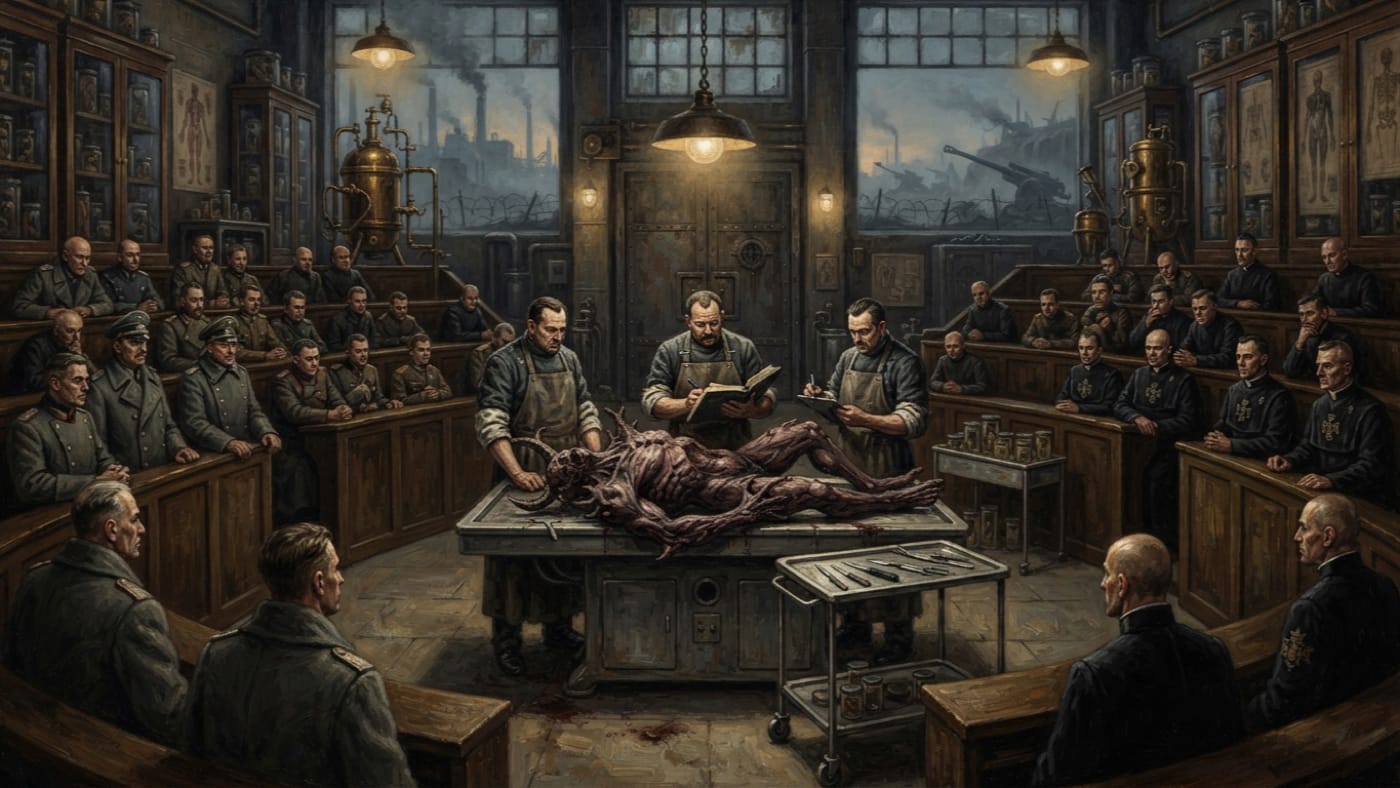
Corporeal demons have bodies. Shot and steel go into them, and they die. The corpse stays where it fell and does not get up again; I have stood beside one on a zinc table behind the Sagittal Line while an anatomist sawed at it and swore. Whether the same creature walks again somewhere else, the Synod cannot confirm. The anatomists have also given up on a single plate of demonic anatomy, because no two bodies on the table agree. These creatures arrive from the east on their own limbs, across No-Man's-Land. When one is found deep in the western provinces, the Bureau of War holds an inquiry, because that should not happen.
Influence-demons are very rare. They show up as smoke along a ceiling, mist in a trench sump, or a whisper in the bunk above. Chains slide through them and they cannot be held in a cell. They possess no one. Within Synod territory no man has been possessed, compelled against his will, or bound by a pact that holds. An influence-demon makes suggestions and waits for someone hungry enough to take one.
Human servants make up the bulk of what the Line calls demonic forces. True demons are a minority among them. The rest are cultists, sorcerers, deserters, captives in the eastern pens, and people whose flesh has been altered and who have been chained into engines. A cultist is not a demon, and neither is a captive with a mutated arm. The bullet does not care about the difference. The Bureau of Purity cares about it a great deal.
The inherited description of the Shadow Court's Thralls speaks of "men and women whose wills have been branded away," husks that "breathe only to obey."
The brand is real. The erasure is not. A Thrall is a captive held under the sigil, the whip, a threat to a child in the next pen, and hunger handed out by the spoonful. That is coercion, and it was entered under the wrong heading. A Thrall can still choose otherwise, which is exactly why the Bureau of Purity is permitted to try him.
#On the Seven Powers
By Church classification the seven Sin-Generals are the primary manifestations, and every lesser demon derives from one of them. None of the seven has sat for a portrait, and no reliable deponent has spoken with one. Accounts of a Sin-General walking openly among men are filed under Legend. That is a real drawer, and it is very full.
Kargath is Gluttony: need that keeps eating and is never filled. Velmora is Greed, the habit of owning and lending until a man amounts to what he owes. Opposite Sibiu her agents keep accounts the way other armies keep artillery. Maldrake is Wrath, violence that carries on long after the quarrel that started it, and he shares the Constantinople front with Kargath, to nobody's comfort. Syrion is Sloth: men stop making the effort, hands go still, and the hour stops before Shipka. Velkara is Lust, sensation pushed ever higher and people used as instruments. She has no single front. Her pressure runs through every sector, and her nominal seat is in the Shattered Courts. Atheron is Pride, supremacy that cannot admit an equal, and he stands opposite Przemyśl. Morwen is Envy: wanting another person's face, name and life, and wearing them badly. Her front is opposite Irongate.
Do not picture the seven as a council at one table. They compete for ground, for servants, and for the same exhausted provinces, and the Line has survived partly by standing in the gaps between their appetites. Königsberg's Grey and the Nameless Tide at Brest are on no list of the seven. Whoever adds them will answer to me.
#On the Enemy Within
The gifts work, at first. A fever breaks. A stove that had no coal is warm in the morning. A debt is cancelled by a hand nobody saw. The recipient tells himself he has been lucky, and he is right until the day he stops being useful. Then the bill arrives. It is not a punishment for disobedience, because the obedient pay it too. The account simply closes.
Cults run as cells, each competing with the others for favour. A typical cell is a quartermaster's clerk, a cook, a signalman with a gambling habit, and a cellar to meet in. No line of command runs from that cellar to any throne. An influence-demon sometimes passes through and sharpens a cell, then moves on. The damage they do is ordinary work done badly on purpose: a misfiled powder ledger, a ration crate opened in the rain, a signal sent a minute late.
#On Vienna
The Siege of Vienna in A.S. 95 / 1805 CE lasted nine months, and it is the clearest specimen in the archive. Rationalist batteries supplied the guns: conventional pieces dragged over the passes and laid by gunners who could calculate a firing solution. Their infernal allies supplied the sorcery: stone that split at a word, bread that spoiled in sealed casks. Each side brought what the other lacked. Demons do not understand a breech mechanism. When they capture an engine they corrupt it with sorcery and feed men into it until it moves. At Vienna they had no need, because the Rationalists did the arithmetic for them.
Althazar of Pest, who led the cultists, was a sorcerer-lord. He was a man. Some of the Bureau's indices list him as a demon, which flatters him more than he earned. Witnesses say that when Bishop-Warden Clemens Stahlhand struck with the reliquary, the demons scattered into ash-clouds. The same witnesses say the bells rang by themselves. The ash proves that something happened in Saint Rupert's nave. It does not prove that slain demons always turn to ash, and the anatomists are glad of that, since they need the bodies.
Vienna held, and Doctrine has preached its survival ever since. The mechanism remains ratified, pending verification.
#On the Bell and the Broken Measure
Readers of the Shrine-Deck Crew entry will know the apparatus. The guns fire on the choir's beat, the choir keeps time to a brass metronome bell that cost four Crowns and six pennies, and each gun position sits inside a ring of chalk and ash with relic pins pressed in at the cardinal points. The Cadence Reforms of about A.S. 95 began this discipline, and the Bell Codex of A.S. 115 standardised the bells.
The first reason for it is mechanical. Cadence keeps recoil from shaking a barge apart and keeps loaders out of the path of the breech. The Bureau of War records that reason, and it is correct.
The crews give a second reason. When cue and bell drift apart by half a measure, they say the deck "goes hollow," and that off-tempo firing draws things that listen. Whether what listens is a demon, this survey cannot say. A platform that has gone hollow may draw the enemy to it like a beacon, but the enemy still has to come over the ground, and that takes hours. Demons do not appear out of the air on a stopped beat. Nor is every jammed breech the Great Deceiver's work. Most are soot.
[CONTENT REMOVED — Bureau of Silence, File 88-K/Shrine] Reference to the phenomenon designated "third voice" is permitted. Classification of the phenomenon is ████████████████. The file remains sealed.
#On Countermeasures and Ratification
Flesh can be beaten with iron. Shell, bayonet and the reliquary mace all kill corporeal demons, and the bodies stay down where they fall. Wards and cadence reduce the danger and promise nothing. The Grey at Königsberg and the Tide at Brest have heard every hymn in the Codex and come on anyway, so no one should be sold a relic pin as a guarantee. Against influence-demons there is no known means of destruction. Miracles have not managed it either, and miracles are not cheap. Saints pay for them in their bodies, their memories and their years, and Doctrine records the payment as willing and righteous. Sorcery sends its bill to the land instead: spoiled stores, roads that will not lie straight, measures that weigh wrong, names that slip out of the register, and hours that run twice.
Before Constantinople, the Bureau answers Kargath with rationing and fasting days so that the enemy finds no appetite to feed on. The garrison fasts and grows hungrier. Kargath's cells recruit among the fasting, the Bureau tightens the ration again, and the cells recruit again.