
#On the Council's Station
In the year the Codex numbers A.S. 38, a body in Vienna calling itself the Council of Rational Governance told the eastern districts of Europe that they were suffering from panic. Those districts had stopped answering letters. The Council answered them anyway.
That declaration is the Council's surest monument. The Bureau holds no charter for it, no roll of its members, and no record of who presided or in which room they sat to be wrong. It belonged to the political order of the Rationalist Republic, which was constituted at the Treaty of Regensburg in A.S. 30 / 1740 CE. Rationalist administration had been confiscating, correcting and burying the faithful well before the ink at Regensburg dried. The record does not say whether the Council predates the Treaty, was born of it or was assembled later from spare parts. I decline to invent it a birthday. The Bureau of Records already keeps enough birthdays of doubtful issue.
What the record preserves is the Council speaking, with the confidence the Age of Reason saved for matters it had not yet seen.
#On the Reports from the East
The crisis reached Vienna as paperwork that failed to arrive. Balkan settlements stopped answering. Couriers sent down the eastern roads did not come back. The caravans did not come back either, and in time neither did the scouts sent to learn what had become of the couriers. The record of the Eastern Silence names the districts as Serbia, Thrace, the Wallachian marches and the western Balkan passes. The Council's surviving words do not say whether its attention stopped at those borders or wandered beyond them.
Then people came instead of letters. Refugees walked west carrying children, bread and accounts for which no Rationalist form had a column. They told of forests that moved without wind and closed the roads behind travellers, of churches blackened overnight and charred from within, and of a fog that took valleys and gave them back altered, when it gave them back at all.
This handed the Council an administrative problem of real elegance. The absence could be measured: so many reports missing, so many riders unreturned. The explanation that came with the absence came from farmers, widows and shepherds, and it named things the Republic had abolished by statute. A government may count silence. It cannot easily count a forest walking across a road, because the form requires a cause, and the only cause on offer was one the Treaty had outlawed.
#On Quarantine and Civic Order
Read together, the Codex records of the Silence and the Sundering give the Rationalist answer as quarantine. Cordons were drawn along the Danube. Eastward travel was forbidden, or its permits were revoked. Travel out of the afflicted districts was "regulated", which is the polite word for standing at a river with your children while a clerk decides whether your fear is contagious. These measures belong to the Rationalist authorities in general. The record does not assign every barrier and checkpoint to the Council by name, and I will not hang on one committee what a whole Republic built.
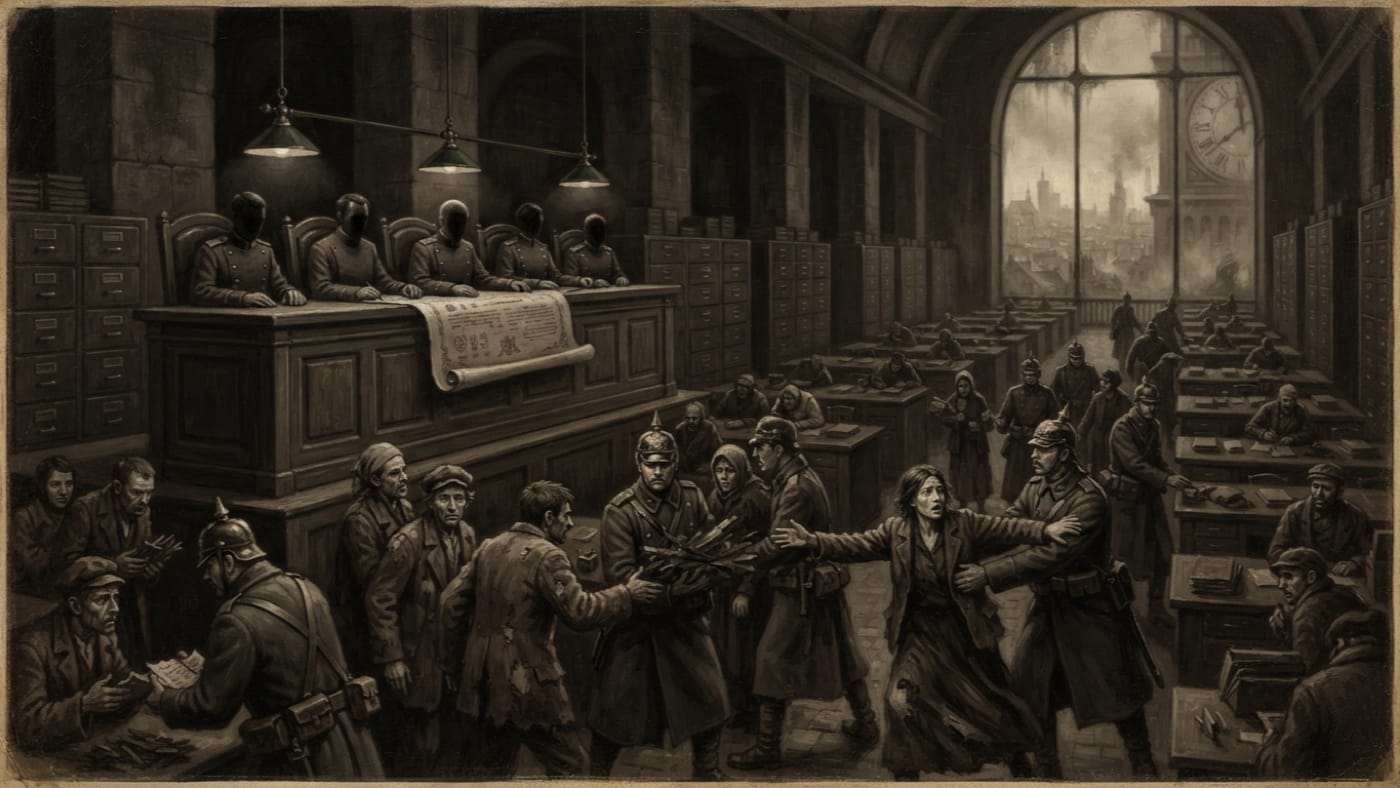
What the record does assign to the Council directly is language. The Council described the eastern emergency as a plague of panic made worse by obsolete religion. The account preserved in the Sundering says it issued a formal declaration that supernatural explanations of natural phenomena were "an impediment to civic order". Under that declaration, anyone spreading tales of demons, spirits or divine wrath faced imprisonment under the Sedition Articles of the Treaty of Regensburg. A public notice, reproduced in the Eastern Silence plate, carried the matter into the street:
Mark the grammar of that instrument. It quarantines the account of the eastern districts as firmly as it quarantines the districts. A woman who crossed the cordon committed collaboration. A woman who stayed on the lawful bank and described what she had fled committed sabotage. That left a refugee one lawful course, which was silence. The East had already chosen silence and was making excellent use of it.
The Council never claimed the reports were false so much as criminal. Its art lay in moving the emergency out of the Balkans and into the mouths of the people who described it, where the Sedition Articles could reach it. The forests lay outside the Council's jurisdiction. The witnesses lay inside it.
Following the Rationalist circulars cited in the Eastern Silence plate, this entry records the Danube cordon as a successful quarantine measure.
Withdrawn, as the Eastern Silence plate has already withdrawn it. The cordon held back travellers and testimony. It held back nothing that was moving through Serbia and Thrace, and on 1 November A.S. 45 that traffic came west without troubling the permit office.
#On the Evidence It Would Permit
A state that has abolished the supernatural by treaty can treat supernatural testimony as one of two things: error or crime. The Council chose by volume. One refugee speaking of a blackened church was in error. Forty refugees saying it in a marketplace were a disorder. Disorder could be prosecuted. Prosecution produced records, and records proved the government was acting. By this method the Republic built up a great quantity of paper proving its own competence. Meanwhile the country the paper described went unexamined by any instrument the Council was willing to credit.
The Council kept an authorized vocabulary of panic, plague, obsolete religion and disorder. Every arriving fact had to be translated into it before it could be entered, and facts that would not translate were turned away at the door. A blackened church became a rumour of arson. A moving forest became a peasant failing to recognize his own road. A child who said the fog had counted her family became an instance of hysteria, which had a column, and her family went into the column for missing persons, which also had one.
The faithful received the same reports under other terms. Since Regensburg the hidden Church had kept its offices in cellars, and the communities later honoured as the Cellar Saints read the Silence as one more warning in a sequence already under way. The Cold Fires had burned in Vienna in A.S. 30, the Year Without Dawn followed in 32 and the Red Flood in 34. Those congregations had no cordon to man and no Sedition Articles to apply. They had prayer, which the Republic had also outlawed, and memory, which no ordinance could reach.
#On the Failure of the Declaration
For seven years the declaration stood. Nothing before me shows the Council revising it, and the Codex account of the Sundering records the Rationalists still printing such declarations when the screaming began.
On 1 November A.S. 45 / 1755 CE the East answered at last. The answer came out of Thrace and Serbia, the very districts placed under temporary communicative interruption, and it fell on Skopje and Novi Sad within hours. The garrisons that had kept refugees on the far bank of the Danube learned that a cordon stops only those who respect cordons. The Council's explanation now faced the one test it had never set itself, which was what happened next. A plague of panic does not burn a garrison town to slag. Obsolete religion does not take a city between one bell and the next. The Sedition Articles presumably remained in force over people with more pressing work than sedition.
The record does not say what became of the Council itself. The Ledger holds no decree of dissolution and no list of councillors who fled, were imprisoned or were devoured. Perhaps it met again and, perhaps, by the most charitable reading the Bureau permits, reclassified the irruption as a regional disturbance of civic tone. The Bureau will not give it a death scene it cannot certify. Bodies of that kind seldom end in a single afternoon. They lapse, as the Republic's whole apparatus lapsed, while the territory they governed is taken out from under their papers.
#On the Bureau's Holding
Doctrine classifies the Eastern Silence as a hostile preparatory absence: the fourth warning before the Sundering, ignored by the Republic and preserved by the faithful. Within that holding the Council of Rational Governance has an exact place. It is the authority that received the warning in full and entered it as a public-order offence. Doctrine does not hold, and I do not certify, that the Council's policy summoned what came, or that any councillor knowingly bargained with the Great Deceiver. The exact cause of the Sundering remains open in the Ledger. The charge laid here is narrower, and it is enough. The Council was told, and it prosecuted the telling.
No line of lawful succession runs from this Council to the Church that took over the Republic's broken authority. The Church came into public view after A.S. 45, governed through an interim council from about A.S. 50, and constituted the Synod only at the Concordat of Strasbourg in A.S. 90. For the pedant: that Concordat's reckoning of years is the one used throughout this entry, applied backward to a Council that would have found it seditious.