
#On the Compendium's Recorded Authority
"Designation 'Somnolent Communion Cells' assigned under Subsection 14.iii of the Compendium of Proscribed Devotional Practices." — Bureau of Purity incident classification, A.S. 196
The Compendium of Proscribed Devotional Practices enters the Ledger the way most instruments of the Church do: by being used. In A.S. 196 the Bureau of Purity took it up, turned to Subsection 14.iii, and applied that subsection to the marsh-folk beyond Bastion-Shipka who had taken to holding hands in the dark. The citation survives. It is numbered, stamped and filed, and it is very nearly all the archive will surrender.
This office cannot say who compiled the Compendium, under whose seal it was first issued, which council ratified it, or which vault keeps the master copy, so it will not. Readers who need a founding date may consult their own imaginations, which is where most founding dates are made.
The case shows what the book does. The Bureau of Doctrine defines what the faithful may believe, and Purity enforces those definitions. Between the definition and the brand sits a book that tells the white mantles which kneeling, which murmuring and which gazing at a lantern fall outside what is permitted. It gives each fault a number so that it can be filed. The Index Damnatus condemns what is written, sung and named. On the evidence of its one surviving citation, the Compendium condemns what is done. Its mercy lies in its numbers. Once a practice has a subsection, it can be dispersed, its leader detained and the folio closed.
#On Subsection 14.iii and the Passive Variant
The Shipka file does not reproduce the text of 14.iii. It records three things: the designation the subsection was used to assign, the category the designation was filed under, and the response Purity recommended. The Bureau considers three entries sufficient. The Bureau considers most things sufficient once they are in triplicate.
The category is Sloth-Heresy, Passive Variant. The catechism teaches children that Sloth means idleness: the sentry dozing at his post, the clerk who leaves a column untotalled. Those who have stood near the fog know that Syrion's domain is worse than that. It is the end of struggle, the comfort of giving up, the moment someone stops and cannot start again. "Passive" is Purity's way of fitting both meanings under one heading. A passive heretic does not preach, print or collect tithes. They sit down, and others sit down with them.
I can read the remit of 14.iii only backward, from its one known victim, as a coroner reads the blade from the wound. Judging by the Shipka citation, it covers communal devotions directed toward rest: devotions held in company, by lamplight, to a soft refrain. If the subsection reaches further than the marsh, the file does not say so, and I will not say it for the file.
The Church does not forbid sleep. It forbids sleeping in a ring, around a dimmed lantern, to a murmured refrain, at the edge of the water. Drawing that distinction is the whole work of the subsection. The practitioners' own names for their gatherings, Circles of the Gentle Lantern and Shared Rest Vigils, only made Purity more certain. In Purity's experience, the softer a heresy's vocabulary, the more confident it is of its welcome.
The response was recommended in this case. Nothing in the file says that 14.iii prescribes it everywhere, and I am not in the habit of writing law for books I have not read.
#On the Shipka Application
The details of the ritual matter here only as far as they explain the classification, so I keep them short.
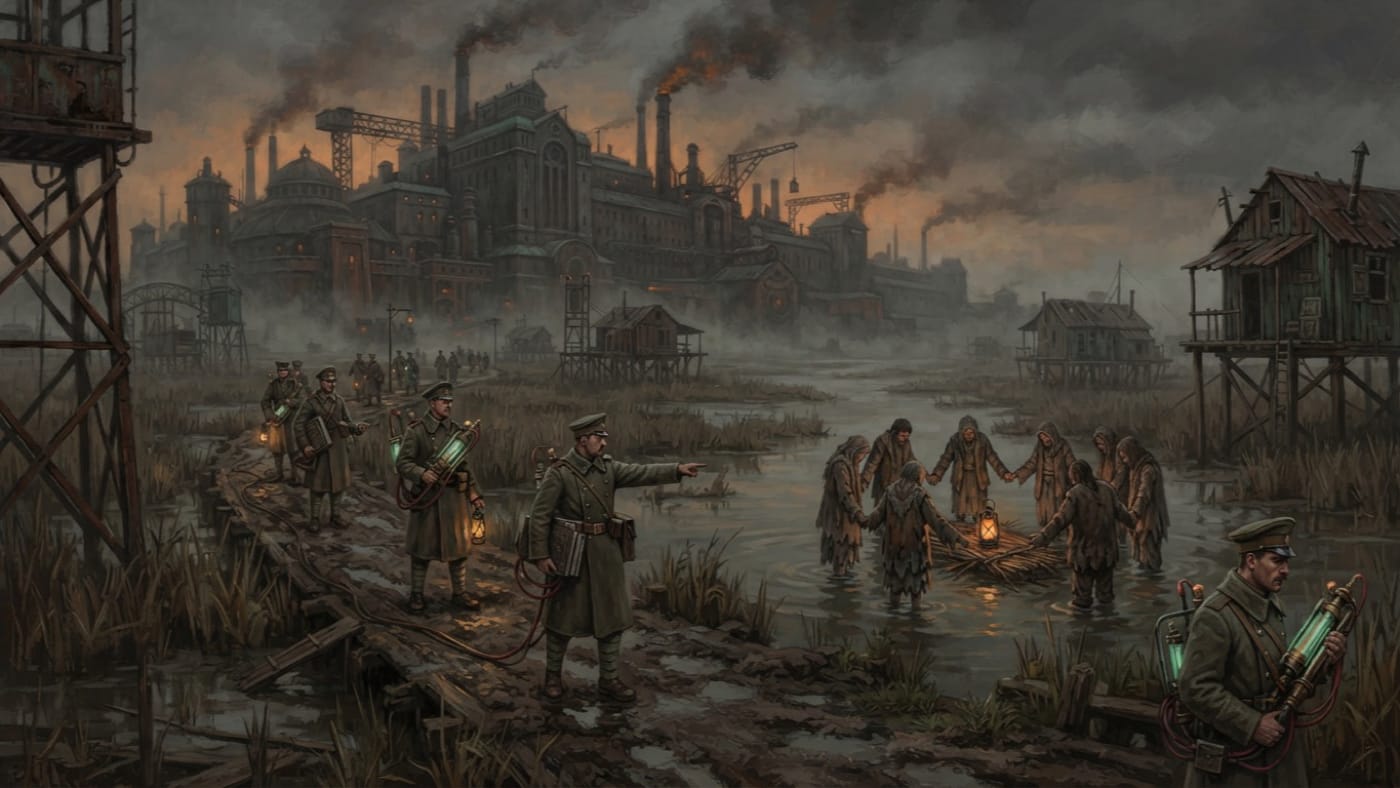
The gatherings form among the stilt-hamlets of the Phocis Marsh, at the point where water begins and the reeds thin. Between seven and twenty people link hands around a dimmed lantern or a dulled relic. A leader murmurs phrases about laying down burdens and forgetting the ache of days, over and over, without scripture. Within about an hour the participants' breathing grows shallow and their eyes fix. Shaking them gets no response, yet their feet shuffle in the mud to keep the ring unbroken. On three confirmed occasions, patrols found an entire circle at dawn standing waist-deep in marsh water, hands still linked and eyes open. The patrol reports call their expressions smiles. Once hauled to dry ground, the participants could not account for the hours between the lantern's dimming and the patrol's hands on their shoulders. What they experienced in those hours the patrol could not record, and they could not report.
None of this troubled the subsection, which needs a practice, not a mechanism. It found one.
Nor did the leaders give Purity anything to seize. They carried no catechism, distributed no literature, kept no accounts and named no teacher. Under sustained questioning they returned the same answer, which the file preserves with visible irritation: I sat down. Others sat with me. We were tired. Purity assumed a shared liturgy behind the uniform pattern and went looking for its author.
The Bureau of Purity's case assessment attributed the cells to a single itinerant organiser, designated "The Lanternist," whose capture was considered imminent as of A.S. 198.
The Lanternist hypothesis is withdrawn. No unifying organiser has been identified. The cells appear in separate hamlets, follow the same pattern and show no evidence of coordination. This correction applies to the Shipka case assessment. Subsection 14.iii and the Compendium stand unamended.
The detentions went as follows. One leader finished her penance, went home to her hamlet, and within months was leading a circle again. One died in correction, and the report attributes the death to "complications arising from pre-existing fatigue." The ferryman slipped away into the marsh during transfer. Hourglass patrol later found his punt drifting empty in the deep channels, with a dulled lantern still burning in the bow.
#On the Instruments and the Unretracted Observation
The Bureau of the Hourglass does not classify. It measures. Its patrols carried drag-gauges to the circles and recorded a thickening of seconds near active rings, the same low reluctance of minutes found at the outer edge of the Vales of Stagnance. The distortion grew the longer a circle held and outlasted the circle's dispersal by hours.
Adept Meryth Vesk's remark is the most dangerous sentence in the dossier. She suggested that the cells might be producing a stillness of their own rather than channelling one. If she is right, the marsh-folk are neither worshipping Syrion nor being worked by him. Their exhaustion has produced something that looks like his work because it grows from the same mud. Nobody has proved that the cells generate their own stillness, and nobody has proved that they channel his. Doctrine asked her to withdraw the observation. She has declined, and the observation remains in the file.
Subsection 14.iii is spared the whole controversy. Purity's long-standing view, recorded in the parent file, is that voluntary and involuntary heresy carry the same penalty, so the question of mechanism does not affect the sentence. A subsection that only has to establish that a practice is proscribed can be applied with total confidence to a thing nobody understands. In this case it was.
I hold, with the Bureau, that the cells are a Syrionic devotion and are properly classed. I hold this officially, and an official holding is a sturdier thing than a private one. It is also one that a gauge can contradict.
#On Containment and Continued Application
The Compendium told Purity what to call the marsh gatherings and what to do about them. It could not supply the people to do it. Commandant Gaius Tarvor asked for more Purity personnel. Purity sent one junior assessor and a memorandum reminding the Commandant that heresy in stilt-hamlets, however regrettable, posed no threat to the logistical function of the Sagittal Line. Tarvor then took the matter into his own hands. He authorised the Hourglass patrols to carry dispersal equipment, meaning bells, flares and the sanctified noise the Bureau of Bells developed for use against Sloth, and to break up circles by force.
The circles broke. Then they formed again, under new leaders indistinguishable from the old, in other hamlets and at other stretches of the water's edge. The recommended response was carried out faithfully, and it did not end the practice.
That is what contained means under the procedures of the Synod: the word describes the state of the paperwork, not the state of the marsh.
Inside the bastion walls there is a separate and more domestic trouble. The Rest Societies form among clerks, nurses and rail hands. They begin as arrangements to share shifts and pool rations so that nobody falls asleep on dangerous duty, and they drift slowly toward the conviction that the true sin is never stopping. Their organisers are charged with Sloth-heresy with seditious overtones. No file I have seen cites 14.iii against them. They are tried under another heading, for the offence of being tired indoors. One of the marsh leaders was a nurse discharged after the Bureau of Mercy judged her guilty of dereliction for falling asleep on a ward shift, which shows how short the walk from the Societies to the circles can be. The Compendium has not yet been asked to measure it.
Subsection 14.iii stands as it stood in A.S. 196: applied, stamped, and satisfied with itself. Somewhere past the reeds a lantern is being trimmed down to an amber nub, and nobody in the ring has read a word of it.