
#On the Instrument
In A.S. 82 the Treaty Office at the Steppe Gate ratified a guild instrument establishing archival service beneath the eastern limestone cutbank. The registers call it the Compact of Subterranean Custody. The Keepers call it the Compact, and they lower their voices when they say it, the way other professions lower them for the dead. It came six years after the seven Treaty-Stones were raised. It also came four years after the events of A.S. 78: the Gate's registration, the filing of the Node Seven charter and the documented widening of the Burnless Archive. So the Archive had been swallowing paper for four years before anyone signed to live beside it. The Compact founded custodians. The vaults were already there.
Its author is reported as Alzen Voss. The instrument gives her title as Custos Chartarum Subterranea, which later clerks rendered as Paper Keeper, First Grade. Its authority was local: recognition by the Treaty Office, within a Church administration that was still assembling its offices on the Moldavian approaches. The formal Synod did not yet exist. Its numbering, A.S. 82 included, was applied backward at the A.S. 90 settlement, the way the Synod applies most things: late, and in excellent penmanship.
#On Admission to Custody
The sources agree on three qualifications, which at the Steppe Gate counts as a miracle of clerical consensus. A candidate must be literate, must command the pronunciation protocols of all seven Treaty-Stones, and must be willing to live underground.
Present accounts name the required literacy as the Triune Alphabet. That alphabet was formally promulgated in A.S. 178. The script on the stones resembles it. Doctrine explains the resemblance proleptically, and I will not try to improve on Doctrine in an entry of this weight. Keep the two facts apart. The Keepers of A.S. 82 read the script the stones required. Later centuries described that script by the name the Church eventually gave it. The guild's own histories close up the gap. The Ledger keeps it open.
The second qualification has no ornament on it. At the Gate, speech binds, and a badly spoken clause near the treaty can bring clause-spirit enforcement down on the speaker. A Keeper who mispronounces a heading while shelving it endangers more than the shelf. Mastery of seven protocols is the minimum price of keeping one's throat.
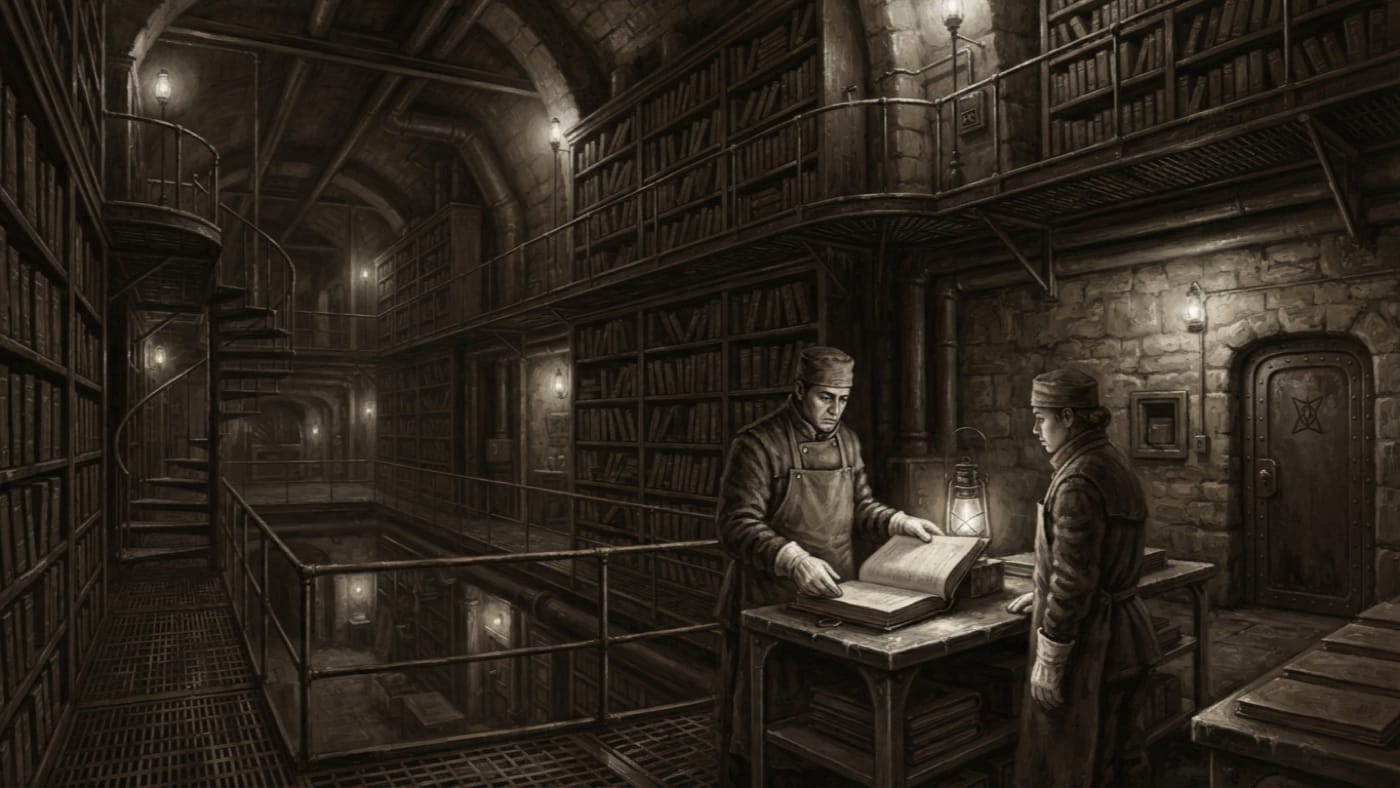
The third qualification is literal. Under received guild practice, Keepers sleep in limestone cells above the Third Vault and eat what comes through a service hatch. They wear white cotton gloves, speak only in whispers and get four hours of daylight a week. These are guild customs. None of them has been shown to be a clause of the A.S. 82 text. They show what "willingness to reside underground" turned into once the willing were counted. The Keepers are a lay guild and hold no ordination. The Gate calls them Dust Priests because the Gate is rude and enjoys it.
#On the Received Rules
The Voss dossier credits the Compact with five handling restrictions:
- no bare hand on a folio;
- no voice above a whisper in the vaults;
- no correction without a witness;
- no document removed;
- no document declared silent until it has been watched for seven nights.
The guild's own history treats the gloves, the witness marks and the seven-night watches as later additions. The two accounts do not agree. I will not reconcile them by inventing a numbered transcription that neither source possesses. The Codex records the five rules as received guild discipline, attributed to Voss by her dossier. When each one entered the Compact remains unresolved.
What the rules are for is plain enough. The glove keeps skin off paper that remembers contact. The whisper keeps the voice below the point where pronunciation becomes performance. A correction made alone is a forgery waiting for a motive, so every correction needs a witness. The ban on removal is a rule of custody. The Archive's reported material behaviour (fire refused, damp ignored, worm diverted) belongs to the paper, and nothing in the Compact grants it.
The seven-night rule is the most abused. It governs one declaration only: that a document is silent. It releases nothing when the seventh night ends, and it imposes no seven-night wait on ordinary shelving, stamping or index work. Surface officials who quote it as a general waiting period are either misinformed or hoping the Keepers are. The Keepers are not.
The dossier attributes a third clause to Voss, forbidding that a document be hurried "merely because a surface office fears what it says." That supports refusing expedited handling. It does not let anyone supply clauses one, two, four and onward, a total count, or penalties. Such lists are sold at the Gate in a confident hand. So are most lies.
#On Surface Authority
Administrative Node Seven is older than the Compact and outlived it. Its A.S. 78 charter is a separate instrument, and the Compact amended none of it. The stone treaty is a third instrument. The A.S. 94 Seal-House monopoly ratification is a fourth. The Compact governs custody. It gives no authority over passage law, tolls, patrols or sealing monopolies, and a Keeper who claimed otherwise at a toll bench would be corrected by men with clubs.
What the Compact did was move decisions downward. The Node's published account says it went on receiving, acknowledging and routing papers, keeping its forms and numbering, and issuing its vouchers. Below ground, the Keepers decided where a document was shelved, how it was watched and when it was ready to be retrieved. The surface kept the counter. The judgement went down into the cutbank.
An A.S. 83 memorandum records a surface supervisor's complaint that underground staff had refused an expedited retrieval. The reply is attributed to Voss: "The Archive has not finished reading the request." After that, retrieval urgency was downgraded to petitionary status. This is reported practice after the Compact, the earliest on file. Ever since, surface urgency has arrived as a petition, which is the proper station for urgency in every office I have governed.
#On Attribution
Three things get confused at the Gate with tiresome regularity: the Compact, the guild manual and the inscription over the inner iron door.
The Compact is the A.S. 82 custody instrument described above, and it is reported to survive. I have not inspected the original. This entry assigns it no shelf, material, page count, seal or list of signatories. Anyone who supplies those from memory is supplying them from somewhere else.
The manual is later and the guild's own work, built up over time. It has rules for wet ink, dead witnesses and blank pages, and the Keepers of A.S. 82 had no occasion to write any of them. The disputed paragraph on Vault Seven, which an A.S. 187 inspector said was in the Voss hand, proves nothing about where the Compact came from. It proves only that the inspectors of A.S. 187 were nervous.
The inscription is physically present: The fire refuses it. The damp ignores it. The worm turns aside. Only the ink consumes, and even the ink must ask permission. Who wrote it, and when it was cut, are disputed.
Earlier guides described the inner-door inscription as "guild motto, carved at foundation."
Corrected. The surviving foundation Compact is reported to contain no motto. The inscription's first confirmed mention is A.S. 112, and that is the date of the mention only. When it was carved is unknown. Guides printed before this correction may be used as kindling, if the kindling consents.
#On Present Application
Two current cases show what the Compact's discipline demands in A.S. 201.
Paper Keeper Seld inspects the blank folio every morning. It appeared in A.S. 199 on the shelf that had held a rubbing of the Third Stone's southern face. The rubbing is gone, and nobody can explain its loss, which sits awkwardly beside every Archive claim that paper does not leave. The folio is empty and its ink has stayed wet for two years. Seld puts on his gloves, lifts it by the lower edge, holds it to the lantern, says nothing and records what he sees. He may not declare it silent before seven nights of watching. He has watched for far longer and has declared nothing. The rule forbids a hasty verdict. It does not require any verdict at all.
The Living Addenda, first found in A.S. 194, put harder pressure on the witness rule. They arrive with no known author, sealed, wet-inked and complete with witness blocks. The Keepers who find them handle them gloved and witnessed and put them through accession like any other deposit, because the discipline has no clause for refusing correct paper on the grounds that it arrived strangely. High Arbiter Senn Vark ruled in 201-Blue/17 that an amendment stands if it carries valid witness blocks, authentic seals, a pronunciation key and an archive mark. The archive mark is the Keepers' own work. Procedure is satisfied at both ends, and authorship at neither. None of this shows that the Compact produced the Addenda, that the Compact has been amended or that it commands the Archive. It shows that a custody rule written for frightened clerks now processes paper nobody can account for, and processes it correctly.
The guild recruits from Keepers' children and from Corral orphans. An orphan entered on the guild roll appears in the Records for the first time and pays for it in daylight, at four hours a week. No known original clause created this arrangement. It grew out of custody all the same.