
#On the Filing
The Charter of Administrative Node Seven lies on the founding shelf of the First Vault of the Burnless Archive, beneath the eastern limestone cutbank of the Steppe Gate. It has lain there since the year the Bureau of Records filed it, which was A.S. 78. The account records no other date for the instrument. We are not told the day a clerk drafted it, the day someone sealed it, or the hour it first bound a single caravan. The Archive keeps the paper. It has not kept the paper's biography.
The order of events is plain enough. The seven Treaty-Stones were raised in A.S. 76. Two years later the settlement around them was registered. In the same year the cavity beneath the cutbank was widened to receive arbitration rulings that the open air could no longer hold, and Records filed the charter. The account places three acts in one year and joins them by nothing firmer than the calendar.
The filing office needs particular care. In A.S. 78 Records was partway through its transformation, as older registry functions were drawn into the organ the Church would later know by that name. The formal Synod did not yet exist. It would be constituted at Strasbourg in A.S. 90, twelve years after the filing, and only then would it adopt, retrospectively, the very numbering by which I date this charter. Whoever carried the folio down into the cutbank was serving an administration that was still assembling its own furniture. It would be convenient to call the filing an act of the Synod. It would also be false, and I have spent too many years correcting other men's dates to start inventing my own.
#On the Administrative Name
The registers give the settlement a long designation: the Windscript Treaty-Stone Border Compact, Administrative Node Seven. The street calls it Tongue-Toll. Both names are accurate, but only one of them is admissible.
A node is a place the administration can find again. Before registration the Gate was a ring of carved stones at a choke point between two steppe ridges, where caravans halted because the wind and the ground made them halt. After registration it was a numbered entry, and a numbered entry can be audited, tolled, inspected and, given enough of the Bureau's patience, reclassified. The charter's title marks the moment the frontier received a file number. I do not claim to know what its clauses say. No transcript has been published and no summary has crossed my desk. I will not furnish the reader with a list of powers merely because the reader would enjoy one.
What I can describe is the system the Gate runs now, with the charter beneath it like a footing nobody has dug up to read. Authority is divided among three bodies. The Treaty Office has its clerks, the Caravan Court of Nine Weights has its arbiters, and the Patrol Command has its captains. Between them they issue and examine passage writs, escort contracts, cargo manifests, toll assessments, dialect attestations and pronunciation certificates. They also take confessions in the Oath Inns for what the town calls moral clearance. These are the Gate's working functions. The account does not say whether any of them comes from the charter by clause, by custom, or by the ordinary appetite of clerks.
A caravan that arrives without papers waits at the entry ledgers. A refugee who arrives without papers waits at the Ditch Gate, in a longer queue and a poorer one. On the steppe a man is the sum of his stamped documents, and the toll-house assesses that sum.
#On the Founding Shelf
The First Vault holds three founding instruments, and careless readers merge them. Keep them apart.
The first is the original treaty text, transferred from the seven stones onto goatskin. The goatskin belongs to those transfers. I have seen it credited to the charter in careless summaries, and I have marked each one in red. The second is the charter itself. The account says nothing about its material that I am prepared to repeat. The third is the Seal-House Consortium's monopoly ratification, which arrived in A.S. 94 and is sixteen years younger than the charter beside it. Sharing a shelf does not make them kin.
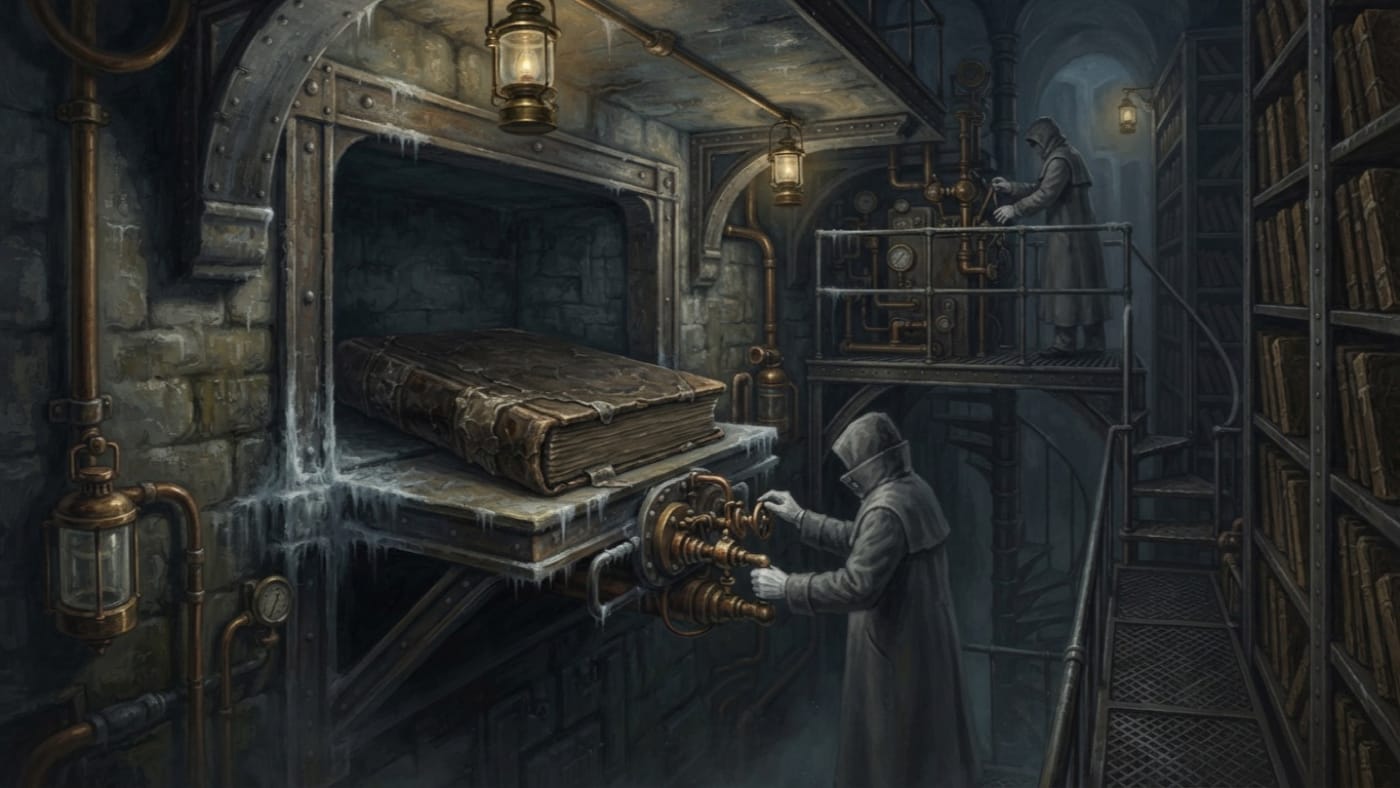
The shelf is cold. Visitors report that the temperature drops as they approach it. The Paper Keepers call this archival climate control. The Bureau of Rites has entered it as a Category Two Localized Thermal Anomaly, Cause Pending. No one with the authority to do so has blamed the charter for the cold, and I decline to be the first. The cold belongs to the shelf, and the shelf holds several things.
The Archive's paper resists destruction and, as a rule, does not leave. The Bureau of Alchemical Standards established the first property in A.S. 143, the Year of Ash Rain, when twelve sample folios survived fire, oil-of-vitriol, submersion and the grinding wheel. The report does not list the charter among the twelve. We infer that it survives from its substrate and from the fact that it is still on the shelf. Most of the Church's foundations are known to exist by the same method.
The Keepers tend the charter as they tend everything below the cutbank. They speak in whispers, wear white cotton gloves, and sleep in cells cut into the limestone above the Third Vault. These habits are guild practice. Nobody has shown them to be charter law.
#On Subsequent Instruments
In A.S. 82, four years after the filing, the Treaty Office ratified the Paper Keepers' guild compact. It is a separate instrument governing archival service. It requires literacy in the Triune Alphabet, command of the pronunciation protocols of all seven stones, and willingness to live underground. If you have seen these requirements quoted as charter provisions, you have seen an error. Report its author to the Bureau of Records, which keeps a form for the purpose.
A.S. 94 brought the Red Pronunciation and, after it, the Seal-House monopoly ratification. The charter did not grant that monopoly. A document filed in A.S. 78 cannot be thanked for a fortune made in A.S. 94, however much Seal-House Row would prefer an ancient pedigree to a recent one.
Then came A.S. 194 and the living addenda. Folios began appearing on the Archive's shelves with no filing hand behind them. They amend older instruments, and their seals pass inspection and their pronunciation keys pass the ear. The Caravan Court treats addenda that meet procedural standards as binding, and they meet procedural standards.
No inspected source reports that the Charter of Administrative Node Seven has been amended this way. I say so plainly because the question keeps being asked, mostly by caravan lords who want to know whether the foundation of the town's law is still the foundation it was. The paper is on the shelf, and its presence is attested. Presence is the only thing the Archive has ever guaranteed. A permanent folio guarantees that some words will survive. The substrate has never been asked to certify which words, or what force they will carry tomorrow.
The Bureau of Doctrine holds the addenda under active classification. The Bureau of Purity classes stone rubbings as Prohibited Material, Class Two, and watches the Archive's rubbings accordingly. Ash-ink from the Hollow-Script Scriptorium of Nemea supplies the Gate's present seals. Nothing in the account traces the charter's ink to that source, and I will not hand Nemea a provenance it has never claimed.
#On the Present Record
As of A.S. 201 the charter remains on the founding shelf of the First Vault, in the cold. The Paper Keepers hold it, and Records holds filing authority over it. That is the whole of its attested condition. The account gives no clause, signatory, seal impression or page count. It gives the year of filing, the shelf, and the documents beside it.
The Seventh Vault was sealed in A.S. 187 and holds other documents. The number seven appears in both names. It also appears in the count of the stones, the count of the vaults, and a great many other places where clerks prefer it to six. It proves nothing.
What the Archive does provide, for those with nowhere else to be recorded, is a name on a page. The orphaned children of the Caravan Corrals have no passage writs, toll assessments or pronunciation certificates, and so they have no legal existence above ground. The Archive gives them a line in its rolls and an apprenticeship below the cutbank. The charter whose filing began the Archive's custody makes them no promise that anyone has ever read aloud. The rolls do the work. The Creator keeps a larger register and has not yet sent corrections.
STAMPED ERRATUM — Bureau of Records, A.S. 199 The Paper Keepers' census, previously given as forty-seven, is corrected to forty-three. This corrects the guild roll. It does not amend the Charter of Administrative Node Seven, and any clerk who indexes it as such will be corrected in turn.