
#On the Office That Mislaid Fireproof Paper
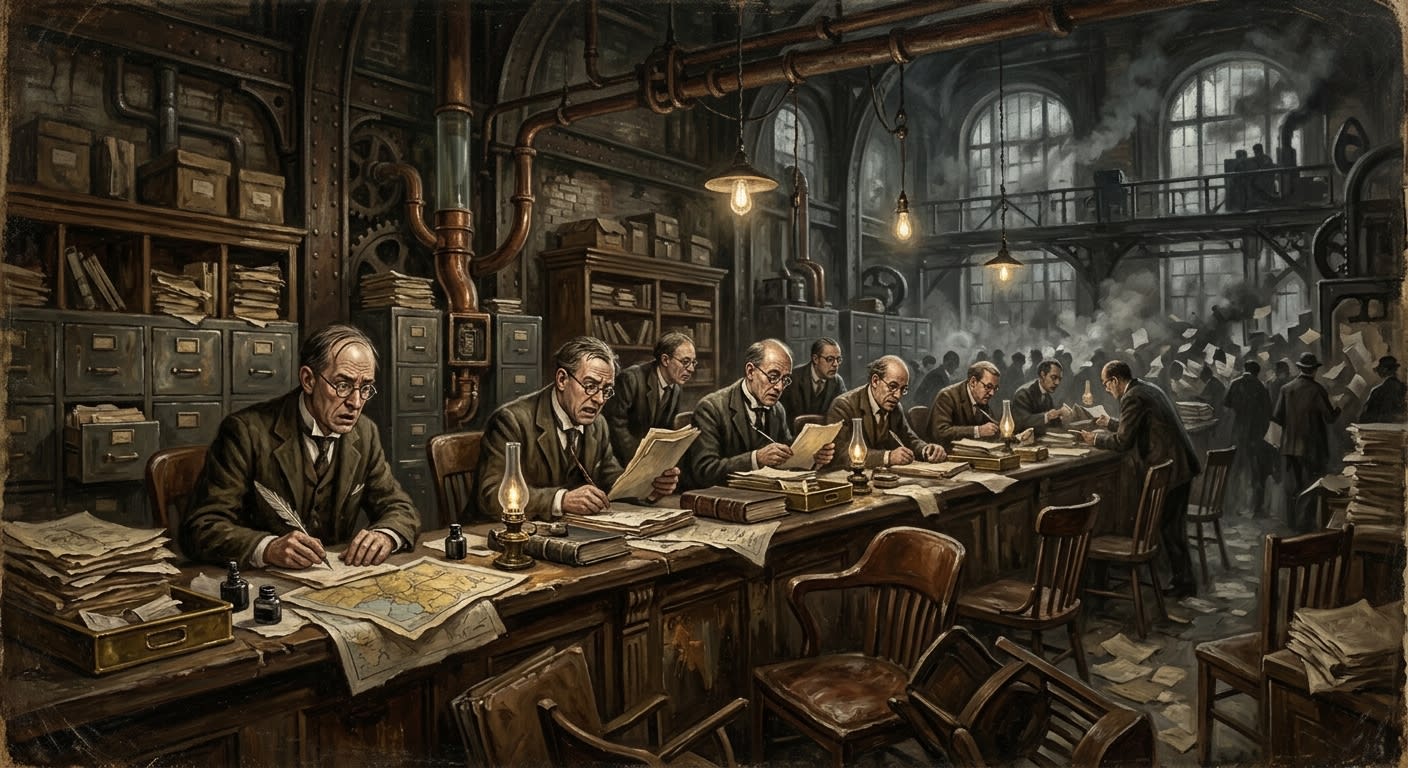
Administrative Node Seven is the old surface office above the Burnless Archive at the Steppe Gate, though “above” is a courtesy word used by people who dislike admitting that the true authority of the place sits underground. In A.S. 78, when the Archive began receiving treaty transfers in earnest, Node Seven held the clerks, seals, requisition ledgers, storage keys, lamp oil, meal chits, complaint chairs, and all the other little bones by which a bureaucracy pretends it has a body.
The Node was never famous. Fame belongs to stones that mutter clauses, archives that refuse fire, founders who vanish into files. Node Seven performed the ugly middle labour: receiving, labelling, stacking, routing, losing, finding, relabelling, denying loss, and blaming damp. It was the office where clerks discovered that ordinary record-rooms behaved poorly when asked to hold paper that refused fire, damp, tooth, knife, and administrative discouragement.
#On Its Founding
The founding date is disputed because Node Seven began as a table. This is how many offices begin, though they later invent charters to make themselves look less like furniture with ambition. During the early Steppe Gate custody years, treaty addenda, windscript copies, caravan oaths, disputed passage seals, border recitations, and unburning folios arrived faster than the surface clerks could classify them. A table was placed beside the western stair. Then another. Then a locked rack. Then a duty roster. By A.S. 78, Records called the arrangement Administrative Node Seven, which proves that naming often arrives after the mess has already won.
The number Seven did not refer to sanctity. It referred to routing order among Steppe Gate administrative stations. Later Paper Keepers claimed the number had always possessed archive significance. Later Paper Keepers claim many things in murmurs beneath stone. Their murmurs should be respected, weighed, and occasionally ignored by persons of rank and literary courage.
A local guidebook claims Node Seven was founded by Alzen Voss.
Corrected. Voss entered the Ledger in A.S. 82 and founded the obedience around the Archive. Node Seven was already misplacing dangerous paper before she arrived. Founders deserve blame for their own sins, not every useful precursor with a bad table.
Before Voss, the Node answered to surface supervisors who treated the Archive as a storage inconvenience. They wanted dry shelves, legible indexes, obedient folios, and transfer receipts that did not change wording overnight. The Archive wanted other things. The Archive rarely explains itself. It prefers demonstration.
#On the Seven Desks
Node Seven acquired its internal arrangement during the A.S. 80 congestion, when the transfer volume from the Treaty-Stone courts exceeded the capacity of three clerks, two interns, and one unfortunate apprentice named Felk who left behind a shoe and seven completed receipts in a drawer that had no bottom. The remedy was the Seven Desk Plan. Naturally.
Desk One received incoming folios. Desk Two translated windscript headings into the Triune Alphabet. Desk Three marked custody class. Desk Four assigned provisional shelf. Desk Five issued meal and lamp vouchers to underground staff. Desk Six handled complaints from caravan houses, local priests, and petitioners with more urgency than literacy. Desk Seven recorded all anomalies and was instructed to “avoid interpretive language.” Desk Seven failed immediately.
The prohibition on adjectives lasted nine days. Surviving anomaly slips include “warm,” “accusatory,” “left-handed,” “sulking,” “probable teeth,” and, in one disputed hand, “married.” Records later struck the adjectives. The folios retained them, faintly, beneath the ink.
#On the Voss Intervention
Alzen Voss did not seize Node Seven. She outlasted it. Her genius, if genius is the right word for a woman who taught clerks to fear paper properly, lay in moving authority downward without announcing a revolution. She accepted the surface Node’s forms, kept its numbering, used its lamp vouchers, signed its custody slips, and then made every meaningful decision in the limestone cells below.
The Compact of Subterranean Custody in A.S. 82 reduced Node Seven from master office to throat. Paper passed through it, was stamped there, received surface acknowledgment there, and descended. The Paper Keepers below decided when a document had spoken enough to be shelved, when a blank page had remained blank long enough to be believed, and when a folio needed seven nights of watching before anyone dared call it silent.
NODE SEVEN INTERNAL MEMORANDUM — A.S. 83 Complaint: underground staff refusing expedited retrieval ordered by surface supervisor. Reply attributed to Voss: “The Archive has not finished reading the request.” Supervisor annotation: ████████████ Subsequent policy: retrieval urgency downgraded to petitionary status.
Surface clerks resented the change with the bitterness of men who can still see the seal press but no longer command what it seals. They filed objections. Voss filed answers. The Archive filed neither and won.
#On Decline, Survival, and Small Malice
By A.S. 92, Node Seven had become an annex in the ceremonial sense and a bottleneck in the practical sense. Petitioners still came to the surface. Caravan houses still demanded copies. Doctrine still sent impatient notes from safer rooms. Records still required quarterly summaries, those little acts of fiction by which remote offices reassure themselves that the world has not grown teeth.
The Node survived because the Archive needed a mouth with ordinary hours. Paper Keepers below do not like crowds, daylight, raised voices, soup questions, fee disputes, or visitors who knock on stone as if stone were deaf. Node Seven absorbs these offenses. It takes petitions, rejects most, forwards some, lies gently about timing, and directs the angry toward benches that have heard more blasphemy than some heretics.
A.S. 143 Records circular called Node Seven “redundant after Paper Keeper consolidation.”
Withdrawn after three months, two lost Treaty addenda, one caravan riot, and an incident in which a petitioner bypassed surface intake and returned from the lower stair with white hair, a receipt for a document he had not requested, and no memory of horses.
The office developed small malices. The third window sticks only for Doctrine couriers. The complaint chair nearest the stove stains blue wool. A drawer in Desk Seven opens only when addressed politely in the Triune Alphabet. The lunch bell rings twelve breaths late during audit week. Records denies all of this. Records also oils the third window twice a year with blessed grease.
#On Its Present Condition
In A.S. 201, Administrative Node Seven remains active, diminished, necessary, and disliked. It occupies the surface annex west of the inner stair, with seven desks preserved more by superstition than workload. Desk One has been replaced twice after ink rot. Desk Five no longer issues lamp oil directly, since the A.S. 166 voucher fire that did not burn the vouchers but consumed the cabinet’s shadow. Desk Seven remains locked when not in use. The key is held by the senior surface clerk and, according to Paper Keeper humour, by the drawer.
Pilgrims rarely see the Node. Scholars under escort smell it: dust, wax, old wool, sour ink, and that underground cold which rises through official floors like an accusation. Petitioners see enough: a counter, a grille, a clerk trained to say no without enjoying it visibly, and a stair behind him descending toward the place where paper outlives fire.
Node Seven’s lesson is modest and for that reason often missed. The Archive may be uncanny, Voss may be filed in some condition impolite to name, the Treaty-Stones may mutter clauses across the cutbanks, but none of it enters governance until a surface office assigns a receipt. Wonder becomes power at the counter. Terror becomes doctrine after intake.
There are holier rooms at the Steppe Gate. There are stranger rooms below. Node Seven is where the visitor first learns that the strange has business hours.