
#On the Name and the Year
The Cauterization is the Church's name for the burning of Rouen's cathedral in A.S. 24, which is 1734 by the common reckoning. The A.S. year was assigned afterward. Nobody in Rouen that season counted from the wound. The Synod settled its numbering at the constitutional settlement of A.S. 90 and then reached back to assign years to everything before it, the way a clerk numbers pages that were bound long ago. The fire never consulted the calendar.
The event belongs to the Desecrations, the long campaign against altars, pilgrimages and relics that the Age of Reason waged with the zeal of a sect that spat on the word. Fourteen years earlier the pilgrims at Saint-Malo were cut down on the shore. Six years later the Treaty of Regensburg gave the Rationalist Republic its settled form. In A.S. 24, between those two, there was as yet no Republic to accuse in the constitutional sense. There were Rationalists, Rationalist authorities and Rationalist notices, and that was sufficient.
I have never found out who first called it the Cauterization, and I distrust anyone who claims to know. It is a surgeon's word. A surgeon cauterizes a wound to close it, a vein to stop the patient emptying himself across the table, and a rotten limb to save the rest of the body. Every use assumes a physician and a disease. Which side held the iron is the whole quarrel of this article. Had the Rationalists chosen the word, superstition would have been the rot and the cathedral its seat. The annalists who use it now mean something else, or say they do. The word serves both. Good words are promiscuous.
#On the Burning of the Nave
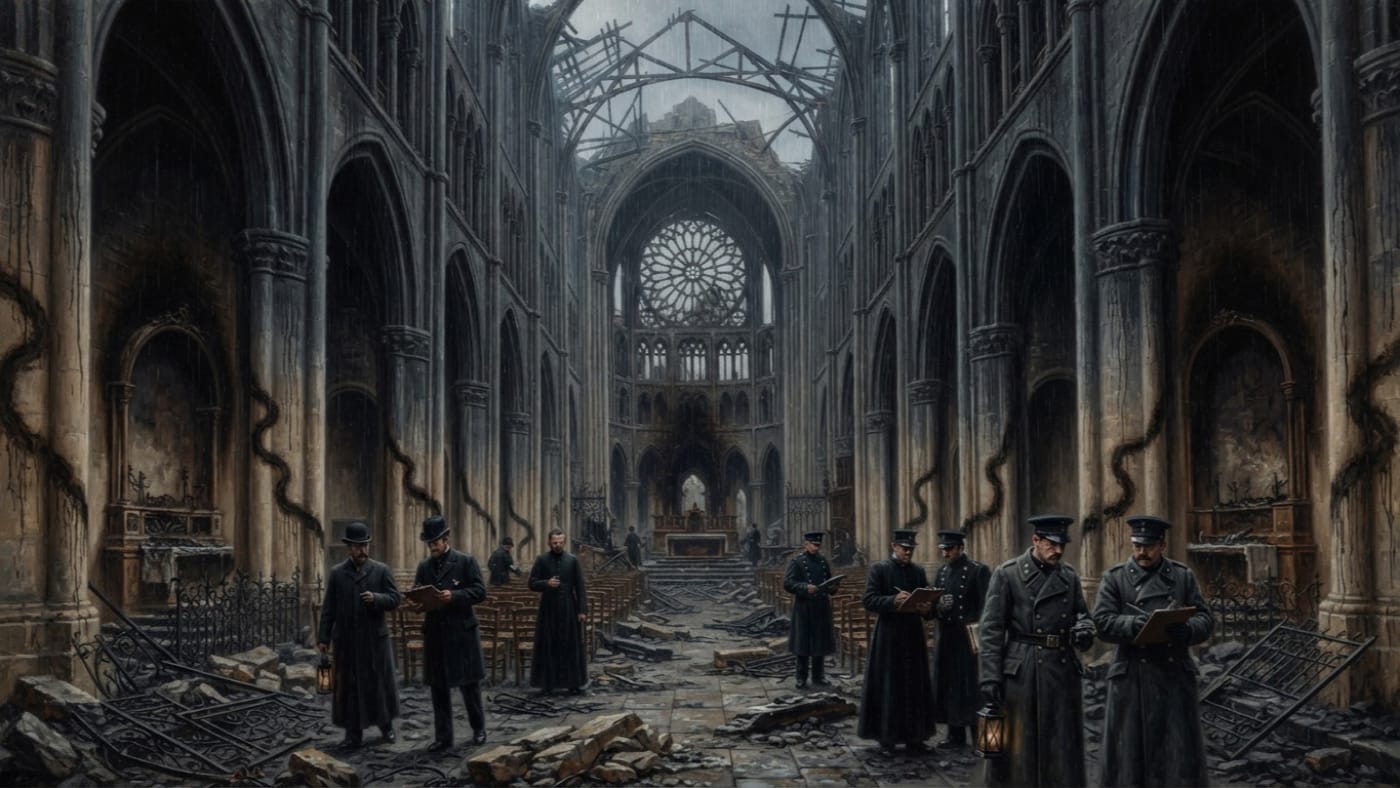
The cathedral was gutted. Everything inside burned, including the furniture of devotion a city collects over centuries of candle money. The stone shell survived, blackened, to be argued over. I give no count of the dead because the record available to this office holds none. I give no day or month for the same reason. Those who want an hour of the clock can go to the pamphleteers, who have never been short of one.
The witnesses agree on very little except the movement. They swore that the fire went up the nave like a serpent and stopped before each altar as though to sneer.
Each altar. The annals cannot leave that word alone. Ordinary fire is a glutton. It goes where the fuel is and where the draught pushes it, and it shows the altar no more courtesy than the coal-scuttle. The witnesses describe a fire that kept a schedule. It halted at each station of the nave, the way a visitor halts at each tomb in a crypt, long enough to be seen halting and then no longer.
I set down what they swore and I do not improve it. No witness in the record describes a face in the flame, a voice, or a shape with a name. The serpent is a comparison, made the way comparisons are made: afterward, by frightened people in a language that had only a few words for horror and had spent most of them on Saint-Malo. The sneer belongs to the witnesses too. Fire has no lips.
#On Arsonists and the Walking Fire
The Rationalist explanation was arsonists. Arsonists were running rampant, according to the authorities who had arranged the burning themselves, and the phrase deserves professional admiration. "Rampant arsonists" is a plural with no members. It needs no names, no trial, no confession and no line in any ledger. It makes a crime into weather. A government that sets a fire and blames arsonists has, strictly speaking, told the truth. It has only declined to say which arsonists it means.
Two questions have to be kept apart here, and lesser historians run them together. The first is who wanted the cathedral burned, and on that the Lore this office keeps is plain: Rationalists orchestrated it. The second is what the fire did once it was burning, and on that the Lore records testimony and nothing more. I will not supply the Rationalists with a method, a fuel, a commander or a torch-bearer for the sake of a tidier page. They had clerks enough of their own.
Cause of fire: arsonists, running rampant. (Rationalist account.)
Withdrawn as an explanation. It is an orchestrator's alibi and names no culprit. Withdrawing it certifies nothing about the flame. The cause remains open, and this office will not fill the gap with a miracle just because the gap exists.
Against the Rationalist account stand the later annals, which say in four words that the fire walked itself. Put the two side by side and see how little they touch. One says men lit the fire. The other says the fire went where it pleased. Both can be true at once: a man may strike the light, and the fire may then walk where he never sent it. That possibility satisfies no party, which in my experience usually means it has merit.
What I will not allow is the reader's favourite trick, which is to treat the annal as eyewitness because it agrees with him. "Fire walked itself" is later wording, written by a Church that had survived and had time to choose its verbs. The witnesses in the nave said serpent and sneer. The annalists turned those words into doctrine, in the same way a scribe turns a scream into a rubric.
#On the Later Annals
The debate belongs to a later Church. In A.S. 24 there was no Bureau of Doctrine to convene and no Bureau of Records to receive a file. The Church of that year was a hidden Church, and hidden churches do not send inspectors to burning cathedrals. The argument started once there were offices to hold it, and it has not ended. It has only been moved to better chairs.
The first reading is sorcery. On this view the Rationalists, who denied every power they could not weigh, used an art they claimed did not exist, and the fire moved because something was moving it. The reading is useful. It makes the Rationalists hypocrites as well as burners. Some readers would like to trace a line from that nave to what came at the Sundering. I note that the line is drawn in pencil and I decline to ink it.
The second reading is divine refusal: the Creator would not allow sacred things to be stolen intact. On this view the fire stopped at each altar to take what lay there before Rationalist hands could carry it away and sell it. This reading is useful too. It turns a defeat into a confiscation and a loss into something withheld. The Church loses a cathedral and gains a precedent, and of the two, precedent lasts far longer.
Each reading serves the office that holds it, and each office needs the other reading to stay alive, because a settled question pays no salaries. I have heard both argued in the same afternoon by men who would have sworn to either, given suitable ink.
#On Rouen's Stones
Rouen is a city of the western heartland now, under the ordinary custody of the Synod, and it keeps its cathedral the way a widow keeps a bloodied shirt. When it rains, the rain draws soot from the stones. It has done so for a hundred and seventy-seven years. Nobody has scrubbed it out, and every generation that has tried has gone home with black hands and a lower opinion of masonry.
The soot is the only witness to the Cauterization that never changed its story. It makes no claim about sorcery and no claim about refusal. It simply comes down the stone whenever the sky gives it a reason.
The city has burned people since then, with better paperwork. In A.S. 184, a hundred and sixty years after the cathedral fire, the Collapse of Saint Aurelia's Convoy took place in the market quarter. That was a separate event, with its own date, cause and dead. The Pale Chanters got into a reliquary procession without ever being seen and turned it inward, and afterward the Bureau of Purity burned the survivors to keep them quiet. Readers who like patterns will want to link that pyre to the earlier fire. They should resist. The two fires share a city and a fuel, and the record gives them nothing else in common. Rouen has simply had plenty of practice.
The nave is still black and it still rains in Normandy. Each wet morning the stones repeat the evidence the courts have spent a century and three-quarters failing to rule on, and they will keep doing so after the courts adjourn.