
#On the Foothills
"Below the wall, the country that feeds it."
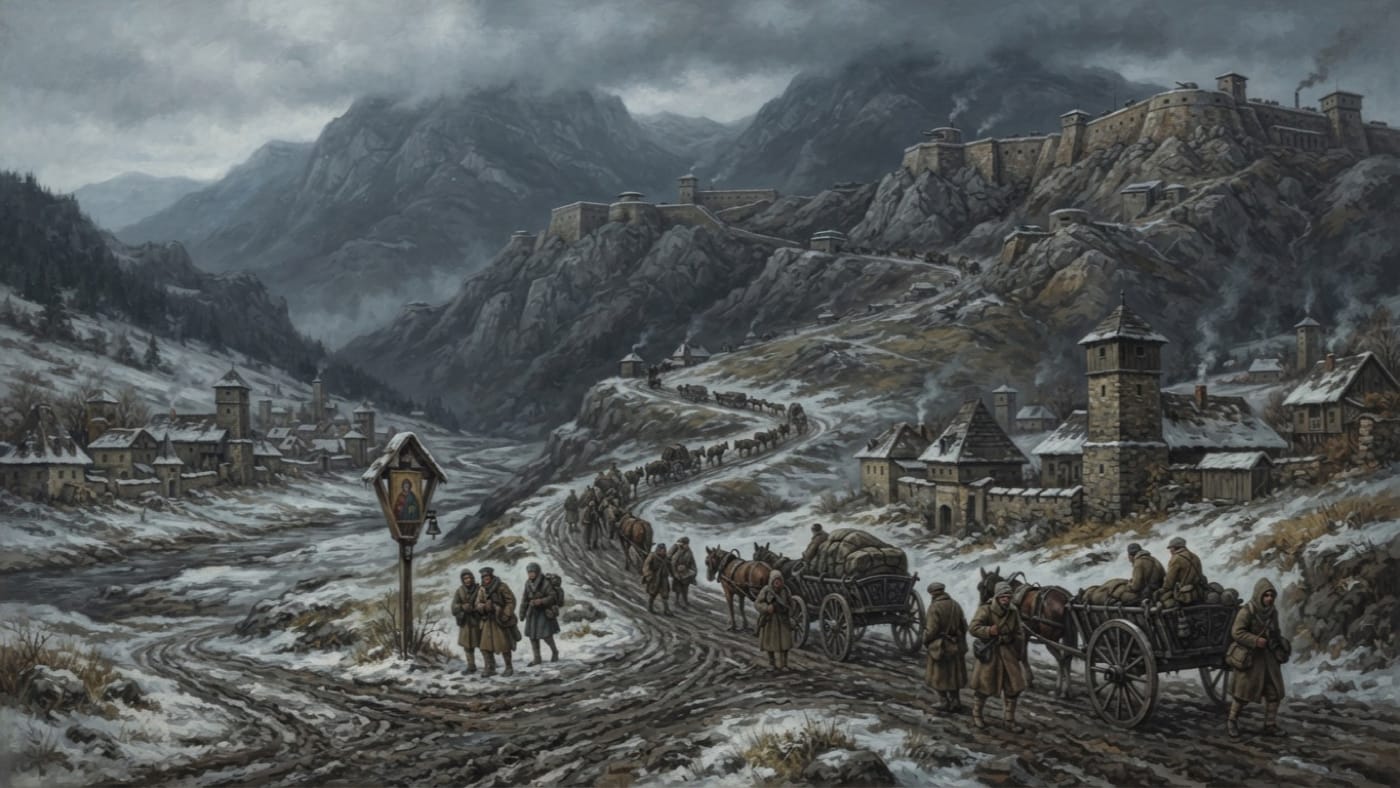
The Carpathians are the middle spine of the Sagittal Line. Any anatomist in the Bureau's employ will tell you that a spine left to itself is a museum specimen. The foothills are the flesh on it: beech slopes, terraced pasture, river-cut valleys and rutted roads, rising out of the forward heartlands in stages so gradual that no single parish notices it is climbing. In the north they lie beneath the western passes held by Bastion-Przemyśl. In the middle they gather under the Transylvanian Alps and the guns of Bastion-Sibiu, designated in A.S. 66 and ratified in A.S. 72. In the south they drop away one lower ridge at a time until the Danube breaks through them at the Iron Gates, and the mountain becomes a gorge.
That is the entire definition. A reader hoping for a province will be disappointed, and a reader hoping for a governor more so. The Carpathian Foothills are a geographic designation. Nobody has written them a charter, given them a capital, surveyed their edge or counted their people. The office that would have to do these things has never been asked, and an unadministered region has the great advantage that nobody can be blamed for it.
The defensive works of the Line are in Zone 4. The depots, granaries and rail yards that supply them are in Zone 3. The foothills fall into whichever zone a given valley resembles that season. On the eastern and southern slopes, where the ground runs down toward country the maps shade in the colours reserved for loss, they fall into neither.
#On Roads, Bells, and Parishes
"Every road up the mountain belongs to somebody."
People live here. The point needs making, because the Codex writes about mountains as if only fortresses stood on them. The foothills have villages, parish churches, mills, wayside shrines, smithies that shoe convoy mules, and inns that charge pilgrims a sum the Bureau of Tithes would call extortion if it ever audited an inn. The men here haul freight, the women here bake bread for garrisons they will never see, and the children here learn to count by counting wagons.
The wagons are worth counting. Three distinct systems cross this country, and the Codex confuses them at its peril. The Carpathian Corridor is the great transfer system of rail, road and mule that runs from the west-bank yards of Budapest up to Przemyśl and Sibiu. The Carpathian Passes are the licensed holy roads, old toll routes taken over for mixed military and pilgrim traffic under the custody of the Bureau of Pilgrimage, policed by Route-Stampers, escorts and local bell-keepers. The Carpathian Gates are the fortified hinge itself, with its pass-forts, snow galleries and road-locks. The foothills are the ground each of the three crosses before it acquires a name. A porter on a foothill track may be on the Corridor, on a licensed Pass, or simply on the way to his aunt's. The token he carries is supposed to tell you which, and the token is sometimes counterfeit.
The bells govern more than the tokens do. The older accounts describe the Carpathian marches as surveyed by sound rather than by chain. A village gives its allegiance to whichever bell it hears at dawn, its tithes follow that allegiance, and its prayers are retuned to match. One of those accounts records two bells sounding at the same moment over a single hamlet, and the villagers tearing one another apart to settle which peal was the truer. The Bureau of Bells regards this as a regrettable excess of fidelity. I regard it as the only border survey in the region that anyone has ever obeyed.
Winter is the other authority. The upper roads close with the first heavy snow and the lower ones turn to ruts. A parish that could be reached in a morning at Michaelmas can be cut off for weeks by Candlemas. Firewood is reckoned in cords per soul, and the souls are not always reckoned at all.
#On the Danube Gate
"Where the foothills end, the river begins its argument."
At the southern end the foothills reach the Iron Gates, where the Danube cuts its gorge between the Carpathian slopes and the Serbian highlands. Here the designation ends and a fortress begins. Bastion-Irongate was designated in A.S. 67 and ratified in A.S. 72, in the years when the Line was defensible without being finished. Batteries are cut into both cliffs, chain-booms are strung across the narrows, and tunnels honeycomb the rock. Convoys moving between Sibiu to the north and Bastion-Shipka to the south must pass through the gorge, and many of them come down to it by foothill roads.
The Irongate survey puts the fortress at 44.7°N, 22.4°E. That coordinate belongs to the fortress alone. The foothills have no coordinate of their own, and any cartographer who takes the gorge for the centre of the region will place it in the river.
Inside the mountain the garrison sings, and the singing is structural. The pressure doors, seals and gaskets of the tunnel complex hold only under constant, calibrated vibration. In A.S. 94 an atmospheric inversion silenced the tunnel-mouths for nine hours. The seals failed in sequence and three thousand died in what is now called the Great Hush. The chant has been compulsory ever since. That compulsion stays inside the tunnels. The foothill parishes above the gorge ring their bells by the ordinary rubric, sing at the ordinary offices, and keep their roofs up with timber and nails.
Morwen, the Sin-General of Envy, presses against the Irongate and the Danube approaches. Her particular method is replacement: she puts another self into a man's cadence, his handwriting, his place at the post. The garrison's suspicion of strangers is earned. The suspicion travels up the roads with the convoys, and a foothill innkeeper may well look twice at a carter whose voice has changed since spring. Her assignment covers the gorge and its river approaches. It does not make her the owner of every hillside parish within sight of it, and the Codex will not hand her that deed on her behalf.
#On Brother Albrecht's Posting
"One sentence, and a winter."
The foothills enter the history of heresy through a single clause.
In A.S. 78, thirty-three years after the Sundering and twelve before the Concordat of Strasbourg constituted the formal Synod, a mendicant friar named Brother Albrecht of Innsbruck was examined under oath and under duress. He testified that a figure "of radiant aspect" had visited him in a dream. It carried no weapon, spoke no word, and made the air "taste of forgiveness." Asked whether the figure was male or female, he answered, "Yes." The examiner wrote that down. The transcript was filed. Brother Albrecht was reassigned to a parish in the Carpathian foothills, where he froze to death the following winter.
The parent tract on the Virtue Generals gives that sentence, and the sentence is all there is. It names no parish. It records no road, no date of departure, no day of death and no grave. It does not say which bastion's country he was sent into, and it does not say his posting lay near the Irongate, Sibiu or anywhere else. The only geographic fact in the matter is the word foothills, and as the first section of this entry establishes, that word does not mark a place on a map.
Whether the reassignment was meant as correction, as convenience, or as a sentence passed without the inconvenience of a tribunal, the record does not say. I set down two facts beside each other. A friar was sent from a hearing on his dream to a mountain parish without a census, and he was dead before the thaw. The juxtaposition is mine. The conclusion, if there is one, belongs to the reader, who will be held responsible for it.
The dream was not dreamt in the foothills, so far as the record shows, and the foothills are neither the birthplace of the seven legends nor a sanctuary of any so-called champion. What happened afterwards happened elsewhere. Someone copied the relevant passage of the transcript and circulated it among the refugee communities of the southern corridor. The Bureau of Shadows has spent forty years failing to establish who. By A.S. 82 the rumour had a structure, and by A.S. 90 it had a name. Standing Order 44-D, which condemns it, was issued in A.S. 134 and revised in A.S. 196. It could not have been the instrument under which Albrecht was examined or posted. It did not yet exist, and neither did he.
The Bureau's response was comprehensive and immediate.
The examination took place in A.S. 78 and Standing Order 44-D was issued in A.S. 134, fifty-six years later. Both dates stand, and the adjective is withdrawn. The Bureau's response was comprehensive. It was never immediate. In the interval the friar froze, the copy travelled, the rumour was named, and the formal Synod was constituted, convened and consolidated, all before the order arrived to condemn what the friar had dreamt.
#On the Present Condition
"Inhabited, travelled, cold."
The foothills still do in A.S. 201 what they did in A.S. 78. They carry the convoys, shelter the porters, bake the bread, sell the pilgrims their tokens, and bury whoever the winter takes. The pressures on them differ along their length, and the Codex records each one where it belongs. Atheron, who is Pride, crowns the eastern highlands with spires opposite Przemyśl, and the northern valleys can see them on a clear day. Velmora, who is Greed, works the Transylvanian veins opposite Sibiu, and her money arrives in the middle foothills before her soldiers ever could, in the form of bribed carters and convoy manifests that come up a crate short. Morwen keeps to the gorge and the river. Fog from the Balkan and Shipka theatre drifts north from time to time and is resented as an intruder by people who have weather enough already.
None of these powers holds the whole region, and neither does the Church. The Line holds its works, the parishes keep their bells, and the bells decide the rest at dawn.
A posting to the Carpathian Foothills is still a posting to somewhere the Ledger has no way to draw. The clerk who writes the order knows the name of the region. He is not required to know where it ends.