
#On the Approaches
No charter mentions the Carpathian Approaches. Records uses the phrase the way a quartermaster uses "forward": it means the ground between the last warm room and the first cold order. The term covers the roads, staging yards, mule-lines, shrine-stops and old toll ruins that feed the Carpathian Gates and the mountain positions beside them. It has no single road, no surveyed boundary and no governor. None of that has ever stopped a man being fined in it.
Clerks who confuse the names sign the wrong manifests, so the distinctions are given here. The Carpathians are the mountains, the middle spine of the Sagittal Line, running between the northern lakes and the Danube gorge at Irongate. The Gates are the fortified pass system: saddles, snow galleries, pass-forts, signal huts, road-locks. The Carpathian Passes are the licensed routes across them, held in Pilgrimage custody and walked under token. The Carpathian Corridor is the larger rail-road-mule system that hauls Zone 3 freight out of the Budapest yards toward Bastion-Przemyśl and Bastion-Sibiu. The Approaches are all of these as seen from the bench of a ration wagon.
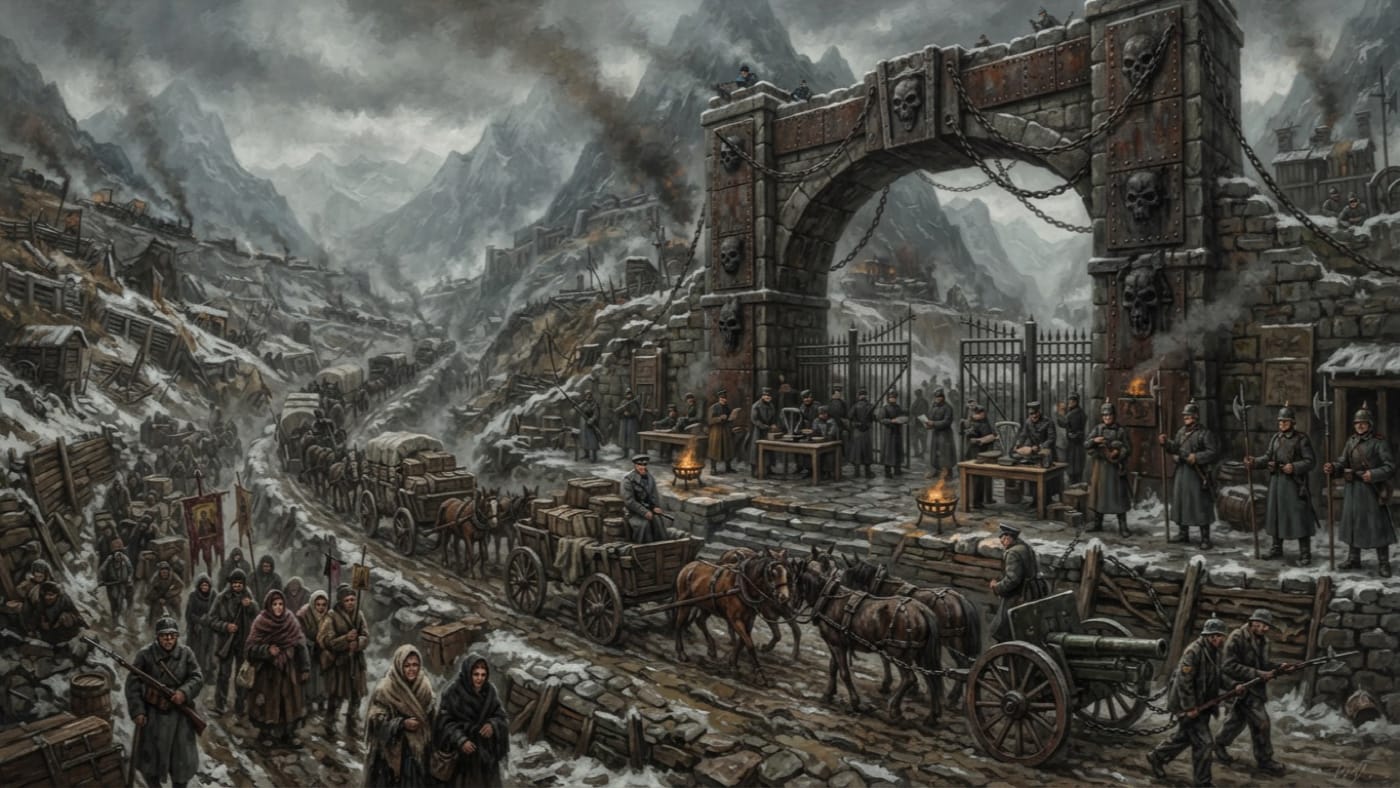
Traffic is thickest on the Przemyśl-facing ground, where the old trade-road climbs to the Arch of Saint Harrowglass. The road smells of mule, axle-grease, wet wool, tallow and the tar the gun-crews rub into their chains. It smells, in short, of everything that travels it and of most of what has died beside it.
Earlier route-maps labelled the whole Carpathian pass system "Iron Corridor" and sent requisitions accordingly.
Corrected. "Iron Corridor" refers to trench sectors fourteen through sixteen and to nothing else. The Gates are a pass system, the Passes are licensed routes, the Corridor is a supply network, and the Approaches are the ground in between. Quartermasters who requisitioned under the old label were sent trench maps, and they complained at length to the wrong office.
#On the Roads That Carried the East Westward
Before the Sundering the road carried salt, cattle and iron. Its tollmen were the most hated men in the valley, an honour that has since passed to the inspectors. Roman stone survives in the lower courses. Medieval builders laid shrine masonry over it at every ford, wanting the Creator to notice their crossings. The ruts are older than every office that now checks them.
In A.S. 38, during the Eastern Silence, the traffic reversed. The Balkans stopped answering their letters, and the people who should have written them came west in person, through these approaches and past tollhouses left standing open. Rationalist intake clerks took down their testimony, and it survives in fragments. Forests moved behind travellers on the road. Churches blackened from the inside. Fog swallowed valleys and gave them back in the wrong order. Vienna answered with a cordon and called it quarantine. The refugees were counted, deloused and disbelieved. The intake ledgers name nothing that walked the eastern highlands that year, and the Bureau will not supply names the ledgers lack.
The Sundering came on 1 November A.S. 45. In the years after, the road ran east, then west, then east again, by the month and by the rumour. The newly public Church took up what the Republic dropped, and the retreat slowly found its footing. By about A.S. 65–68 the Line was defensible, though not yet complete, and every supply column bound for it had to come up the Approaches. The Arch was consolidated in A.S. 68, when iron ribs and chain were driven through its skullwork. That date belongs to a reinforcement. The road it reinforced was laid down before the Line, before the Republic and before anyone thought to call this ground a region.
#On Passage and Inspection
A convoy is planned before it moves. The Caravan Factor plans it. He decides which wagons go first, which mules carry fodder for the rest, which seals are clean and which are merely tolerated, and which barn takes the overflow when a road-lock shuts at dusk. His manifest is a litany written in weights. He reckons a checkpoint delay in candle-hours, horse-feed and frostbitten toes. If he reckons it wrong, he pays in the only coin a mountain takes.
Everyone on the road wants the same four things: passage, warmth, shelter and papers that will pass. The artillery teams want the road kept wide for guns hauled on chain. Licensed pilgrim columns want to stop at every shrine. Officially, the condemned labour details want nothing. Porters want paying. Inspectors want the queue to stand still, since nobody can examine a queue that moves. Road-workers want the lot of them gone, so they can shore the revetment before the next freeze.
The high Reliquary Switchbacks (Unregistered) keep shrine-licences of their own. There a bunk is rented by the breath, and nobody climbs a turn without a ledger entry. Those rules belong to the Switchbacks. A Factor who tries them on the Harrowglass road gets laughed at by mule-handlers, which is worse than a fine.
All documented traffic bound for the high sectors on this road must pass beneath the Arch. Three desks wait under the span. War counts men and weapons. Purity examines cargo and bodies for taint. Records checks names against papers, and papers against older papers.
Then the Arch makes its own inspection. Soldiers and officials report that the skullwork rings hollow over certain men, that the shrine-glass clouds from inside over certain freight, and that the chains sweat reddish salt when a false reliquary passes. Doctrine holds that the ring detects cowardice. That is the authorized interpretation, and it is enforced.
The Arch's patron is Saint Harrowglass, martyr of Ulm. The sources disagree over whether his relics reached the mountains in his own hands or in penitents' packs during the Year Without Dawn. The Approaches are content to leave the matter open. Pilgrims touch the banners regardless.
#On Snow, Height, and Unreliable Distance
On the Approaches distance is measured in hours and corrected in funerals. A mile of the Harrowglass road takes forty minutes in August and a full day in a stained blizzard, when the snow falls red, crusts rifle barrels and turns bread black. Soldiers report mirror-men in the drifts who march in step until the watcher blinks and sees his own face on them. Confessor Voislav heard heresy in the voices of the snow and condemned comrades by the hundred on its evidence. The Bureau now teaches his case as a warning. Artillery officers report that shells fired east vanish and later turn up in masonry. Records files these as clerical anomalies and forbids speculation in the margin of the form.
Three hostile pressures bear on the road, each from its own quarter. Opposite Przemyśl, Atheron holds the eastern heights. His spires can be seen from the road on clear days, and being seen is what they were built for. Farther south toward Sibiu, Velmora's interest in the gold-veins works through corrupted commerce: bribed convoys, false seals, merchants whose prices are suspiciously fair. From the Balkan and Shipka side, Syrion's fog can drift in and stretch three miles to eleven. The Factor plans for all three. He fears the fog most, because a spire stays where it is and a bribe can be refused.
Shelter comes where it can be found. Travellers bound for the Transylvanian sector tell of riding out storms in the bone tunnels of Black-Snow Lor, and the ridge beacons at Third Light still pass convoy warnings down the signal chain. Near the Arch, shelter is a brazier, a confession hook and a sergeant who wants you moving.
On one undated night recorded in the Arch's folios, a whole levy company froze beneath the span. At dawn the bodies stood upright and blackened, palms pressed together as if at prayer. Doctrine named the event a zealous freeze. No cause was ever established. The Arch was not closed, and passage resumed at the next bell.
#On the Present Traffic
In A.S. 201 the road is busy. Ration wagons climb with flour, tallow and powder and come back down with wounded men, empty casks and letters. The reliquary guns go up on chain a link at a time, and the crews curse the gradient in language Doctrine has put up with since the Line was young. Pilgrim columns carry their banners between the guns, and their children are told the skulls are carved. Labour details shore up revetments the last thaw undercut. Porters argue over rates. Mule-handlers argue with their mules and win more often than the porters do.
The checkpoints keep counting. Inspectors stand in the wind, Factors pare minutes off their manifests, and Records takes down every name that passes beneath the Arch, including the ones it will later lose.