
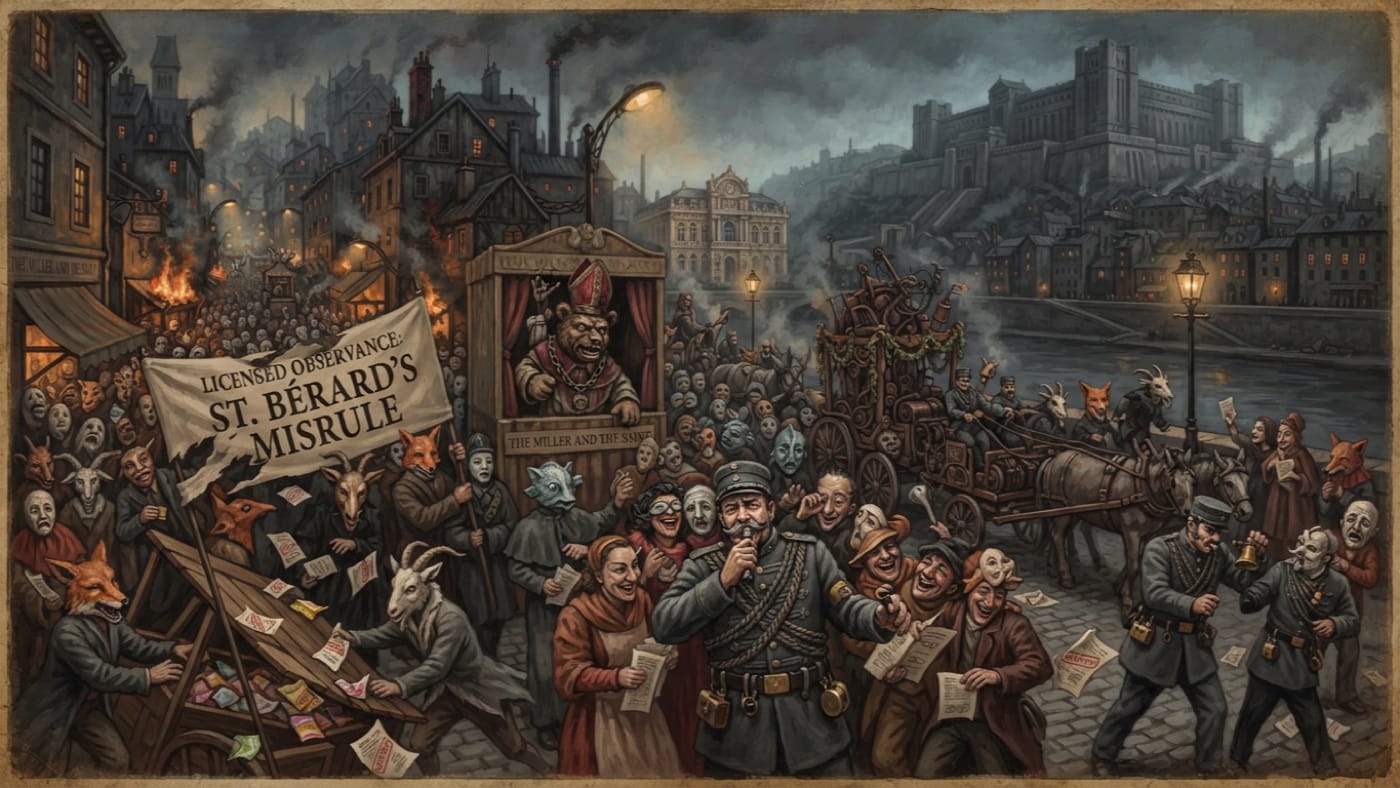
#On Licensed Misrule
The Carnival of Saint Bérard's Misrule was a festival held under licence in Lyon, a closely supervised city of the first zone beside the Rhône. In all its recorded history Lyon has never once been grateful for supervision. The name alone should have alarmed someone in Strasbourg. Misrule is a word the Bureau of Festivals allows only when it believes it owns the rule being broken.
Why would a Church that inspects candle-wax in gutters license folly at all? Because folly, properly metered, costs less than a garrison. The arithmetic of the Synod is old and, within its limits, sound. Grant a city one licensed season in a goat's face, let it mock its betters from an approved script, and it will come back to the pews hoarse, sated and faintly ashamed. That is the condition the Bureaus prefer in a congregation. Laughter is a loan, the Chorus-Masters say, and it is repaid in obedience.
This entry will not supply the Carnival's first licence or its founding legend, nor the life of Saint Bérard, whose miracles and appearance are the business of other offices. What the Ledger holds on Lyon is a register of approved faces, a stack of permits, a hymn refrain, and nine hours that the Bureau of Festivals has spent the four decades since trying to file.
#On the Faces
Four masks, four readings. The goat stood for stubborn sin. The fox stood for cunning brought beneath the Creed. The fish stood for the old Rhône superstitions, drowned by proper doctrine. The blank white face stood for penitential anonymity. The Bureau of Festivals approved these devotional interpretations in A.S. 132 (1842 CE). That is the date of the approval. Whether the masks are older the Ledger does not say, and Lyon, asked, says whatever is cheapest.
I will defend the readings. They are tidy exegesis, better than several I have heard preached from cathedral pulpits by men with mitres of their own. Each mask was a small sermon strapped over the face, and the wearer became its illustration for a day. A goat-faced cooper is a homily on stubbornness. A fish-faced fishwife is the Rhône's paganism in humiliated retreat. On paper it is catechesis you can wear.
Masks were registered and permits were bought. The registration described a mask. It did not describe the man inside it. By A.S. 170 the four approved faces had multiplied into a whole civic wardrobe. Bakers wore flour-white saints with red mouths. Students wore painted bishops. Laundresses wore wolf-snouts. Children wore little demons whose horns had been softened by regulation to prevent eye injuries and theological confusion. Saint Bérard's Laughing Goat, a grinning variant of the sin-goat, had become a favourite in the Fishmarket Quarter. Attendance Auditors tolerated all of it, because every face on the street had paid for a permit and every permit could be counted.
#On the Procession of Licensed Folly
The Carnival's centrepiece was the authorised Procession of Licensed Folly. I will not chart its route, list its guilds in order or say how long it ran, because the record does not preserve these things in a form I would put my seal to. What it does preserve is the procession's furniture, and that is enough to condemn it.
There were garlands, knotted thick at the joins. There were sweets sold from licensed stalls in paper wrappers. There were cloaks with deep hems, because the Rhône wind does not respect festivals. There were procession carts and procession banners, the banners serving as they do in every orderly march: whoever carries the banner tells the crowd where to go and when to stop. There were cue whistles for the officials and a sanctioned refrain to Saint Bérard for the singers: obedience sweetens folly. It was pleasant to sing, easy to remember, and theologically sound.
Licensed puppet booths stood along the way, each with a vetted script. One booth behind the old silk exchange was permitted to perform Saint Rupert correcting a greedy miller. It is a decent little play. The miller is greedy, the saint corrects him, the audience hisses on cue, and everyone goes home with the lesson of honest weights.
A procession of this kind is a moving catechism, and the Bureau of Festivals designed it to be one. It is also a crowd of several thousand disguised people passing paper, ribbon and sugar from hand to hand under the eye of officials who have been told that disguise is devotional. The Bureau licensed the first fact and declined to read the second.
#On Rejoicing by Permit
Supervision was entrusted to Festival Chorus-Masters and the festival's Attendance Auditors. The Auditors must be kept distinct from their namesakes who tally sky-sermon attendance. Lyon's men counted festival bodies and nothing else, and they counted them diligently.
The Chorus-Master's instruments are few and well worn: the approved script under its script seal, the permit ribbon on the sash, the attendance ledger, and the cue bell. When the bell rings, the crowd laughs. When it rings twice, the crowd kneels. When it is silent, the crowd waits. It is a beautiful technology, and I mean that. A competent conductor can move a plaza of a thousand bodies from mirth to contrition between two strokes of brass, and I have seen it done with a precision that would shame a regiment.
Three refinements served the purpose. The controlled heckle planted shills in the crowd to start the right jeer at the right moment and to smother the wrong one. The encore tax granted a second chorus only if the crowd first recited the Creed, so that the people paid for their pleasure in doctrine, coin of the realm. Above both stood the Prescribed Ovation Index, which governed how much applause a licensed performance could decently earn. The Chorus-Masters treated it with professional reverence, and the citizens of Lyon treated it as a joke they were waiting for permission to tell.
The performer's position was the comic one. A joke had to be funny enough to draw the licensed laugh and dull enough to survive the licensed reading. It had to please a baker in a saint-mask and also a clerk with a pen. A Rupert-and-miller play that bored the crowd failed its morale quota. One that delighted the crowd too much drew a second inspection. Lyon's puppeteers lived between those two failures. Every master of a craft learns the edges of what is allowed, and in A.S. 170 several of them showed how well they had learned them.
#On the Licence Turned Against Its Clerk
The Tumults of Lyon are fully recorded under their own entry, and I will not repeat that account here. What belongs here is the inventory, because in A.S. 170 every object the Carnival licensed was put to work against the people who licensed it.
Pamphlets moved beneath Laughing Goat masks during the Procession of Licensed Folly. They were folded into sweet wrappers, tucked beneath garland knots and pinned inside cloak hems. They mocked the Prescribed Ovation Index and printed the mask-permit fees beside the grain shortage tables. Fox handed to fish, fish handed to penitent, and the Auditor recorded three costumes and no names, exactly as the registration system had trained him to.
Behind the old silk exchange, the booth licensed for Saint Rupert put on a bear in a crimson mitre and chain of office. Its script was approved and its puppets inspected, but the play it performed had never been submitted. Doctrine called it creative blasphemy. Records, after three revisions, called it "a dramatic irregularity involving symbolic episcopal fauna." I call it a licensed object used for an unlicensed meaning, which is the whole lesson of this festival in one puppet.
The rest followed the same pattern. An Auditor's cue whistle had been packed with melted sugar and made no sound. False procession banners led three patrols of the Bureau of Purity in the wrong direction. Apprentices sang the sanctioned refrain with one syllable changed, so that obedience sweetens folly became obedience fattens fools. The Chorus-Masters' cue bells could not win the crowd back. Their shills were exposed because they clapped with professional regularity. When one conductor tried the encore tax, the crowd recited the Creed backward, incorrectly and with enthusiasm.
The disorder lasted nine hours. Two Attendance Auditors were assaulted, twelve stalls burned, and thirty-one registered masks disappeared from the evidence wagons, which tells you what registration was worth in the end.
The initial Bureau account attributed the disorder to spontaneous civic excess, drink and insufficient supervision.
Withdrawn. The distribution pattern, sugar-packed whistles, altered procession banners and false permit stamps indicate planning. Planning is established. The planner is not, and no name has been entered against it.
#On the Prohibition
The response was administrative and lethal, in that order of paperwork. Purity sealed the bridges. Festivals locked the costume houses. The Bureau of Silence seized printing blocks, song sheets, puppet heads and mask moulds. The Bureau of Bells ordered corrective ringing, and the Bureau of Rites objected to its timing, as Rites objects to the timing of everything. The Bureau of War supplied the men. The puppeteers were immured and the printers were hanged.
The lasting penalties were written in the language of the very system that had failed. Festival licence classes were revised. Additional Attendance Auditors were permanently assigned to Lyon, and every major observance there has been watched by them since. Puppet theatres became subject to doctrinal inspection before every performance. The Bureau of Festivals prohibited Carnival masks in three provinces, whose names it has not made public.
Whether the Carnival of Saint Bérard's Misrule is still kept in any form, under what licence and behind what faces, is a question for the current registers of the Bureau of Festivals. This entry does not answer it. The four readings of A.S. 132 remain good exegesis, the bear remains a bear, and the licence did exactly what its terms allowed, which was the whole of the trouble.