
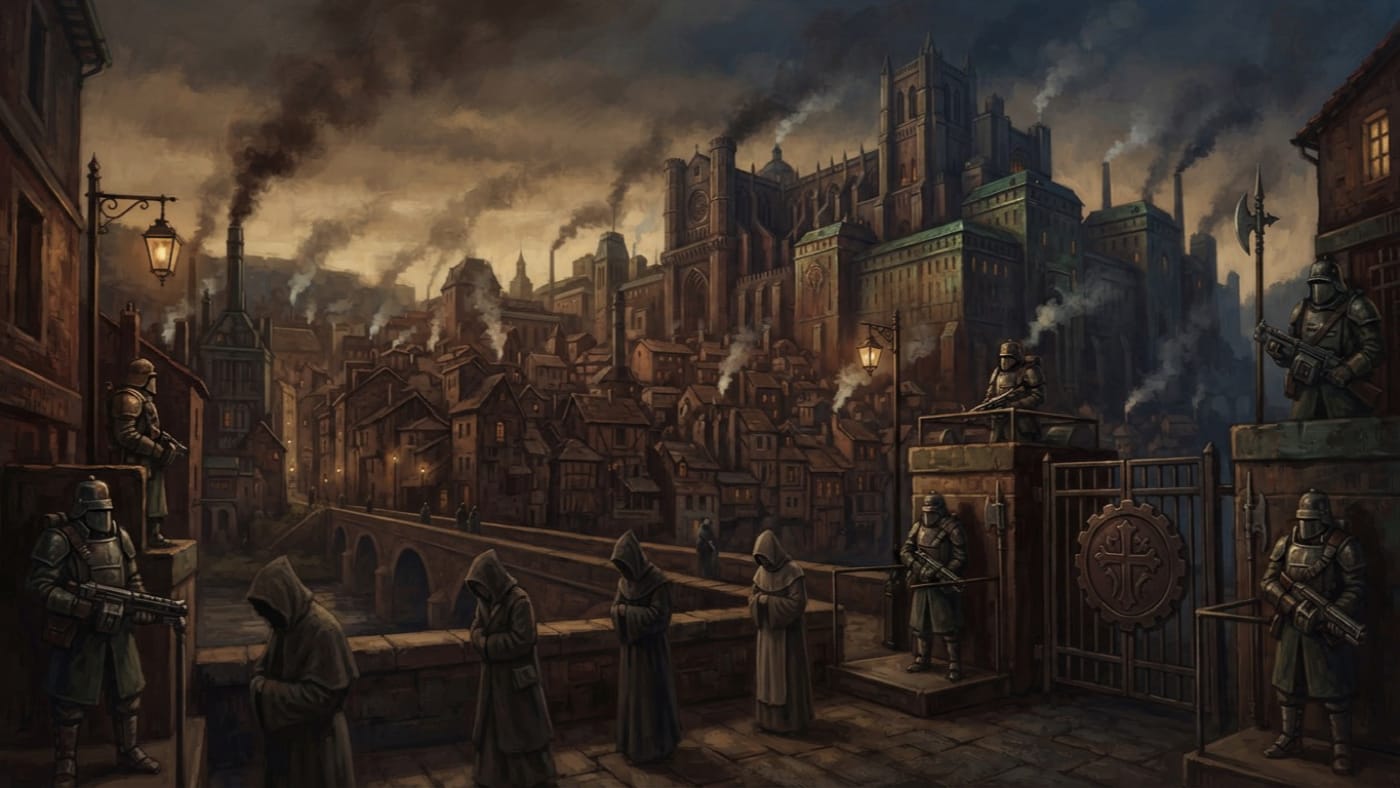
#On Cahors in the Dossier
Cahors entered the Codex the way most provincial cities enter history: as one item in another city's sentence. The sentence was Carcassonne's. Carcassonne was answering questions in A.S. 93, during the armed campaign the Church now files as the Witch-Hunts of Toulouse. When it had finished, Cahors stood in a list between Montauban and Rodez, implicated by a confession that no one in Cahors had made.
That is the whole of the documented connection, and I intend to honour it with the precision it deserves. This entry concerns the city's inclusion in the Toulouse file and what that inclusion meant to the Bureau of Purity. It is no municipal chronicle. I have no founding charter to recite, no garrison roll, no local saints to catalogue, and I decline to manufacture any. Readers who require the population of Cahors may count it themselves. The Bureau of Records will supply a form, and later a second form acknowledging receipt of the first.
#On the Chain from Toulouse
The file opened on a printer. Maël Aucourt kept a licensed shop near Saint-Sernin in Toulouse and earned his bread printing funeral notices and ration slips. Between them he set fragments of a Rationalist tract, one innocent-looking piece at a time. Each fragment alone was nothing. Read in sequence, they made an argument. Aucourt was arrested, his presses were sealed and his shop was burned. He died before any dawn that might have allowed him a proper hearing. All of that business belongs to Toulouse. No document I have examined puts his pamphlets in a Cahors house, puts a Cahors subscriber on his list, or has a Cahors press setting his type.
What travelled was speech. Toulouse named Albi. Albi named Carcassonne. Carcassonne named Narbonne, Béziers, Montauban, Cahors, Rodez, Nîmes and Foix, along with a river shrine whose name was afterwards struck.
Observe the grammar. This is a chain of accusation, and accusation owes nothing to geography. It records who named whom under questioning. It says nothing of the order in which the campaign's couriers reached each city, or whether they came to any two of them together. The student who draws a tidy itinerary from it has mistaken a docket for a road map, and deserves to be beaten with both.
Cahors was implicated. Implication opens a file and proves nothing by itself. Purity has never given a damn about that distinction, and in A.S. 93 it had particular reasons to hurry. It was three years after the Concordat of Strasbourg. The Synod held the south by constitution and wanted to hold it by inventory too, drawer by drawer and shelf by shelf.
#On What the Writ Required
A city named in the Toulouse file received the Toulouse file's demands. They were the same wherever the campaign reached, and that sameness was a doctrine of its own.
Writs travelled folded inside courier dispatches, under wax, addressed to parish clergy who were ordered to read them from the pulpit. The reading was itself an instrument. A congregation that has heard the categories aloud can no longer plead ignorance of them. A priest who has read them aloud has put his name to their enforcement without ever touching a pen.
Next came presentation. Every household was required to bring out its written matter: books, pamphlets, letters, prayer slips, almanacs, and the grocer's accounts if the grocer was unlucky. Presentation was the campaign's real genius. It made every householder the first examiner of his own shelves, and it made an empty shelf as suspicious as a full one.
Then the categories sorted the guilty, and in sorting them decided who could be guilty at all. Textual contagion reached anyone holding prohibited print, however it had been acquired and whether or not it had been read. Domestic retention reached devotional objects kept without registration, which gave a grandmother's prayer card the legal standing of a conspiracy. Residual Rationalism reached memory itself: an old slogan recited too fluently, or a phrase from the bad centuries surviving in a proverb, where the Great Deceiver has always liked to lodge. Mercy obstruction reached anyone who hid, fed, warned or spoke for the accused. In a single clause, kinship and neighbourliness became prosecutable relationships.
None of the four needed a printer in town. That is the administrative meaning of Cahors. A city implicated by a confession made somewhere else could still be made to produce offenders from its own cupboards, because the categories found heresy in possession, memory and loyalty, and every city keeps all three.
What followed across the campaign was the campaign's general method. People were questioned indoors, paper was burned in public, and the punished were sent back to the square carrying their correction where the square could read it. I record that method here as the one Cahors was drawn into. I do not have the name of a Cahors square, the door of a Cahors household or the face of a Cahors penitent, and I will not pretend to. The Bureau would forgive the invention. I would not forgive the prose.
#On the Offices Behind the Correction
Four functions stood behind any writ that reached a city in the Toulouse file. They are distinct enough that clerks still confuse them on purpose.
The first is definition. The Bureau of Purity says what doctrinal cleanliness is and enforces it. Its memorial tablets prefer otherwise, but it did not hatch in Toulouse. Purity's organs and its proscription work were already developing by A.S. 80, ten years before the Concordat. A.S. 93 gave it range, practice and a pretext for becoming permanent.
The second is proscription. During the campaign, packets of forbidden titles, phrases and songs piled up, tied with string, marked with wax and carried from city to city. They are the ancestors of the Index Damnatus. The Index records what may not be held. It knocks on no doors. Others do the knocking.
The third is confession, and its public form belongs to the Lictors of Purity. Their office is to extract an admission and then make it visible on the person who made it. When their corps was founded remains a quarrel for the Toulouse file and the Bureau's own archivists. This entry needs only their function, which is turning a body into a notice.
The fourth is visible punishment. It is the one the public remembers, and being remembered is its purpose.
The White-Mantled Inquisitor profession still teaches recruits the campaign's handling of denunciations and confiscated paper. I leave the history of its garments to a separate dispute among separate fools.
Toulouse also taught the Bureau a lesson it learned late: a public death can publish the person it was meant to erase. That irritation gave rise to the subtraction doctrine later kept by the Order of the Shroud, which means removal without bell or grave. I mention it because it descends from the campaign that named Cahors. I attribute no disappearance in Cahors to it, and in A.S. 93 no mature Shroud apparatus existed to carry one out.
#On What the Record Will Bear
The official accounting of the campaign counts eleven cities. The list as the Toulouse file sets it down names ten cities, Toulouse among them, and one shrine. I report the official figure as the official figure. I will not supply an eleventh city to make the sum behave, and I will not name the shrine. Readers who write to me with a candidate will be added to a list of their own.
I do not know Cahors's share of the campaign's dead and corrected. The Bureaus dispute the campaign's total figures, and each reports whatever number flatters its own appetite. No breakdown by city is supported. Dividing a disputed total by eleven and printing the result beside the name of Cahors would be the kind of arithmetic that ends careers, usually someone else's.
The record will support this much. Cahors was named. Being named brought it under the campaign's jurisdiction. The campaign's instruments were general, and they needed no local proof to begin. The record shows no single named act within the city's walls. An accusation tells you who spoke. What was found is a separate folio, and for Cahors that folio is not in my hands.
Earlier tables in the Toulouse file dated the campaign, and with it every city the campaign named, to A.S. 3.
Corrected. A.S. 3 marks the Rationalist-era offence bundle later attached to the Toulouse file. The armed campaign that named Cahors took place in A.S. 93. No Cahors event belongs to A.S. 3. Cahors is not to be credited with a heresy committed ninety years before anyone thought to accuse it.
#On the Significance of Inclusion
When the campaign closed, its functions were made permanent. Temporary teams became officers, parish informants became standing arrangements, and the travelling packets became a proscription system with its own custody. A city named in the Toulouse file did not leave the file when the couriers left the road. It stayed on the jurisdiction's map as a place where the categories had once been read aloud and could be read aloud again without fresh cause.
That is what Cahors is to the Bureau. It is credited with no instrument and no documented offence. It was reached, and in the Synod's administration, being reached is a permanent condition. The Index does not forget an address.