
#On Carcassonne in the Toulouse File
Carcassonne lies in southern Synod France. That puts it, on my reading of the zone tables, in the Western Heartlands, well west of the Sagittal Line. The war against the Great Deceiver reaches such cities as levy rolls, tithe schedules and the occasional coffin returned at public expense. The registers have not given Carcassonne a row of its own, so the classification is mine. I stand by it.
The Codex files the city under A.S. 93 / 1803 CE. That is the year of the armed campaign the Church calls the Witch-Hunts of Toulouse, and it dates Carcassonne's entry into the file. It does not date the founding. Foundings belong to masons, and I do not catalogue masons.
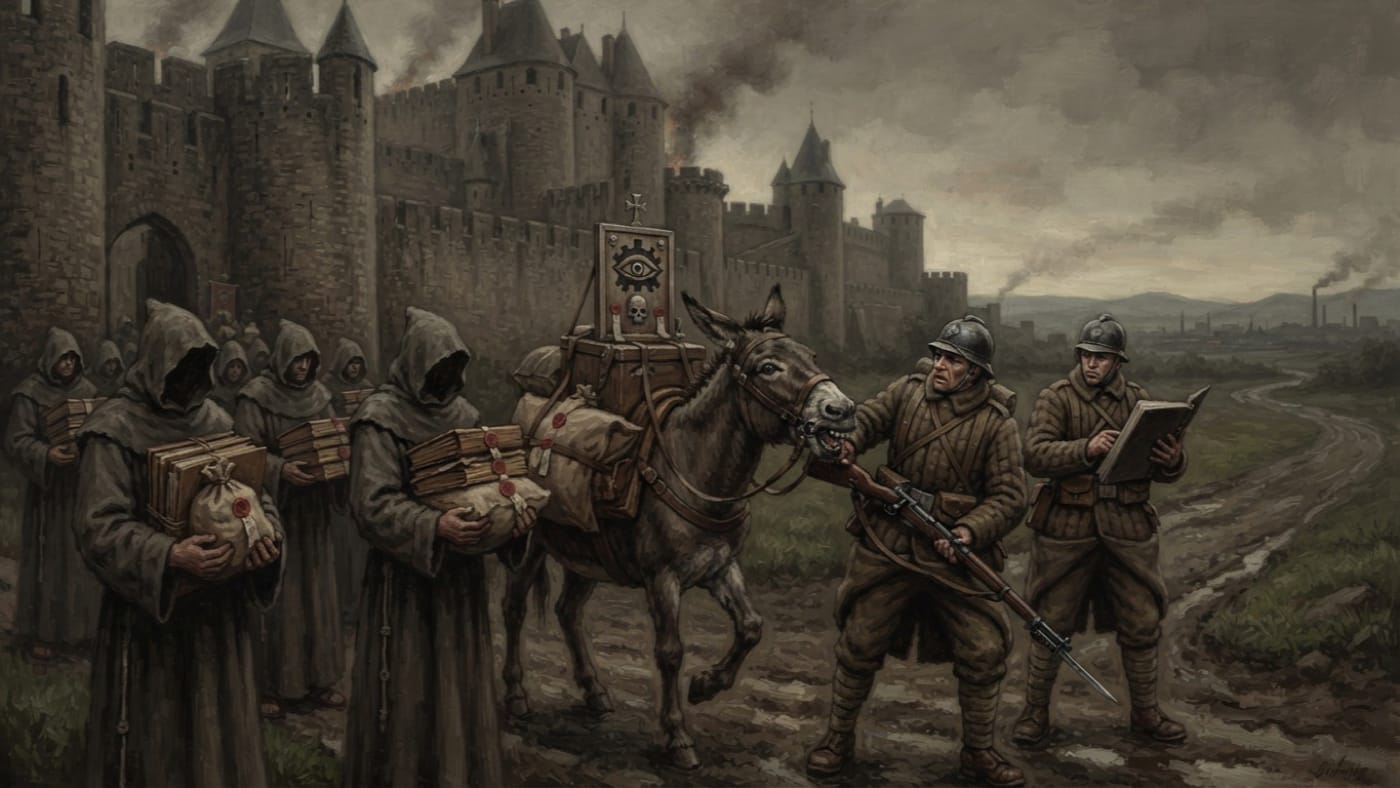
The city did two things in the campaign, and they ran in opposite directions. Accusation reached Carcassonne from Albi and left again with seven more names attached. Paper travelled the other way, toward Toulouse, tied with string, sealed with red wax and loaded on a mule. Few cities enter the Ledger twice in a single season. Carcassonne managed it without volunteering for either entry.
#On the Names Sent Out
The dossier moved by speech. Toulouse named Albi. Albi named Carcassonne. Carcassonne named Narbonne, Béziers, Montauban, Cahors, Rodez, Nîmes and Foix, along with a river shrine whose name was afterwards struck. The Bureau says the shrine was rewarded with anonymity for cooperating so well. I keep the name struck, as I was ordered to.
Read the grammar of the record before you read anything into it. It records who named whom under questioning. It does not say who in Carcassonne spoke, who asked the questions, in what room, or how many sessions it took before the list came out whole. Nor does it say whether any courier rode from Carcassonne to Foix in that order, or at all. The student who draws an itinerary from a confession chain has mistaken a docket for a road map.
In practice, each name on such a list worked as a warrant waiting for its clerk. Before Carcassonne spoke, Purity's commission reached only as far as the Toulouse docket could be stretched. Afterwards it reached seven cities further, and a shrine. The confession did not establish that anyone in Cahors had touched a forbidden page. It established that Carcassonne had said "Cahors" while being questioned the way people were questioned that year, and Purity treated that as sufficient. The entries for Cahors and Béziers set out the cost: inclusion in the campaign with no local offence on record.
Someone said those names. The file keeps the city as speaker and loses the voice, along with whatever was done to that voice before it obliged. A city makes a convenient witness for Purity, since a city cannot recant.
The Bureau of Purity reports that eleven cities were cleansed. I give that figure as Purity's official total and decline to audit it in public. The enumeration is preserved above for anyone who wishes to audit it privately.
#On the Writs That Followed
The spark belonged to Toulouse and stays there. Maël Aucourt was a licensed printer whose shop stood near Saint-Sernin. He hid a Rationalist tract in fragments among funeral notices and grain allotments. He died on the night of his arrest, and by then the list of his subscribers had doubled. Carcassonne had nothing to do with Aucourt except that his file eventually came to include it.
Once the names went out, the campaign's procedures followed them. Writs of cleansing came folded inside military dispatches. Parish priests were ordered to read lists from the pulpit. Households had to bring their libraries out into the market squares for inspection, and the bookless denounced neighbours so that their own empty shelves would not look prepared. The offences grew new categories. Textual contagion covered pamphlets. Domestic retention covered unregistered devotional objects. Residual Rationalism covered old slogans remembered too exactly. Mercy obstruction covered sheltering the accused.
These were the rules of the whole campaign. The file does not say which Carcassonne square received which presentation, which priest read which list, or which neighbour denounced which shelf. I record the rules, and I will not stage a scene in Carcassonne to illustrate them.
Certain Bureau files date the Witch-Hunts of Toulouse to A.S. 3. Any city in that file inherits the date.
Corrected. A.S. 3 / 1713 CE marks an offence bundle from the Rationalist era that was later attached to the Toulouse file. The armed campaign, and Carcassonne's part in it, belongs to A.S. 93 / 1803 CE. No Synodal officer questioned Carcassonne in 1713, because there was no Synod to employ one.
#On the Packets Sent Back
The second line in the Ledger is the one people remember.
What the campaign confiscated travelled as packets: banned titles, street songs, recipes for ink, oath formulas and other suspect matter, each bundle tied with string and marked with a dot of red wax. As the campaign spread the packets multiplied, and they went where the paper of the campaign went, toward Toulouse. A clerk travelling from Carcassonne to Toulouse complained in writing that the forbidden matter needed its own mule. The complaint was granted, which is rare for clerks.
The mule was called Bernard. The name comes from three inventories and one disciplinary report, and I trust them more than most sworn testimony. The parent file counts the rest in campaign weeks, not calendar dates. By the sixth week Bernard had a guard. By the seventh, the guard had orders to kill anyone who touched him. By the eighth, Bernard had been blessed, had bitten two officers, and had entered the Purity ledger under a classification I reproduce in full.
The mule is funny. The cargo was not. An accusation travelling outward enlarged Purity's reach over places. A packet travelling inward enlarged its reach over words. A song confiscated in one city became, once listed, a song forbidden in every city, including cities where nobody had ever sung it. What Carcassonne sent back by mule did not establish anyone's guilt either. It supplied the vocabulary for the next accusation.
The packets were additions to something that already existed. The Index Damnatus had been under development since A.S. 80, a full thirteen years before Bernard first carried anything. Purity likes to say its chained book came down from Heaven already tabbed. In fact it grew by accretion, and part of that accretion came up the Toulouse road on a mule that resented every page.
#On the Offices That Kept the Method
Purity calls the Toulouse campaign its founding. Records knows better and says so only in footnotes. Purity's development dates to A.S. 80. The Concordat of Strasbourg made the Synod formal in A.S. 90, after both founders were dead and beyond issuing orders to anyone, Carcassonne included. The Seven Seals were established at the Concordat. The Council of Mainz ratified them in A.S. 93, and the same year confirmed that Purity's campaign functions were permanent. What the campaign added was scale, routine and precedent. Carcassonne helped supply all three by talking and by shipping.
Two other consequences of the Toulouse method outlived the campaign, and I note them only so far as they touch this city. The first was the branded confession, which began as crude marks pressed into the condemned and later became the script of the Lictors of Purity. The second was a problem. Public punishment makes martyrs, and martyrs carry heresy further than printers ever did. Toulousain side files on keeping witnesses out of the square later fed the subtraction doctrine of the Order of the Shroud.
No Carcassonne brand-roll has reached my desk, and no Carcassonne side file either. I do not take that silence as proof of anything. I note only that I will not forge an entry to balance the page.
#On the Labels Still Sent to Toulouse
In A.S. 201 the southern route offices use Toulouse as a sorting conscience for the safer provinces. Among the material they send there for preliminary opinion, before Purity decides whether to smile or bite, are disputed relic labels from Carcassonne.
Note the word "labels." The traffic is documentary. It shows that someone in Carcassonne could not settle what a label said, or whether it was entitled to say it, and sent the question to Toulouse. It does not show a relic trade in Carcassonne, a forging ring, or any bone that works miracles. Clerks who read a smuggling scandal into a referral docket will find their own handwriting referred next.
The direction of travel has not changed in a hundred and eight years. Paper from Carcassonne goes to Toulouse for judgement. No mule appears in the current referral record.