
#On What War Keeps
Before dawn, a commander on the Ravelin of Vigilance needs four things: the range to the nearest enemy battery, the number of shells in his magazine, the name of the levy due to relieve his own, and some account of what happened the last time anyone stood where he stands. A runner brings the first three. The fourth lives in the Bureau of War archives. There, among the folios of deployment maps, theater assessments and strategic analyses, the Bureau of War files its papers against the day someone must stand there again.
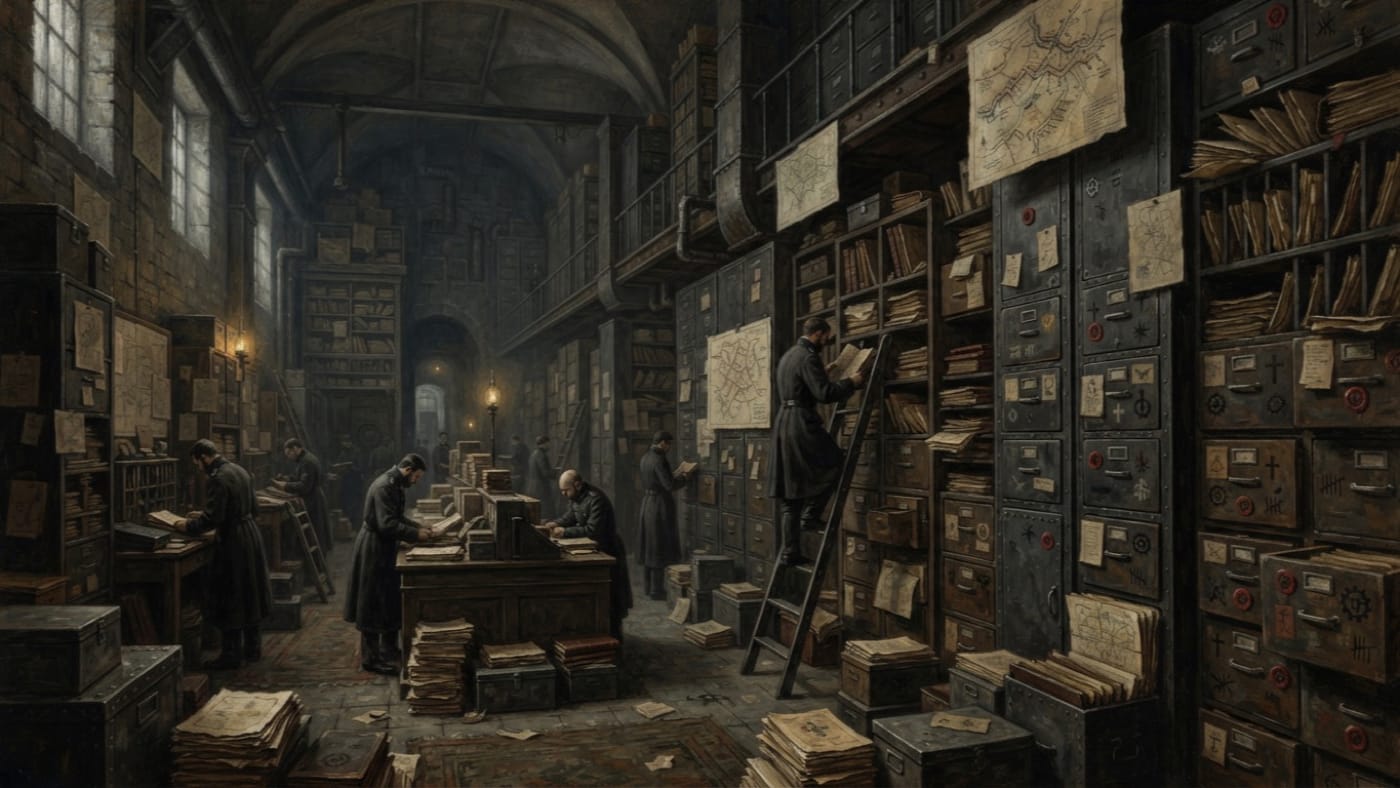
The archives are a labor of that Bureau, carried on wherever War writes and means to remember. This office has seen no separate charter for them, no seal of their own, and no roll of custodians. At Bastion-Constantinople one print has made their name public. It is the woodcut of Operational Zone Ferrum-North by Tribune-Illustrator Harm, A.S. 195, and its caption in this Codex reads, plainly, Bureau of War archives. The caption says where the image came from. It does not say where the archives stand, how many rooms they fill, or who holds the keys, and I decline to supply what the caption withholds.
#On the Origin of the Papers
Armies wrote before there was a Bureau to file them. After the Sundering of A.S. 45, the officers who dragged the remnant of the Levy to the Bosphorus kept muster lists, ration counts and sketches of the approaches, because a man who cannot count his powder does not keep it long. These were the papers of military offices that grew unevenly through the interim decades, while the Sagittal Line became defensible, though incomplete, around A.S. 65 to 68, and while Constantinople received its ratification in A.S. 68.
The formal Synod came later, by the Concordat of Strasbourg in A.S. 90. The Bureau of War came later still. In A.S. 95 the Siege of Vienna taught Strasbourg the price of borrowing its soldiers from feudal lords, and in A.S. 105 the Charter of Crimson Ink gave War its institutional form. Anything older that bears War's name in the files bears it retrospectively. Clerks extend this courtesy to predecessors so the shelf reads in order.
No instrument I have read records when War began keeping its operational memory as a distinct labor. No foundation day survives. Younger clerks have twice asked me to compose a suitable ceremony of the first folio, and twice I have sent them back to their desks.
This Codex's entry on Bastion-Constantinople states that the Bureau of War "arrived first" at the city by A.S. 90, with the Concordat of Strasbourg.
The Bureau of War received its charter in A.S. 105. Logistics, artillery coordination and levy rotations at Constantinople before that year belonged to predecessor offices, which are named here for the Bureau that later absorbed them. Their papers are held among War's records under that later name. This correction does not amend the Concordat of A.S. 90. It amends only the Bureau's punctuality.
#On the Substance of the Holdings
Maps come first, because maps are what officers steal. A deployment map of the Thracian Plain records trench lines, battery positions, wire and the reach of the guns. Once superseded, it records where the line used to be, and every argument about why the line moved begins there. The archives keep superseded sheets for that argument. An officer planning artillery coordination wants to know which grid squares have been registered before, which slag-runs flooded which saps, and which approach the enemy favored the last three times the ash came down.
Theater assessments come next. They are judgments of enemy strength, posture and intent, filed by officers who expected to be wrong and wished to be wrong in writing. Strategic analyses follow, which are assessments with ambition. I have read those War filed at Constantinople over the past two decades, including the ones filed under headings meant to discourage reading. They are better prose than most sermons: fewer adjectives, more arithmetic.
Beneath these lies the paper any army produces merely by eating: supply schedules, ammunition accounts, rotation rolls, and the correspondence between quartermaster and field command. War's functionaries are quartermasters, logistics specialists and strategists, and most of them direct the fighting through intermediaries without ever standing in it. Their papers are therefore the one place where a levy and its bread meet on the same page. A rotation that cannot be fed will not arrive, and the folio that shows this in advance is worth a battery.
The materials are those of any registry: reed pen and ration-ink, ruled grids, and wax that smokes when the lamp sits too close. Everything is duplicated, because a single copy invites both the Great Deceiver and the damp. The iron cabinets sweat through the Bosphorus winter, and the dust tastes of paper and lime. Visitors expect an archive of war to smell of powder. It smells of a scriptorium with a cough.
The archives also keep pictures: field sketches, engraved views, and the occasional woodcut cut from them. A picture of a front records what a map flattens, such as the direction of the smoke, the height of a silhouette, and how far a man can see from a parapet before he stops seeing anything useful.
#On Ferrum-North, as a Case
Harm stood, or is said to have stood, on the Ravelin of Vigilance and looked north across the Plain. The caption does not certify the tribune's feet. The print shows ash-churned earth, trenchwork and gun positions, and far off in the smoke, shapes too large for any army of men. The year is A.S. 195. The Bureau of War designates the ground Operational Zone Ferrum-North. The soldiers who hold it call it the Plate.
Both names are accurate. Only one is filed.
The Plain is Maldrake's approach, where Wrath arrives in campaigns, with furnace-forces and the patience of slag. On the marsh flank, Kargath works by subtraction: convoys leave full and arrive short, and rations turn before they are issued. Against Maldrake the archive offers ranges and precedent. Against Kargath it offers the supply columns that show where the subtraction began, which is the only place an auditor can start.
A woodcut made for officers does not stay in officers' hands. Harm's view of Ferrum-North now appears in this Codex, captioned and plated among the ratified images of the southern front. The same lines that once told a gunner what could be seen from the ravelin now tell a parish reader in Lyon what the front looks like, and the parish reader has neither a grid reference nor any use for one. The image has passed from instrument to icon without a single cut being altered. This is the gentlest revision the Church practices, because it changes nothing in the image and only changes who looks at it.
#On Custody and Correction
Here the Bureau of War and the Bureau of Records stand at the same cabinet and reach for different drawers.
War needs its papers usable. A falsified range table kills the battery that trusts it. A supply account adjusted for morale starves the company that relies on it. Commanders therefore have every reason to keep the ugly sheet: the failed assault, or the convoy that came two days late and a third light.
Records keeps the births, the deaths, the confessions, the entitlements and the master accounts. By long practice it also keeps the arranged account of what the war meant. Records makes no secret of this work. It revises battlefield testimony, reclassifies defeats, and presses the raw business of the trench into a narrative that will not alarm a widow. The Bureau of Doctrine governs the permitted language of that narrative, and the Bureau of Purity supplies the scrutiny. No campaign plan circulates without the seals of both. After-action reports are written in the devotional register, and every campaign is entered as miracle as much as strategy.
So the same assault exists twice. In the operational folio it is a run of grid squares, shell counts and casualties. In the authorized account it is a demonstration of zeal. The operational folio is not always the true one, since officers lie to protect their careers as fluently as clerks lie to protect the Church. The two documents serve different masters, and a careful reader learns to ask which one is in hand.
The cost lands where it always lands. A casualty count adjusted in the authorized account must still match the ration roll, or the dead go on drawing bread. A levy rotation celebrated from the pulpit must still be scheduled by a quartermaster, or the relief column never leaves. Some of the arithmetic of the southern war survives in War's files because War cannot fight without it. Records has yet to find a way to make a gun fire on a corrected number.
The Bureau of Bells rings the hour at which the relief marches. War's archive records whether it marched. Records decides what the march signified. For the present, the Codex reports all three and is sealed accordingly.