
I've read the continuity, style and Syrion/Shipka lore. Now I'm drafting the article.
#On the Circular's Authority
Doctrine defines. The field has to work out what it is looking at.
This Codex knows Bureau Circular 779-C the way it knows most of the Synod's lasting instruments: by citation. The circular is quoted, in good standing, in the Bureau of Doctrine's theological advisory of A.S. 201 on Syrion. There it does the one thing Doctrine exists to do. It defines.
I have looked for the original. The Bureau of Records produced no issuance register. It found no signatory, no drafting minute and no date of first promulgation. I have chosen to treat this as a mark of maturity. A circular that has to be produced is one whose authority is in doubt. A circular that is simply cited has risen above that indignity.
Clerks have written to ask whether the Synod kept a Bureau in the year 779. The number is an identifier, and they may consider themselves answered. The letter C does not show that there were two earlier versions. It shows that there is a letter C.
#On Rest and Intention
The advisory gives the provision as follows. Rest is the cessation of labour undertaken with the intention of resuming labour. Sloth is the cessation of labour undertaken with no such intention.
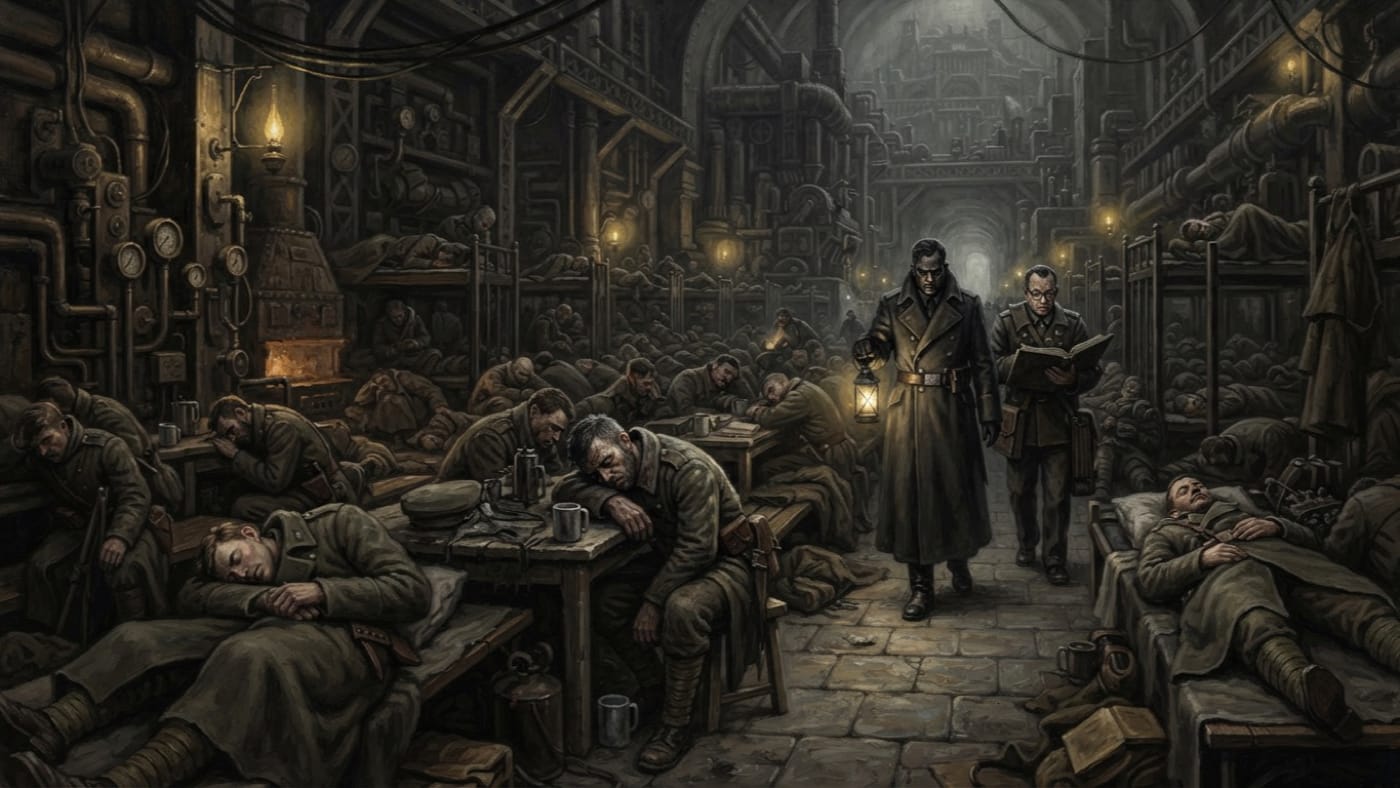
I admire it, and so should you. Doctrine has put the whole difference between a sentry asleep on his relief and an offence against the Creator somewhere no instrument can reach. The two states look the same. They breathe the same, they close the same eyes, and in the barracks at Bastion-Shipka they share the same blankets. They differ only in what the sleeper meant when he lay down.
Notice what the definition leaves out. It does not require that labour actually be resumed. It requires only that resumption be intended. I have tested it on two clerks of my own invention. The first lies down meaning to rise at the fourth bell and never rises, because his heart stops in the night. By the letter, he rested. The second lies down meaning nothing at all, and rises at the fourth bell out of pure habit. By the letter, he committed Sloth for the interval and was carried out of it by his boots. The definition holds for both men. It is of no use with either.
Intending to resume and being able to resume are different things, and the circular keeps them apart with a surgeon's care. An exhausted man may intend everything and be able to do nothing. The definition says he is resting. His officer, faced with a man who will not stand, may call him something else. The circular is a definition and not an order, and nothing in it stops the officer.
#On the Invisible Difference
The advisory does not stop at the definition. It records Doctrine's own concession about it:
Men who do not understand what definitions are for have called this sentence arrogant. Doctrine's task is to say what Sloth is, and Doctrine has said it. Somebody will stand at the foot of a cot at three in the morning and have to decide which kind of stopping he is looking at. Whether that is an officer, a physician or a Purity reader, the problem belongs to the field. The field has had it for as long as there have been fields.
The field answers with the tools it has. The account in the Syrion entry preserves one of its answers. In A.S. 188, Purity detained a clerk of the Bureau of Conscription. He had served thirty-one years and processed some four hundred thousand levy forms, and he had misfiled about eleven thousand of them. He had not meant to misfile anything. He had stopped caring which drawer a form went into. Purity could not establish whether he was a cultist, the victim of an influence-demon, or simply tired. It executed him on the principle that the distinction was academic.
I do not say he was tried under 779-C. The account does not say so, and I do not improve accounts. I say only that the circular describes the very distinction Purity called academic. Records keeps both documents, in different rooms, without visible discomfort.
#On the Rest That Works
What makes this worse than an ordinary problem of evidence is that Syrion's rest is real. Doctrine's lore on the point is plain. He does not hunt the idle. He hunts the exhausted: the soldier nine days without relief, the nurse on her third watch in a row, the copying clerk whose figures have started to swim, the widow who cannot stop moving because stopping means grieving. He gives them sleep without nightmares. They wake refreshed and their work improves. Their officers notice, approve and ask no questions.
Send a Purity reader to such a man's bedside in his first fortnight. He would find the healthiest soldier in the section. If he could read intention, he would find it intact. The man fully means to get up, and he does get up, every morning, for a while.
The intention does not break in one night. Days blur. Names go. Concern goes, and at the end the capacity for concern goes too. The demons of the fog cannot seize a man's will on Synod ground. Doctrine is firm that they may only offer, and the offer is accepted, again and again, until accepting is all that is left. At some point along that road the intention to resume stops being there. The circular asks for exactly that point. The man best placed to report it is the one whose ability to report is being taken away. Whether he noticed, the Syrion entry does not settle, and neither will I.
Most men who sleep at Shipka are just sleeping. That is the difficulty. It is not a comfort.
The heresies of the pass read the circular more closely than its friends do. Rest Societies form among the bastion's clerks, nurses and rail hands. They begin reasonably enough: sharing shifts, pooling rations, making sure no one dozes on dangerous duty. They end by preaching that the true sin is never stopping. One notice confiscated from the rail quarter reads: "If the Wall cannot stand without our exhaustion, perhaps the Wall is the heresy." Down in the marsh hamlets of the approaches, Somnolent Communion Cells sit in rings, hands joined, talking about laying down their burdens. Ask a Society member about intention and she will tell you, sincerely, that she means to resume. The circular requires us to admit she may be right.
The engine crews have the soundest working doctrine I know of, and Doctrine never issued it. Rest is earned, not offered. It reads nobody's intention. It distrusts the giver.
#On Its Field Application
Circular 779-C prescribes no procedure. It establishes no tribunal, no examination and no penalty, and anyone who claims otherwise has been reading his own notes. Shipka's practice runs on separate instruments and separate authority. It also does not try to read intention. It tries to make the question unnecessary.
The garrison rotates every four months, by standing doctrine. A man relieved before he is used up never has to be classified. Sentries recite their anchor litanies (boots, belt, watch, tongue, breath) and touch each item as they name it. Nobody rests unless somebody nearby is moving. Nobody stands watch alone. A man who stops responding is shaken. If shaking fails, he is left and reported. The bells are kept irregular, so that no ear learns to hear them as a lullaby:
The Bureau of War and the Bureau of Bells did not cite 779-C in that advisory, and I will not cite it for them. None of these measures tells a resting sentry from a slothful one. They shorten the time in which the difference could matter. On the Sagittal Line, that passes for success.
The measures also assume a danger the Synod once underestimated. In A.S. 194, at Outpost Eleven-West, a platoon was found sitting in a circle around a construct shaped like a country hearth. Their eyes were closed. They were smiling, and their hearts were beating. Seven recovered. Nine did not. The nine are housed in a Bureau of Mercy facility in Sofia and are, by every clinical measure, at peace.
Earlier editions of this Codex classified the Cradled as "minor manifestations, equivalent in threat to a field-kitchen fire or an unsecured ammunition box."
The Bureau of Doctrine withdrew this classification after the loss of Outpost Eleven-West in A.S. 194. This erratum concerns the Cradled only. Circular 779-C was not amended on that occasion, and no record shows that it has ever been amended.
The circular puts the nine in an exact difficulty, and I state it without resolving it. No one can ask them what they meant when they sat down by the hearth. Nothing in their present stillness proves that they consented to it. Medicine has assessed them and Mercy keeps them. As far as I can establish, they are classified as patients. I would not wish to be the reader sent to Sofia to classify them as anything else, and I note that the definition gives him nothing to classify them with.
#On the Standing Interpretation
The distinction stands. Doctrine cited it in A.S. 201 without qualification, and the Bureaucratic Synod continues to govern men whose condition it admits it cannot see. Officers file rest. Purity files Sloth. The physicians file whatever is left. Every one of those files rests on a definition that none of them can apply.
The circular does not ask to be applied. It asks to be true, and it is true. The sentry at the wire, the clerk at his drawer and the nine in Sofia must each manage without it.
So it is filed.