
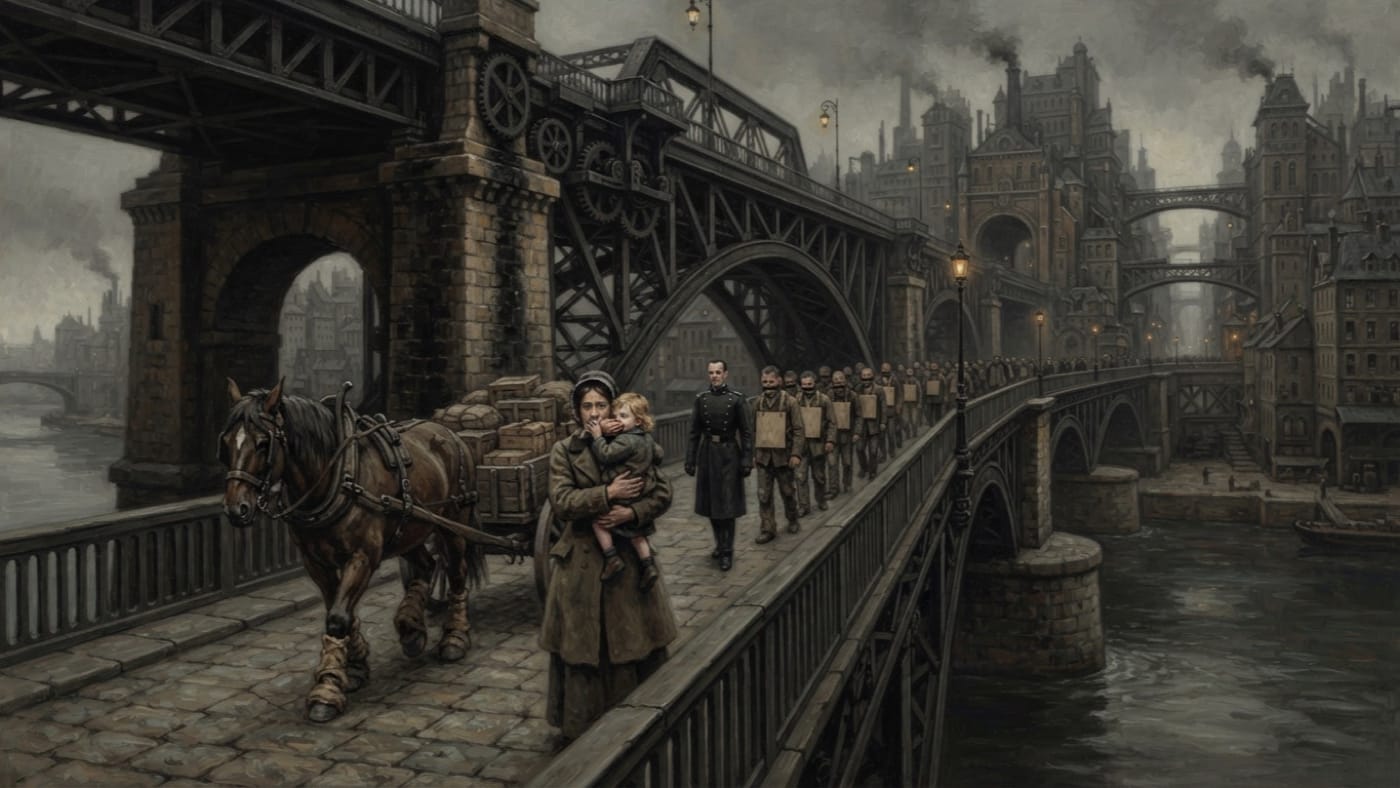
#On the Passage
Every crossing in the Synod collects something. This one collects the throat.
Metz counts whatever passes through it: flour, rifles, cot frames, ash, recruits, ration slips, confessions. Wagons are weighed at the warehouse gates. Ledgers are kept twice. The vault clerks balance a grandmother's future cremains against a winter's bread and call the result prudence. It is a loud city. Quartermasters shout tallies, carters curse mules in three dialects, convoy bells mark departures before dawn, and the markets go on gossiping because no city has ever grown loyal enough to stop wanting news.
Across one river crossing, all of that stops.
The Bridge of the Silent Toll takes no coin and no prayer, spoken or whispered, and it permits no bargaining at the approach. Travellers cross mute. The silence itself is said to pay the passage. Below the span the river keeps up its own noise, which is not subject to the toll and has never been invoiced.
Metz, which will sell anything twice, has kept for itself one tariff that cannot be resold. The city resents it the way a miser resents the collection plate, then pays it with the same fidelity.
#On the Payment
Elsewhere, crossing is a sacrament with a coin slot. The general gate and bridge regime of the Synod requires the traveller to place coin, recite a verse of the Creed, and be notarised in the act. Recite badly and the gate records you absent until confession repairs the entry. Metz keeps gates of that kind. At this bridge it keeps the opposite rule. The general catechism demands the Creed aloud, and here the Creed aloud is forbidden. Where a named crossing contradicts the general regime, the named crossing governs. Canon law has always made room for cities too proud to be consistent, provided they are consistent about it.
The preparations are domestic and exact. Children are carried across with a hand over the mouth, the palm cupped and the fingers set firm along the jaw. Bells on harness, cart and pilgrim staff are muffled before the approach. Horses have their hooves wrapped so that no iron meets the stone. No Bureau had to print any of this. Families teach it the way they teach a child its parish, its ration desk and its place in the queue, and in Metz a child is carried quiet over the water before it can recite.
The canon records the rule and the precautions. It records no measure of permitted sound, no breath allowance and no listening officer posted at mid-span, and I decline to supply one. The traveller knows what is owed. Speech is owed. Whatever a man murmurs inwardly to the Creator remains between him and the Creator, which is the one transaction in Metz that Records has never managed to notarise.
#On the Toll of Held Speech
The Order of Saint Ephrath preaches that heretics must be humiliated in public before they are disposed of, and it oversees the Procession of Tongues for that purpose. Metz holds a licensed variant. Ephrath supplied the authority, and local Purity officers supplied the adaptation, having studied what other cities did with the rite and resolved, with Lorrainer economy, to make the city do less and fear more.
The Metz rite is called the Toll of Held Speech. Those marched are condemned petty heretics, false stampers, ration-queue agitators, and citizens whose public speech has exceeded their station. Each crosses the bridge with black linen between the teeth and a doctrine tablet strapped flat against the chest.
There are no nails.
In Prague the condemned are nailed by the tongue to tablets of doctrine and marched until silence claims them. In Lyon the procession has been turned into festival: citizens recite the Creed until their voices crack, and those who falter are gagged. Prague wounds the tongue and Lyon wears it out, while Metz binds it before the first step and charges the condemned the same toll the city charges a baker's cart. Visiting preachers sometimes mistake the missing nail for leniency. It is a matter of procedure, and the procedure is chosen to fit the bridge. A tongue nailed to oak can still produce sound. Linen between the teeth produces almost none, and so the condemned pay the passage like everyone else.
The procession ends at the east toll-stone, past the span and off the water, where nobody is any longer crossing. There a Purity clerk reads the tablets aloud, each offence in its turn, while the condemned stand gagged beside the stone. Witnesses hear the crime and never hear the criminal. The accused cannot correct the wording or plead an ambiguity. He cannot tell the crowd that the ration queue was three days old and the bread mouldy. The clerk's account is the only account offered.
This is the whole Metz genius in one ceremony. The toll of silence is collected on the bridge, and once the bridge is crossed the Bureau speaks for the condemned.
#On the Collapse
Civic tradition holds that a child once cried halfway across, and that the entire bridge then collapsed into the river.
That is the whole of the story as Metz tells it. The child has no name. The tradition gives no year, gives no count of the drowned, and does not say whether the mother's hand slipped or was never there. Local story has kept the order of events and nothing more: the cry came first and the fall came after. Every child carried across with a palm over its mouth hears this account before it is old enough to understand the masonry.
The Bureau of Engineering examined the matter and blamed the masonry. Purity rebuilt the bridge and kept the silence rule.
The Bridge of the Silent Toll fell because a child cried upon the span.
Corrected. Collapse attributed to masonry flaw. No correlation with crying.
I have read that erratum in more than one folio, always in the same order. The masonry was flawed. The masonry was replaced. The silence was not replaced, since it had never been found at fault, and an office that has just denied a cause owes no apology to the rule it kept. Engineering produced its finding, Purity produced a bridge, and the city went on carrying its children with their mouths covered.
#On the Offices
No single Bureau owns the bridge, and every Bureau with a hand in Metz has a finger on it.
The Bureau of Records holds custody of the city's river tolls, a jurisdiction confirmed in the civic regularisation of A.S. 98, when the warehouses were sealed and the ash vaults put in order. A toll paid in silence produces no coin and no receipt, and Records keeps custody of it anyway. Some clerk somewhere is charged with the ledger of a crossing whose revenue column is permanently empty. I suspect it is the most honest ledger in Metz.
Purity holds the procession licence and the rebuilt span's precedent. The Bureau of Bells keeps the silent bridge schedules, a curious duty for an office whose whole art is sound. It sets out times of hush with the care it gives to times of ringing, and its handbells are muffled at the approach like any carter's. The Bureau of Tithes looks at a busy crossing that yields nothing it can collect and is hurt by the sight.
Upriver, Rheinscarp keeps its Silent Stair: a crossing-ritual hour of absolute hush, a history of collapse accidents, and the same phrase in the mouths of its citizens, that silence counts as payment. Rheinscarp calls Metz corrupt, and Metz calls Rheinscarp vertical. Each city denies borrowing from the other. Whether the stair learned from the bridge or the two simply came to the same conclusion about fear and stone, nobody has established, and the custom does not care. Travellers between the two cities take note of the silent-toll customs as they take note of road conditions, and they muffle their bells twice.
#On the Present Crossing
The bridge is older than the Black Census of Metz and owes it nothing. In A.S. 144, at the eastern Metz position, four hundred and eleven captured Thralls were traced to one dead Ash-Mother, and Classification 7-F entered the files. The bridge was not the site of the census, and the enemy's mortar had nothing to do with it. What the census did was to land on a city already trained in household dread. Metz had its silent toll, its ash vault rumours, its salt stories and its small private rituals for living close to official usefulness. After 144, fathers checked their children's teeth by candlelight. The hand over the child's mouth on the bridge stayed where it was and was given a second reason. The Bureaus have never had to compel a population already afraid in the right direction.
In A.S. 201 the crossing is in ordinary use. Convoys bound for the corridor pass over with wrapped hooves. Market women carry infants across in silence and resume their gossip on the far bank, at the first sentence the toll allows. The Toll of Held Speech marches when Purity has stock to march. Black linen and pale tablets go over the water, and the clerk at the east toll-stone clears his throat for the whole city.